
TLDR
·
1 hour ago
● 6 sources
An economics-focused analysis argues that concerns about Chinese AI models like Kimi K3 undercutting Western competitors are overstated, because the current high prices from Anthropic and OpenAI reflect artificial scarcity of compute rather than cost advantages. Kimi charges $3 per million input tokens and $15 per million output tokens, compared to other providers, but this masks the fact that different models require different token volumes to reach correct answers, making raw token price misleading. As AI markets mature and compute becomes available, competition will be determined by cost structure and serving efficiency rather than nominal prices, and frontier labs will eventually thrive by passing savings to customers as inference becomes the dominant cost compared to training.
TLDR
·
1 hour ago
● 2 sources
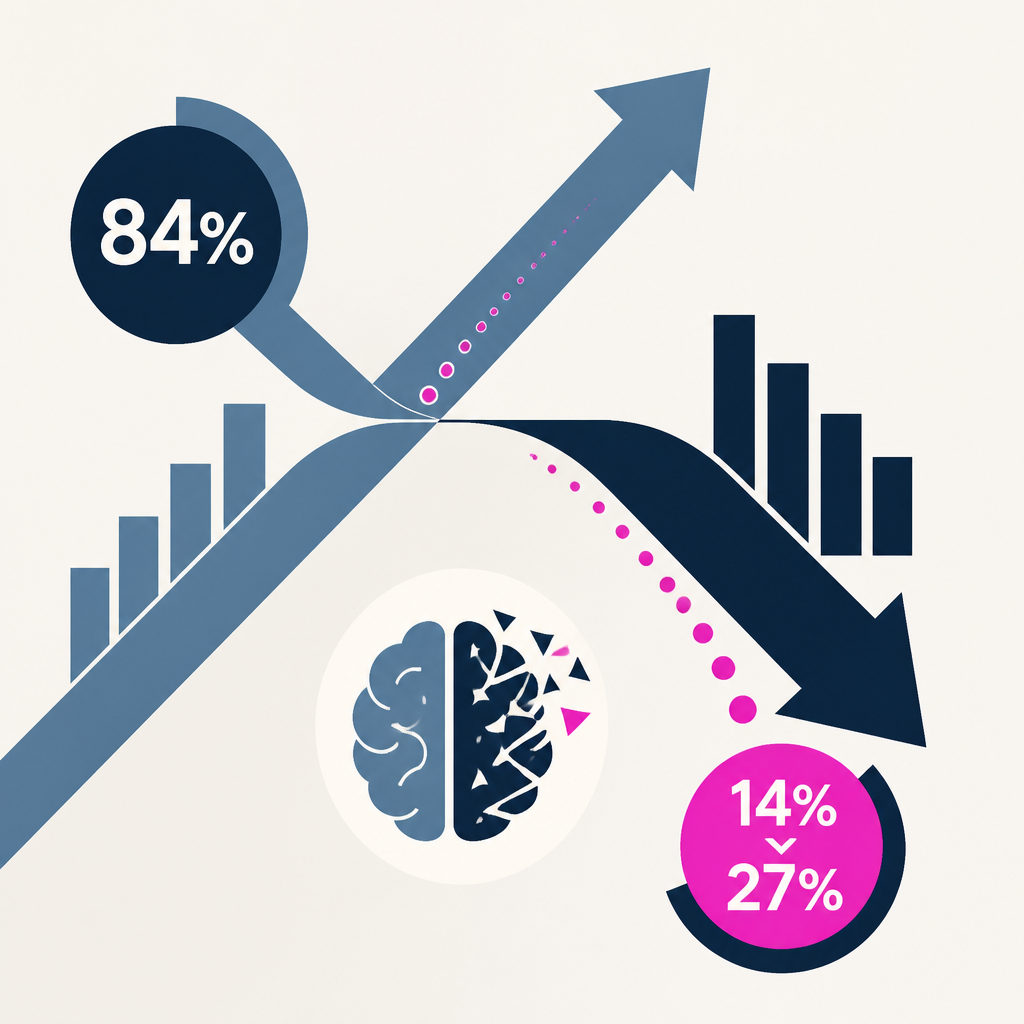
A study of software engineers using AI coding assistants from October 2024 to April 2025 found that 84% reported improved productivity throughout the period, yet developer experience deteriorated for a growing minority, with the negative cohort nearly doubling from 14% to 27%. Flow state—the ability to stay focused and absorbed—declined most sharply, dropping from 7% to 20% of engineers reporting it as worse, while feedback loops improved as AI provided instant code suggestions. The decoupling of productivity and experience suggests that engineers may sustain high output through AI assistance while experiencing increased cognitive strain and context-switching, potentially masking burnout risks that dashboards won't reveal.

TLDR
·
1 hour ago
Researchers built an agent swarm system that decomposes complex tasks into hierarchical trees with planner agents (using capable models) delegating to worker agents (using cheaper, faster models), then tested it on implementing SQLite in Rust from documentation. The new swarm reached 80% test pass rate in four hours using Grok 4.5, compared to the old system's collapse before hour two on the same task. The system uses specialized coordination mechanisms—custom version control handling 1,000 commits per second, design docs with compile-checked references, third-party merge conflict resolution, and stacked review lenses—enabling productive multi-agent collaboration at scales where single agents drift or human coordination breaks down.

TLDR
·
1 hour ago
BrainCo demonstrated a brain-computer interface platform that lets users control robots through neural signals decoded by AI algorithms in under 200 milliseconds. The system was showcased at the 2026 World Artificial Intelligence Conference in Shanghai, where a person wearing an EEG headset directed a robotic arm to grasp objects with precision. BrainCo also introduced a data-collection system combining brain signals, human demonstrations, and robot execution to address the shortage of high-quality training data for teaching robots complex physical tasks.

TLDR
·
1 hour ago
AI models have disproven three major mathematical conjectures in recent weeks: ChatGPT refuted Erdős' Unit Distance conjecture, OpenAI's Sol found a counterexample to Grothendieck's 60-year-old question about group schemes, and Claude found a counterexample to the century-old Jacobian Conjecture. The achievements range from 1.2 million lines of Lean code for the Erdős proof down to 1,076 lines for the Grothendieck counterexample, with formalization times measured in days or weeks. Mathematicians are now considering AI tools essential for research, with some institutions offering free access to PhD students and faculty, fundamentally shifting how mathematical discovery and verification happen.

TLDR
·
1 hour ago
AMD launched Helios, its first rack-scale AI system, with Microsoft as a major new customer joining Meta, OpenAI, and Oracle. The Helios system is estimated to cost between $5 million and $5.5 million, compared to Nvidia's Vera Rubin at $3.5 million to $4 million, and AMD will begin shipping later this year. AMD's entry into rack systems could increase its data center GPU market share from 4.5% to potentially 20-25%, challenging Nvidia's 95% dominance in this segment.

TLDR
·
1 hour ago
● 3 sources
Google is reportedly developing a chip called Frozen v2 that would have Gemini's neural-network architecture physically etched into the silicon rather than stored in memory, potentially achieving 6 to 10 times greater efficiency than current custom AI chips and targeting deployment as early as 2028. The project reflects Google's effort to reduce reliance on Nvidia and address internal capacity constraints, trading flexibility for speed and power efficiency. If successful, this approach could force competitors to develop similar custom silicon solutions optimized for specific models rather than general-purpose hardware.

TechCrunch AI
·
2 hours ago
Gritt, a robotics startup founded by Carnegie Mellon engineers, exited stealth with $34 million in total funding to deploy AI-controlled systems for solar panel installation. The company's robots increased installation capacity from 800 to 3,000-4,000 panels per day for a typical eight-person crew, and Gritt is contracted to help install 2.8 gigawatts of solar panels over the next 18 months. The startup plans to expand its AI systems to other construction tasks like fastening panels, drilling posts, and rebar tying, leveraging recent advances in large AI models to generalize across different labor-intensive jobs.
MarkTechPost
·
3 hours ago
Meta released Astryx, an open-source design system built on React that ships with 150+ accessible components, seven themes, and a CLI tool designed to work with both human developers and AI agents. The system has been in development inside Meta for eight years and includes full TypeScript support, token-level customization, and the ability to eject component source code. Developers can now use Astryx to build applications that maintain design coherence and accessibility without being locked into a single visual aesthetic or forking components.
MarkTechPost
·
4 hours ago
● 4 sources
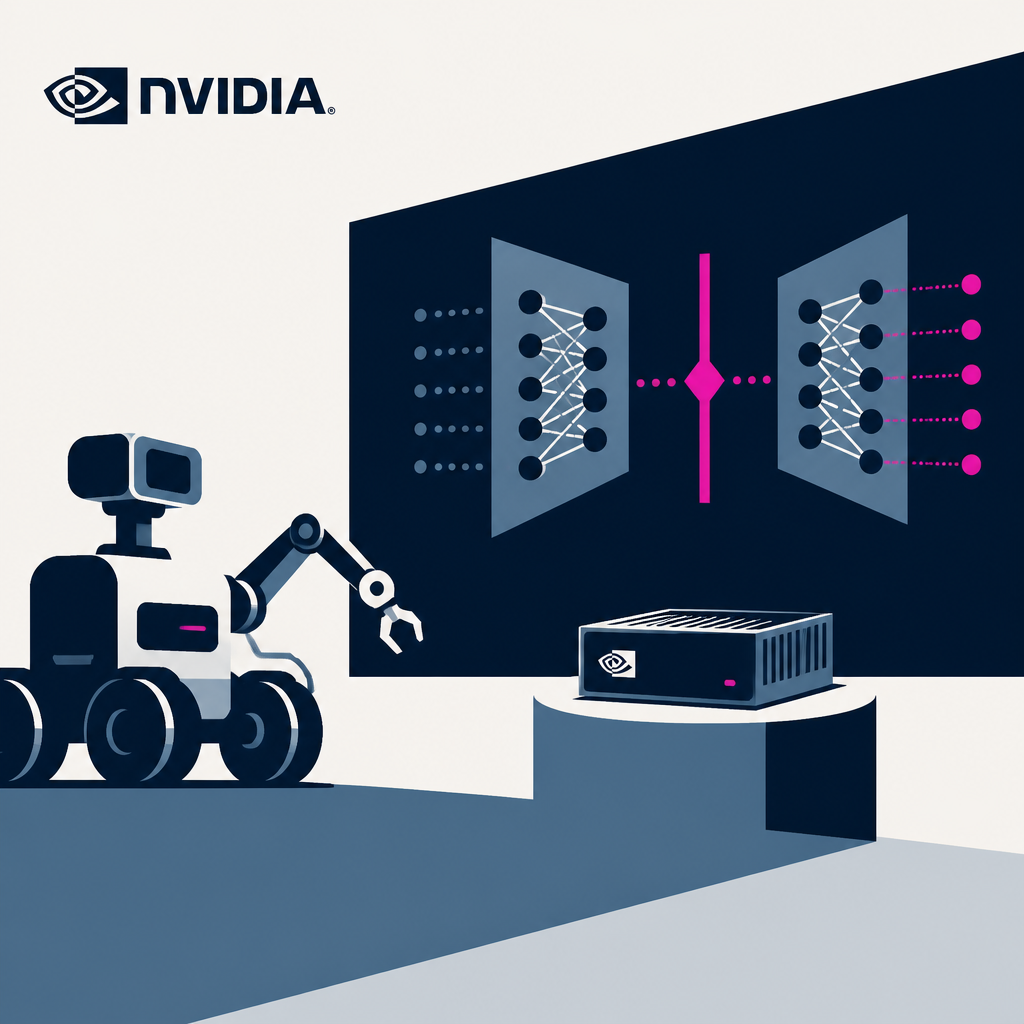
NVIDIA released Cosmos 3 Edge, a 4-billion-parameter world model designed to run on edge devices like robots and vision agents. The model uses a Mixture-of-Transformers architecture with separate reasoning and generation towers, achieving 15 Hz real-time control at 640×360 resolution on NVIDIA Jetson Thor hardware. This enables robots to understand their environment, reason about actions, and generate control outputs locally without relying on data centers.

The Verge
·
5 hours ago
● 9 sources
Chinese AI startups Moonshot and another company released large language models claimed to compete with OpenAI and Anthropic systems, triggering market volatility and concern among US policymakers and investors. The developments prompted headlines framing the advances as surprising breakthroughs that could force American tech companies to reconsider their massive spending on computing infrastructure. Repeated cycles of shock at Chinese AI progress suggest policymakers and industry observers should anticipate rather than be surprised by ongoing Chinese AI capability gains.

The Verge
·
6 hours ago
Data centers powering AI models consume enormous amounts of energy and water while producing air pollution and greenhouse gas emissions, with GPUs in these facilities now drawing scrutiny for environmental and health impacts. Training Meta's Llama 3.1 could generate air pollution equivalent to 10,000 round-trip car journeys between Los Angeles and New York, and AI data centers' power consumption is projected to reach 165-326 terawatt-hours annually by 2028 in the US. Communities are increasingly concerned as data centers expand in their regions, raising utility costs and local pollution while many consumers question whether promised AI benefits justify the environmental costs.
Latent Space
·
8 hours ago
● 10 sources
Alibaba announced that Qwen 3.8 Max (2.4T parameters) will be released as open-weight, and Kimi K3 (2.8T parameters) emerged as a strong open-weight contender, ranking #1 on Frontend Web App Arena with 1326 Elo and #4 on agentic tasks. The U.S. administration is considering layered policy measures against Chinese open models, while technical voices argue that restricting open models hurts competition and security more than it helps. Model routing, world modeling for agents, and long-horizon reliability are becoming first-class infrastructure problems, with frontier models now demonstrating superhuman performance on mathematical tasks like finding a counterexample to the 3D Jacobian conjecture.

TechCrunch AI
·
12 hours ago
A federal judge approved Anthropic's $1.5 billion copyright settlement with authors and publishers who sued over illegal downloading of books for AI training. The settlement pays $3,000 per work across 500,000 works, though the judge ruled that using copyrighted text for training is fair use—only the piracy method was illegal. The case won't set binding precedent since Anthropic settled, leaving other AI companies like Google and OpenAI to face similar lawsuits with uncertain outcomes.

Hugging Face Blog
·
12 hours ago
Pollen Robotics released Grabette, an open-source handheld gripper system that records robot manipulation demonstrations using a handheld device with cameras and IMU sensors. The hardware costs approximately €490 for the recording device (Grabette) and €120 for the robotic gripper counterpart (Gripette), with all components sourced from standard off-the-shelf parts. The system aims to democratize robot learning data collection by enabling anyone to record manipulation tasks and contribute to a shared open dataset on Hugging Face, removing the need for expensive teleoperation rigs or dedicated robotics labs.
