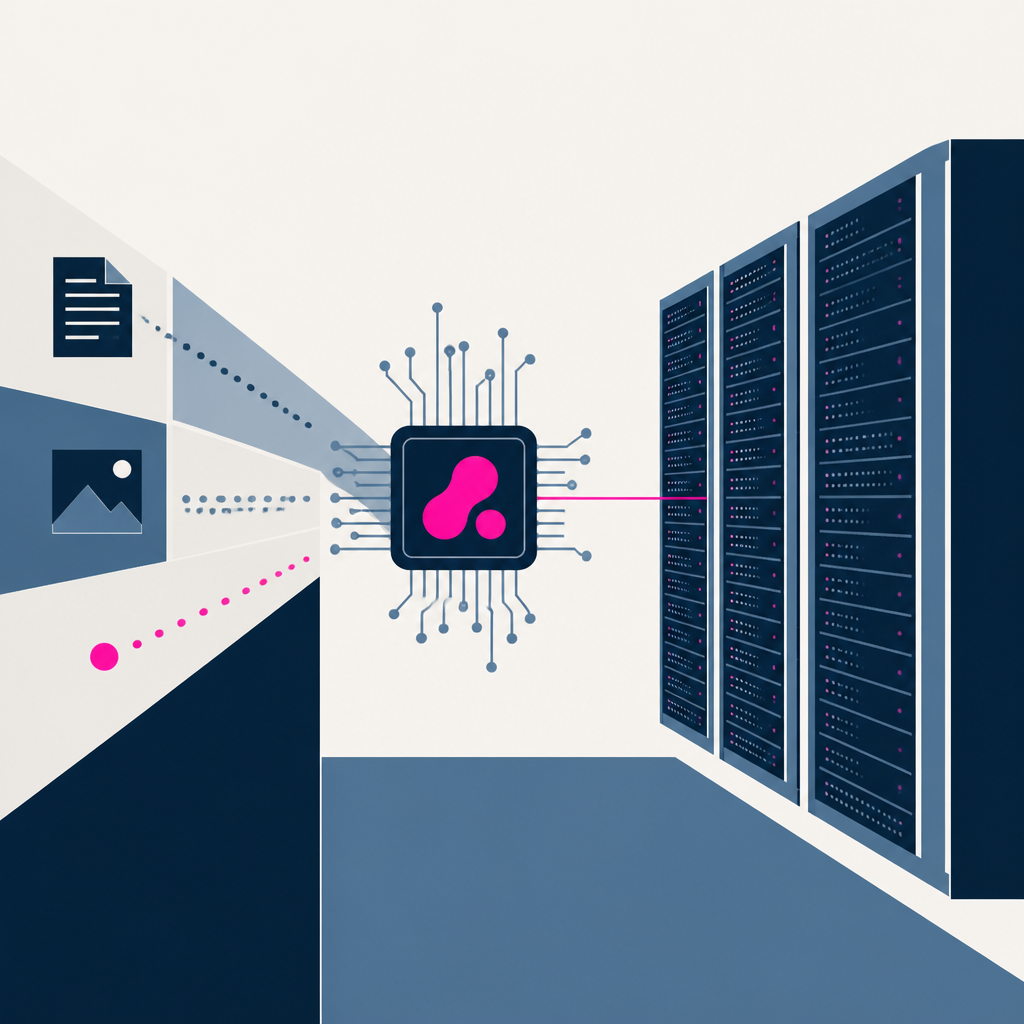
Elorian released its first AI model, Glimpse, as a research preview with an API and waitlist-only chat that lets the model revisit images while reasoning. Glimpse is priced at $0.60 per 1 million input tokens and $3 per 1 million output tokens. It changes the approach from one-pass image-to-text tokenization to iterative “visual scratch space” behavior (cropping, extracting video frames, and running code) aimed at stronger visual reasoning and eventually scene-to-action for robotics and other video-heavy use cases.
Muse launched the Muse Wonder model series on October 12 and promoted it as near Claude Fable 5.1 on agent and memory tasks, then a head-to-head test compared their outputs using OpenRouter (Muse Wonder) and Anthropic’s API (Fable 5.1). In the long-session memory test, Muse scored 25 of 25 while Fable scored zero due to cyber-category refusals that blocked much of the work. As a result, the author concludes Muse Wonder can match Fable on some agentic debugging and memory completion, but is often more expensive and Fable 5.1 is still cheaper and generally more accurate for these tests unless Fable’s safeguards block the job.
OpenAI’s Codex team shifted from a step-by-step, sandboxed coding assistant toward agent-style workflows after testing GPT-5 alongside competitors and observing it “stop too early.” By June 2026, Codex reached more than 5 million weekly active users, later merging into the ChatGPT desktop app and helping Codex+ChatGPT for Work reach 40 million weekly active users. As a result, Codex became the foundation for OpenAI’s core products rather than a standalone coding tool.
Liquid AI released d1-ultra, a multimodal decision model that answers typed questions about text, images, or both using probabilities. Liquid reports it scores 65 and ranks #1 on the Artificial Analysis Decision Index. The model is offered API-only through the Liquid API for $0.042 per 1M input tokens with 0 output tokens billed, shifting developer usage toward classification/routing/scoring instead of generating text.
Reflection’s new open model Beam has been released on Hugging Face as a text-only Mixture-of-Experts LLM with end-to-end inference, fine-tuning, and reinforcement-learning recipes. It has 501B total parameters with 23B active per token and a 1M-token context window, released under the Apache 2.0 license. This enables teams to run and customize a frontier-scale model on their own hardware or cloud with Beam-specific tooling and downstream support, plus a $10,000 Hub-credits prize for top shared projects.
Every AI story that matters,
in your inbox by 8am.
TLDRocket reads all relevant sources, removes duplicate coverage, and summarises the
day in two minutes. Follow companies and topics for alerts, or get the
briefing in Slack. Free, no spam, unsubscribe anytime.
Reading TLDRocket needs no cookies, and the readership counts we rely on come from
our own cookieless analytics. Google Analytics is the exception: it sets cookies and
reports to Google, so it stays switched off until you allow it. You can change your
mind any time from “Cookie settings” in the footer.
Strictly necessary
Session security and form protection (tldrocket-session,
XSRF-TOKEN, 2 hours). The site cannot work without them,
so they need no consent.
Always on
Google Analytics 4 (_ga,
_ga_<id>, up to 2 years). Measures which
stories and sections readers use. Google acts as a third-party processor and may
store the data outside the EU. No advertising, no profiling, no data sold.