
How Meta’s AI Models Are Powering the First Wave of Genesis Mission Projects
Meta AI ● Covered by 19 sources
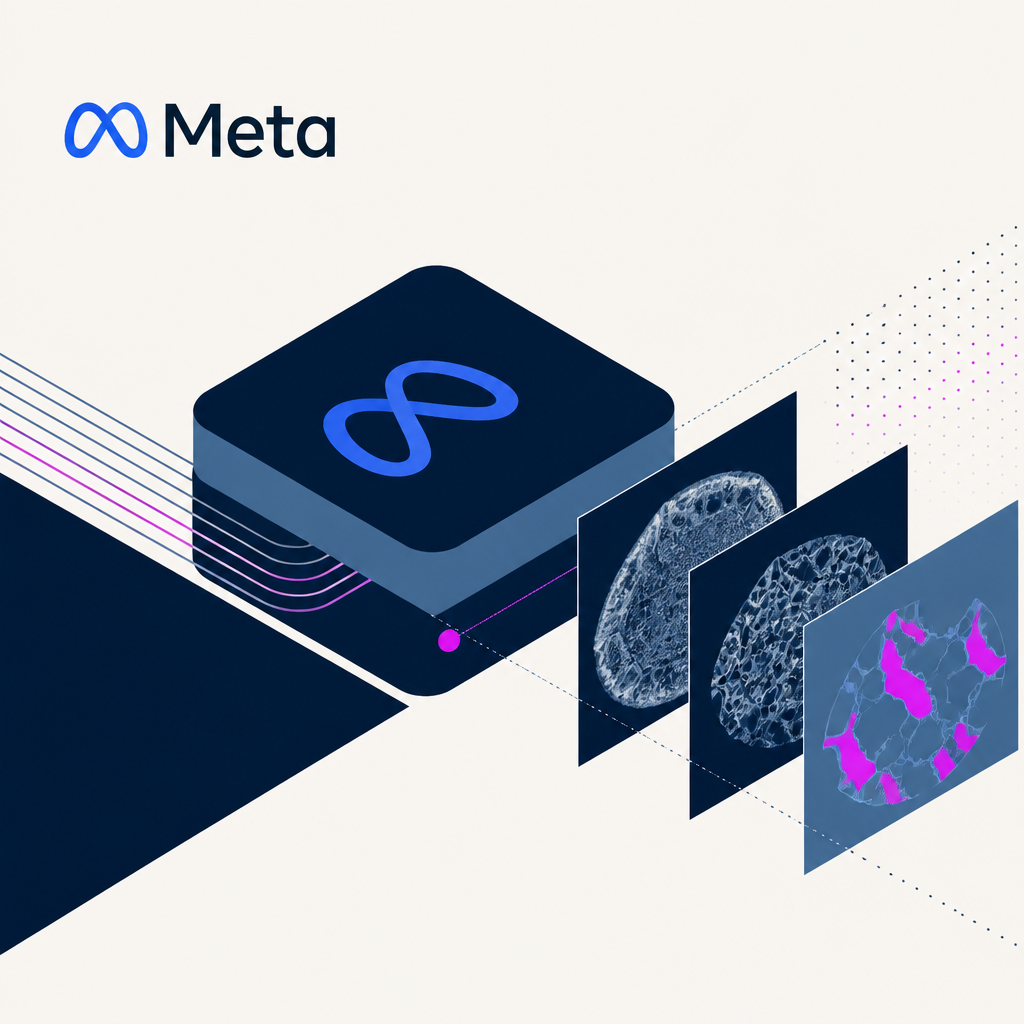
Meta's SAM 3 and DINOv3 are now crunching X-ray data at US national labs under the White House's Genesis Mission. A task that used to eat a month of expert time now takes 15 minutes.
Based on reporting by Meta AI — read the original for the full story.
Summary, retelling and take written by AI under human oversight; images are AI-generated illustrations. How we work · Report an error
Berkeley Lab's Advanced Light Source produces so much X-ray data that scientists have basically stopped trying to keep up manually. Detectors that once captured one image every six seconds now fire off 100,000 a second, and across the Department of Energy's light and neutron facilities that adds up to tens of petabytes a year — something like 2 million hours of HD video. The bottleneck isn't storage. It's segmentation: the slow, expert-driven work of tracing boundaries around cell walls, mineral grains, or semiconductor layers in a wall of grayscale pixels.
That bottleneck is exactly what SYNAPS-I, a flagship project under the Genesis Mission launched by the White House in late 2025, is trying to break. Led by Berkeley Lab with Argonne, Brookhaven, Oak Ridge and others, the project runs its segmentation pipeline on two open-source Meta models: SAM 3 and DINOv3. DINOv3 figures out what's in an image and where, having taught itself from raw pictures with no human labeling. SAM 3 then draws the pixel-precise outlines. Fine-tuned on beamline imagery and deployed across 300 A100 GPUs at NERSC, the pair turn raw scan data into a fully labeled 3D volume in about 15 minutes — while the experiment is still running, and handed straight back to the scientist standing at the instrument.
The grapevine work is the clearest proof of what that speed buys. Researchers used micro-CT scans from the Advanced Light Source to watch xylem vessels — the tiny tubes that move water through a plant stem — shrink and change as drought sets in. That kind of tracking used to demand a month of manual annotation per time step. Now it's 15 minutes, fast enough to study a biological process unfolding in real time instead of reconstructing it after the fact, with obvious implications for breeding drought-tolerant crops.
Open source is doing more than lowering costs here — it's solving a security problem. National labs can't send prepublication data to outside cloud APIs, so the SYNAPS-I team needed models they could download, fine-tune, and run entirely inside government infrastructure. Meta's release of SAM and DINO as open weights made that possible, letting labs repurpose vision models trained on ordinary photos for scientific images they were never built to handle.
Sixty researchers across five labs are now behind SYNAPS-I, and the ambition goes well past faster image labeling. The goal is beamlines that suggest their own next experiment and share findings across facilities instead of sitting on isolated piles of data. DOE Under Secretary Dario Gil put it plainly at the Trillion Parameter Consortium: the aim is compressing discovery from days to moments, building what he called a continuous, self-improving model of science as Genesis expands from a handful of seed projects into full programs.
My take — AI-written commentary, not fact-checked reporting
This is the strongest argument I've seen yet for open-weight models mattering beyond chatbot benchmarks — a national lab literally could not have used a closed API here because the data can't leave government servers, full stop. Every time someone claims open source is just a race-to-the-bottom cost play, point them at grapevines surviving drought thanks to a fine-tuned SAM checkpoint running on DOE's own GPUs. That's the real EU-vs-US tech debate in miniature: sovereignty over your data isn't a nice-to-have, it's the whole ballgame for science and defense alike.
Read more about this at: Meta AI
Related stories
 Reimagining Independence: How Meta’s AI Models Are Helping the University of Pittsburgh Transform Assistive Robotics
Meta AI ·
34
Meta's AI Storage Blueprint at Scale
Engineering at Meta · 2 months ago ·
49
Reimagining Independence: How Meta’s AI Models Are Helping the University of Pittsburgh Transform Assistive Robotics
Meta AI ·
34
Meta's AI Storage Blueprint at Scale
Engineering at Meta · 2 months ago ·
49