
Built in Fort Worth: Wistron Opens Advanced Manufacturing Plant to Produce NVIDIA AI Systems
NVIDIA NVIDIA Writers
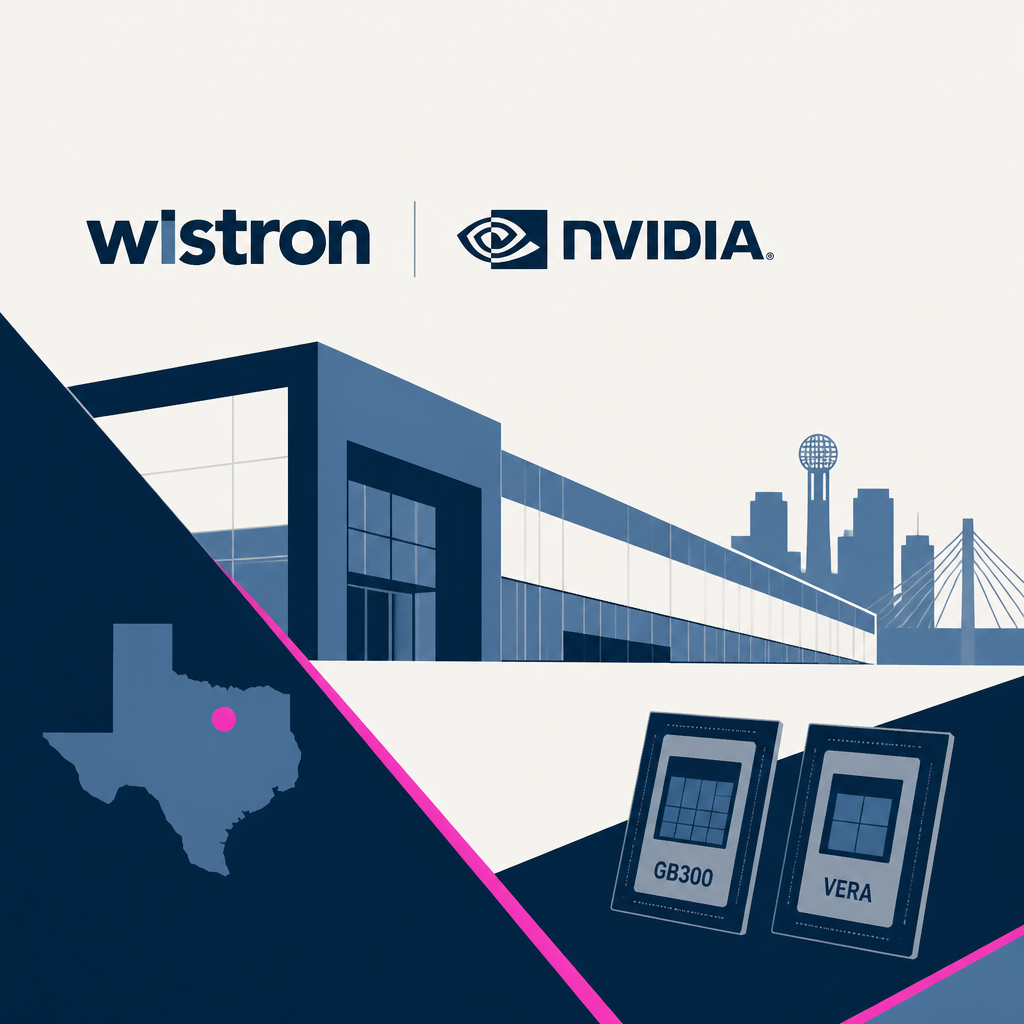
Wistron just opened its first U.S. factory, in Fort Worth, to build NVIDIA's newest AI superchips. It's a $700M bet on American-made hardware, with jobs set to hit 1,000 by year's end.
Based on reporting by NVIDIA, NVIDIA Writers — read the original for the full story.
Summary, retelling and take written by AI under human oversight; images are AI-generated illustrations. How we work · Report an error
Fort Worth has a new resident: a 324,000-square-foot plant that didn't exist as a functioning factory until Wistron flipped the switch this week. It's the Taiwanese manufacturer's first U.S. facility, and it's not making something generic. This is where NVIDIA's GB300 Grace Blackwell Ultra Superchip comes off the line, with a second cell already gearing up to produce the upcoming Vera Rubin Superchip. By the end of this year, the plant — internally called D1 — is expected to be turning out tens of thousands of boards a month.
Jensen Huang showed up for the opening, standing alongside Wistron Chairman Simon Lin in front of Taiwanese officials and local Fort Worth leaders. His pitch wasn't subtle: this is reindustrialization, plain and simple. Plumbers, electricians, construction crews, line workers — all pulled into orbit around a facility whose entire purpose is cranking out chips that power the next generation of AI systems. The company says the plant already represents over 500 new jobs, with a target of 1,000 by year's end, backed by a $700 million commitment to the site.
The interesting wrinkle here is how the factory got built in the first place. Before a single piece of equipment touched the floor, Wistron engineers ran the entire operation through a digital twin — built on NVIDIA's own Omniverse platform along with its Nemotron and Cosmos models and the PhysicsNeMo framework. Assembly line layouts, production flow, even worker training on standard procedures — all of it happened virtually first. It's a neat bit of self-reference: NVIDIA's software simulating the construction of a factory that will build NVIDIA's hardware.
The ceremonial centerpiece was the first GB300 chip produced on-site, which Huang personally signed. He described the full system built around it as the most powerful AI supercomputer in the world — one and a half million parts, two tons of hardware, a four-million-dollar price tag, and now something Wistron is producing at a volume more associated with phones than supercomputers. That framing matters. NVIDIA has pledged to manufacture up to $500 billion in advanced AI platforms domestically, and Fort Worth is one of the concrete pieces making that figure real rather than aspirational.
Huang leaned into the infrastructure metaphor during his remarks, comparing AI factories to roads, railroads and the power grid — foundational systems society will eventually take for granted. Whether that comparison holds up long-term is a bigger question than one ribbon-cutting can answer. But the fact that a plant this specialized, this fast-scaling, just opened in Texas — with another company, Coherent, breaking ground in nearby Sherman this year — suggests the buildout is moving well past the announcement stage and into actual concrete and steel.
My take — AI-written commentary, not fact-checked reporting
A digital twin simulating a factory that builds the chips powering digital twins is the kind of self-referential loop that should make people slightly uneasy about how much of this industry is now vouching for itself. Still, jobs are jobs, and a $700 million plant cranking out board after board of GB300s is a lot more concrete than another roadmap slide. The bigger tell is the $500 billion domestic manufacturing pledge — that's the number to watch, because plants like this one are the receipts, not the promise.”}}}}
Read more about this at: NVIDIA
Related stories
 Everything’s bigger in Texas: Musk’s planned $16.8 billion chip factory is five times bigger than the world’s current largest building
Fortune ·
48
Everything’s bigger in Texas: Musk’s planned $16.8 billion chip factory is five times bigger than the world’s current largest building
Fortune ·
48