
Validating Distributed LLM Serving Benchmarks with NVIDIA srt-slurm, SLURM Recipes, Parameter Sweeps, and Pareto Analysis
MarkTechPost Sana Hassan
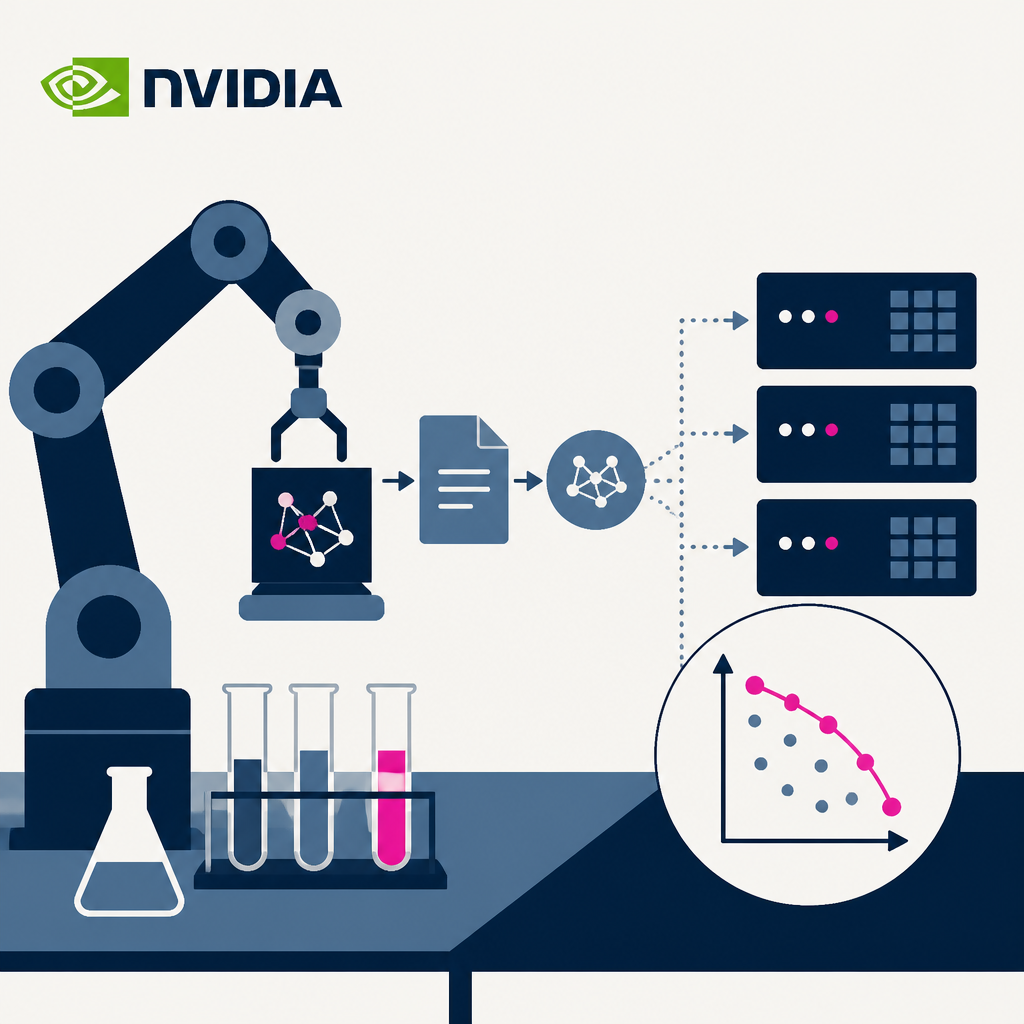
NVIDIA's srt-slurm tool turns YAML files into ready-to-run SLURM benchmarks for serving huge LLMs. It lets teams dry-run and sanity-check costly GPU jobs before ever touching a real cluster.
Based on reporting by MarkTechPost, Sana Hassan — read the original for the full story.
Summary, retelling and take written by AI under human oversight; images are AI-generated illustrations. How we work · Report an error
Benchmarking a distributed LLM deployment across dozens of GPUs is expensive to get wrong. Submit a bad SLURM job to a cluster running DeepSeek-R1 across split prefill and decode nodes, and you can burn hours of GB200 time before discovering a typo in your tensor-parallel setting. NVIDIA's srt-slurm project, walked through in a recent MarkTechPost tutorial, tries to close that gap by giving engineers a typed, validated path from a declarative config file to an actual sbatch script — with a dry-run step in between that catches mistakes for free.
The core tool is srtctl, a CLI that reads YAML recipes and expands them into SLURM-ready job scripts through Jinja2 templates. The tutorial builds the whole thing inside Google Colab, which obviously isn't a real SLURM environment, but that's kind of the point: you can define a cluster config, point it at container images and model paths like /models/DeepSeek-R1, and dry-run recipes to see exactly what job script would get generated, without ever touching real hardware. One example recipe splits DeepSeek-R1 into one prefill node and two decode nodes, each running SGLang with fp8 KV-cache and tensor-parallel-size 4 — a fairly involved disaggregated serving setup that would be painful to debug live on a cluster.
What's more interesting than the YAML-to-sbatch conversion is the sweep and analysis tooling bolted onto it. srtctl can take a sweep config and expand it into a full Cartesian grid of job configs — different chunked-prefill sizes, max-total-tokens values, concurrency levels — and generate a separate config.yaml for every combination, all inspectable before submission. There's also a typed Python API (load_config, generate_sweep_configs) that lets you poke at a recipe programmatically: check GPU topology, benchmark type, supported precisions and GPU enums, all validated against a schema rather than left as free-text YAML that fails silently at runtime.
The tutorial closes the loop with a simulated Pareto analysis, plotting throughput per GPU against inter-token latency for two chunked-prefill variants across rising concurrency. It's synthetic data here, but it mirrors what srt-slurm's real analysis stack — a Streamlit dashboard plus log parsers called NodeAnalyzer and RunLoader — is meant to do with actual benchmark output once jobs run for real. NVIDIA also bakes in a reproducibility nudge: recipes can carry an identity block specifying the exact HF model revision, container URI, and framework version, so srtctl checks at job start that the runtime actually matches what you declared.
None of this is flashy. It's plumbing. But distributed inference benchmarking has been a mess of bespoke shell scripts and tribal knowledge for years, and a validated, typed, dry-runnable config layer is the kind of unglamorous infrastructure that saves real GPU-hours once teams are running sweeps across dozens of nodes rather than one.
My take — AI-written commentary, not fact-checked reporting
I'll say the quiet part: most of the AI infra world is still held together by shell scripts and hope, so a typed schema plus a dry-run step before you touch a real cluster is genuinely the boring, correct move. It's also a tell — NVIDIA building tooling this specifically for disaggregated prefill/decode serving confirms that's where the real inference cost battle is happening now, not in training headlines.
Read more about this at: MarkTechPost
Related stories
 Implementation of Machine Learning Workflows with NVIDIA cuML, RAPIDS, GPU Benchmarking, Explainability, Clustering, and Model Inference
MarkTechPost · 4 days ago ·
3
Implementation of Machine Learning Workflows with NVIDIA cuML, RAPIDS, GPU Benchmarking, Explainability, Clustering, and Model Inference
MarkTechPost · 4 days ago ·
3
 Unsloth vs Axolotl vs TRL vs LLaMA-Factory: A Fine-Tuning Framework Comparison on Speed, VRAM, and Multi-GPU
MarkTechPost · 1 month ago ·
32
jamesob's guide to running SOTA LLMs locally
GitHub · 2 months ago ·
23
Unsloth vs Axolotl vs TRL vs LLaMA-Factory: A Fine-Tuning Framework Comparison on Speed, VRAM, and Multi-GPU
MarkTechPost · 1 month ago ·
32
jamesob's guide to running SOTA LLMs locally
GitHub · 2 months ago ·
23