
Built for Vera Rubin, NVIDIA Spectrum-6 Arrives in Gigascale AI Factories
NVIDIA Scot Schultz ● Covered by 8 sources
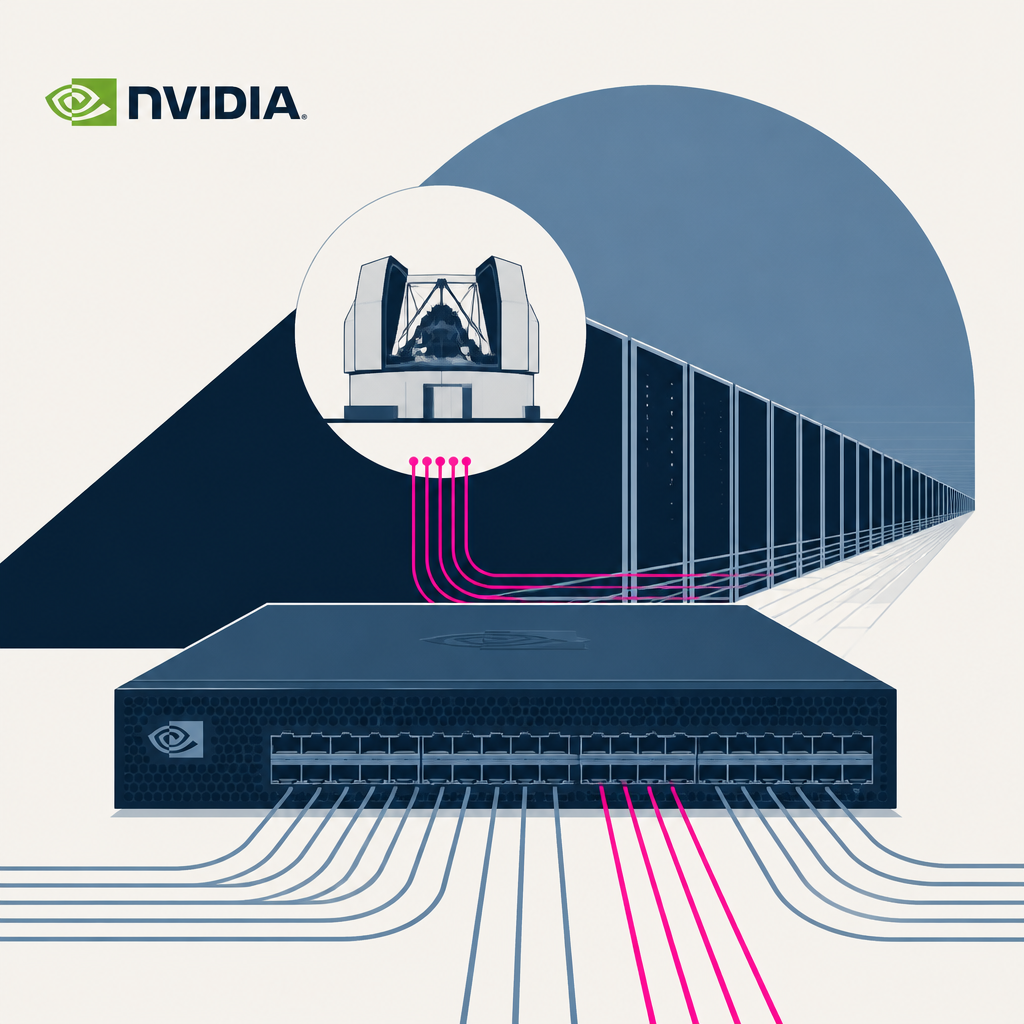
Nvidia's Spectrum-6 Ethernet switch, doubling network speed to 102.4 terabits per second, is rolling into massive AI data centers now. Turns out at this scale, the network matters as much as the chips.
Based on reporting by NVIDIA, Scot Schultz — read the original for the full story.
Summary, retelling and take written by AI under human oversight; images are AI-generated illustrations. How we work · Report an error
Nvidia just shipped the plumbing for its next wave of AI factories, and it's arriving faster than the usual hype cycle suggests. Spectrum-6, a 102.4-terabit-per-second Ethernet switch system, delivers twice the capacity of its predecessor and slots directly into the Vera Rubin platform — the same architecture pairing Nvidia's Vera CPU, Rubin GPU, NVLink 6 Switch, ConnectX-9 SuperNIC and BlueField-4 DPU. CoreWeave, Microsoft, Nebius, SpaceXAI and Tesla are among the first to bring it into their infrastructure, with CoreWeave, Microsoft and Nebius specifically named as early deployers of the full Vera Rubin stack.
The pitch here isn't really about a faster switch. It's about a shift in what actually limits AI performance once you're running hundreds of thousands of GPUs. Peak chip speed stops mattering much when thousands of accelerators need to synchronize constantly during training — a process Nvidia calls collective communications, and one that standard Ethernet, built for ordinary server-to-user traffic, was never designed to handle well. Spectrum-X Ethernet, the platform Spectrum-6 anchors, is built specifically to keep that east-west GPU chatter flowing without stalling an entire job over one slow link.
CoreWeave's Min Jun framed it plainly: networking is central to delivering performance at scale, and the liquid-cooled Spectrum-X infrastructure is meant to give customers the bandwidth and resilience to train frontier models faster. Nebius's Laurelle Roseman put it in terms of coordination — keeping every GPU in lockstep so nothing chokes the whole system as workloads grow. That's the sales pitch, and it's coming straight from two of the earliest customers rather than just Nvidia's marketing copy.
The technical specifics back up the ambition somewhat. Spectrum-X Ethernet claims up to 1.6x higher AI networking performance than off-the-shelf Ethernet, and Nvidia says it holds up to 95% network efficiency in deployments beyond 100,000 GPUs — the kind of scale only a handful of companies operate at today. The multiplane topology approach also cuts the number of switches data centers need by 1.7x, and the associated Photonics layer promises 5x better power efficiency and a 10x improvement in mean time between incidents. Spectrum-6 itself supports both pluggable and co-packaged optics, plus liquid cooling across the board, which matters when you're trying to run an entire AI factory as a single cooled, powered system rather than a pile of separate boxes.
What's notable is Nvidia's insistence on selling this as one designed platform rather than a component to bolt onto existing racks. Silicon, switches, NICs and software are being co-designed together, while still supporting open network operating systems and standard Ethernet protocols. That's a deliberate contrast to the old model of assembling parts and optimizing afterward — and it's the argument Nvidia is making for why gigascale AI needs purpose-built networking, not just bigger GPUs.
My take — AI-written commentary, not fact-checked reporting
The real story isn't Spectrum-6 itself, it's that Nvidia is now selling the entire AI factory as a single product, chips, switches, cooling and software bundled together, which quietly locks customers deeper into one vendor's stack even while it waves the flag of open Ethernet and open network OSes. Every company mentioned here — CoreWeave, Microsoft, Nebius — is already deep in Nvidia's ecosystem, so of course they're first in line. The efficiency numbers sound great, but they come from Nvidia's own benchmarks against unspecified 'off-the-shelf Ethernet,' which is the kind of comparison that always favors the company running the test.
Read more about this at: NVIDIA