Announcing Our Series A
Sakana AI ● Covered by 6 sources

Tokyo's Sakana AI just closed a ~$200M Series A with NVIDIA, big Japanese banks and VCs on board. It's Japan's biggest bet yet on homegrown, nature-inspired AI instead of copying US labs.
Based on reporting by Sakana AI — read the original for the full story.
Summary, retelling and take written by AI under human oversight; images are AI-generated illustrations. How we work · Report an error
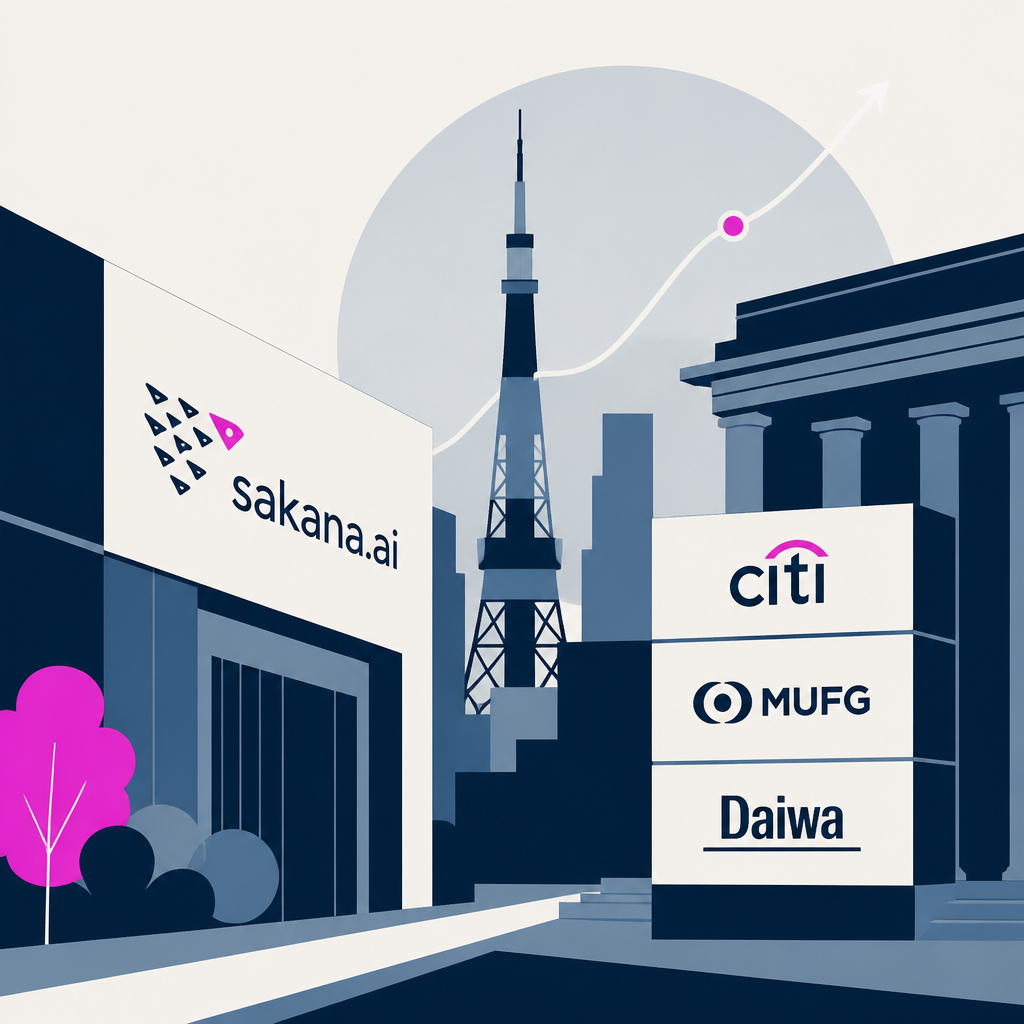
Sakana AI isn't hiding its ambitions behind vague mission-speak. The Tokyo startup, whose name literally means "fish" in Japanese, just closed a Series A worth roughly $200 million, and the investor list reads like a who's-who of both Silicon Valley and corporate Japan. New Enterprise Associates, Khosla Ventures and Lux Capital led the round, with NVIDIA, 500 Global and Translink Capital joining in. That alone would be a solid raise. What makes it notable is the second tier of backers: MUFG, SMBC and Mizuho — Japan's three largest banking groups — plus NEC, Fujitsu, KDDI, ANA, Tokio Marine, Nomura and SBI, among others.
That lineup tells you this isn't just venture capital chasing a hot sector. It's Japan Inc. deciding it needs a domestic AI champion and putting money behind that bet collectively. Sakana's pitch is that it won't build foundation models the way everyone else does — by throwing more GPUs at transformer scaling. Instead, the company leans on evolutionary algorithms and collective intelligence, ideas borrowed from biology, which is also where the fish branding comes from: a school of simple agents forming something coherent, and one red fish swimming off in its own direction.
The NVIDIA tie-up is the more concrete part of the announcement. It covers three things: early access to NVIDIA-backed data centers for testing sparsity and evolutionary optimization techniques at scale, help running experiments so Japan has infrastructure parity with the US and China, and a push to grow Japan's AI talent pool through hackathons, university partnerships and community events. Jensen Huang framed it as part of NVIDIA's broader sovereign AI push — helping countries build their own models rather than renting capability from American labs. Khosla, an early investor, was more pointed, saying most labs globally are just imitating each other's training recipes while Sakana is trying something different.
Sakana is explicit that this is a long game, not a quarterly-earnings play. The company points to Japan's shrinking population, slipping competitiveness and rising geopolitical pressure as the backdrop for why this matters beyond one startup's balance sheet. Building a talent-dense lab and energy-efficient infrastructure takes years, and Sakana knows a small company can't fix demographic decline on its own. But the framing is clear: this money is meant to buy Japan a seat at the frontier-AI table, not just fund another chatbot company.
My take — AI-written commentary, not fact-checked reporting
What's actually interesting here isn't the dollar figure, it's that Japan's biggest banks and industrial conglomerates are treating AI sovereignty as a national-security-adjacent investment, which is a very different signal than another SF fund writing a check. Whether evolutionary methods actually beat brute-force scaling remains to be seen, but at least someone's willing to bet against the transformer monoculture instead of just cloning GPT architecture with a smaller budget.
Read more about this at: Sakana AI