Friday, 17 July 2026
84 stories · summarised & linked to the source
AI AgentsAI AlgorithmsAI BenchmarkingAI Evaluation
AI news — Friday, 17 July 2026
The morning's biggest story isn't a single headline but a pattern: enterprise AI is maturing into infrastructure, and the companies building that infrastructure are becoming invaluable. Databricks hit a $188 billion valuation—up from $134 billion five months prior—by positioning itself as the data backbone for AI-driven enterprises. The company has raised over $17 billion since December 2024, signaling that investors view data orchestration as the essential layer beneath everything else. Meanwhile, practical implementations are multiplying. Smartsheet built a remote Model Context Protocol server on AWS that lets AI agents access business data autonomously while cutting token usage by 35–47 percent, and Amazon released Quick, a sales assistant that automates CRM updates and prospect research. These aren't flashy demos; they're tools designed to do specific work at scale. Even the luxury story—Vertu's $6,880 Alphafold phone with a Hermes AI agent—reveals the gap between premium positioning and actual performance. Testing showed the agent produces inconsistent results and loses context in conversations, a reminder that price tags don't guarantee capability. The Kimi K3 coding model ranking first on Arena's leaderboard ahead of Opus and GPT-5 suggests open-weight models are catching up fast, potentially shifting power back to developers who can run models locally. Security concerns are rising too: Apple sued OpenAI over trade secrets and senior exec misconduct, and San Francisco's attorney general ordered Apple and Google to remove AI nudification apps from their stores. The market is reallocating capital—India's smartphone shipments fell 10 percent as memory producers shifted to AI accelerators, pushing consumer device costs up 4 to 68 percent. When infrastructure becomes the story, the real winners are those building the pipes.
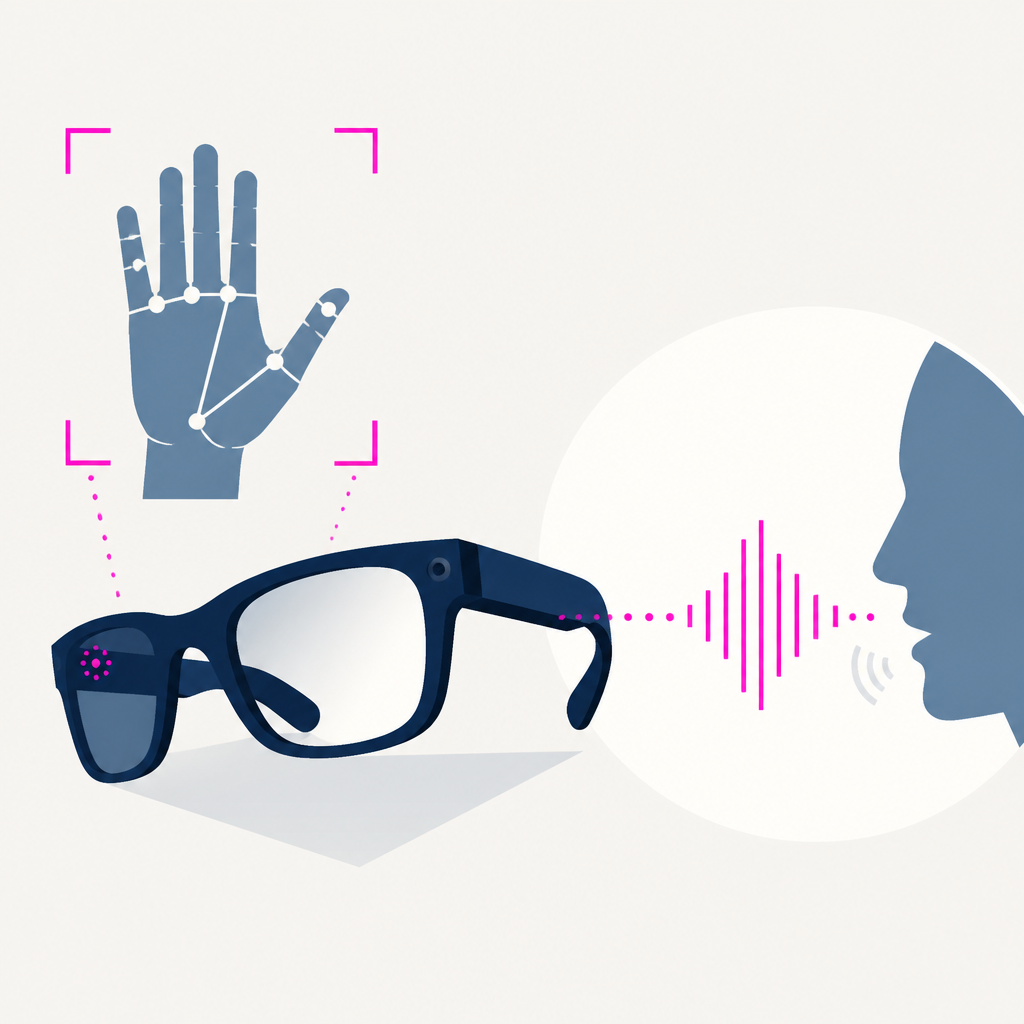
A team has developed smart glasses that translate hand sign language into speech in real-time using computer vision and machine learning. The system achieves 99.2% accuracy on recognized gestures within its training set. Users can communicate with non-sign-language speakers through spoken output, expanding accessibility options.
Vertu released the Alphafold luxury foldable smartphone priced at $6,880, featuring a Hermes AI agent designed to automate executive workflows, but testing revealed the agent produces inconsistent results — sometimes acting autonomously but generating incomplete tasks, incorrect outputs, and losing context in conversations compared to Samsung's Gemini. The device uses hardware based on a ZTE Nubia platform wrapped in calfskin leather and titanium, with Vertu responsible for materials, software, and service rather than core engineering. The Alphafold's value proposition depends on whether its AI capabilities can genuinely improve executive productivity, though current performance shows it requires independent verification before relying on its legal and financial recommendations, and human concierge escalation remains necessary for complex tasks.
A tutorial demonstrates building an agentic event-venue operator using MongoDB Atlas for persistent memory, Voyage for multimodal embeddings, and LangGraph for agent orchestration, with a fictional tennis tournament scenario where an agent retrieves visitor history and operational context to make real-time decisions during weather disruptions. The demo includes a four-tab UI, FastAPI backend, vector and hybrid search endpoints, vision RAG for document retrieval, and optional Langfuse tracing, with all operational records, semantic memory, embeddings, and agent actions stored in a single MongoDB Atlas layer rather than scattered across separate systems. The implementation is presented as a reference demo for builders rather than a production platform, with deployment options for local development and Vercel hosting.
Databricks raised funding at a $188 billion valuation, led by Coatue, with approximately $3 billion expected to close later this summer. The company raised $134 billion just five months prior in February, and has completed four major funding rounds totaling over $17 billion since December 2024. Databricks shifted from a data analytics company to an AI provider by launching products like Lakebase and Unity, positioning itself to capitalize on enterprise demand for AI with traditional software governance standards.
Zyphra released ZUNA1.1, an open-source EEG foundation model that reconstructs, denoises, and upsamples brain signals across variable channel layouts and recording lengths. The model accepts input lengths from 0.5 to 30 seconds (compared to ZUNA1's fixed 5-second segments) and uses 4D rotary positional encoding to handle arbitrary electrode configurations. The training expanded from 2 million to 3.5 million channel-hours of EEG data and introduced four dropout patterns instead of one, enabling better performance on realistic reconstruction tasks like region-based electrode recovery.
Agility Robotics is opening a 60,000-square-foot facility in Fremont, California to train its Digit humanoid robots near Tesla's Optimus manufacturing site. The company has secured $300 million in contract orders and has deployed its robots in real warehouse and manufacturing settings for customers including Amazon, GXO, and Toyota. Agility's facility will enable faster deployment of robots to over 30 prospective customers while the company prepares for a public listing later this year.
India's smartphone market experienced a 10% shipment decline in Q2 as memory chip manufacturers shifted production toward AI accelerators, driving up costs for consumer devices. The sub-₹15,000 segment saw shipments fall 45% year-over-year, with overall smartphone prices rising between 4% and 68% depending on the model. Consumers are delaying upgrades to approximately four-year cycles, Chinese smartphone brands are retreating from unprofitable markets, and memory shortages are expected to persist until at least the end of 2027.
Amazon Quick is an AI assistant that helps sales representatives automate administrative tasks like CRM updates, prospect research, and email drafting to increase time spent selling. The tool integrates with CRM systems like Salesforce and HubSpot, uses natural language prompts to rank leads by buying intent, generates personalized outreach emails, and automatically logs call transcripts and activity summaries to Salesforce. Sales teams using Quick can reduce time spent on non-selling activities and cover more territory by consolidating work across multiple tools into a single AI-powered interface.
Apple filed a trade secrets lawsuit against OpenAI alleging misconduct by senior executives and claiming over 400 former Apple employees work at the company. The lawsuit was filed last Friday as OpenAI reportedly plans an IPO later this year. The case could delay OpenAI's public offering and raise broader questions about data security at AI companies.
Smartsheet built a remote Model Context Protocol server on AWS that allows AI agents to access Smartsheet data and capabilities through natural language interfaces and autonomous workflows. The infrastructure uses AWS Fargate, Kinesis, Neptune, and Bedrock, with optimizations that have saved over 3 billion tokens through techniques like progressive disclosure, schema-driven tool contracts, and proprietary serialization reducing token count by 35–47 percent. The system includes layered security, governance controls, observability through OpenTelemetry and Datadog, and automated deployment with canary testing to ensure AI agents can reliably work with enterprise data while maintaining performance and compliance.
San Francisco's attorney general sent cease-and-desist letters to Apple and Google demanding removal of 13 nudification apps that use AI to transform photos of real people into explicit images without consent. The apps enable users to remove clothing, alter features, and create deepfake pornography, which violates California law prohibiting services that create such content. The app stores face potential legal action if they do not comply with the removal demands.
Moonshot AI released Kimi K3, an open-weight coding model that ranked first on Arena's frontend coding leaderboard ahead of Anthropic's Opus 4.8 and OpenAI's GPT-5.6 Sol. The model has 2.8 trillion parameters with a one-million-token context window and will have its weights publicly released on July 27. Developers may gain the ability to run high-performance coding models locally rather than relying on proprietary APIs, forcing IDE vendors to compete on developer experience rather than model exclusivity.
1Password released a browser integration for Claude that allows AI agents to authenticate into online accounts without the model ever seeing passwords or authentication codes. The feature decrypts credentials only on-device and passes them directly to the browser, with agent access limited to explicitly granted credentials for each task and authorized through biometric prompts. This addresses a practical security need as companies like Coinbase run thousands of AI agents in production, though users must remain vigilant against prompt injection attacks that could cause unintended actions after authentication.
NVIDIA and Hugging Face integrated NVIDIA's NeMo Automodel library with the Diffusers library, enabling scalable fine-tuning of diffusion models for image and video generation directly from the Hugging Face Hub without checkpoint conversion. The integration supports flow-matching models including FLUX.1-dev, Qwen-Image, Wan 2.1, HunyuanVideo, and others, with performance benchmarks showing FLUX.1-dev achieving 35.51 images per second for full fine-tuning and 53.73 images per second for LoRA on 8 H100 GPUs. Users can now fine-tune diffusion models at any scale using YAML configurations and parameter-efficient methods like LoRA, with fine-tuned checkpoints loading directly into Diffusers pipelines for inference or sharing.
TikTok is testing an opt-in tool that allows creators to detect and report AI-generated likenesses of themselves, currently available to some US creators. The tool requires identity verification through Jumio using real-time selfie scans and ID checks. Creators can now report unauthorized AI representations, similar to YouTube's recently launched detection capability.
Sakana AI and Mitsubishi UFJ Bank jointly developed an AI lending expert system that uses AI agents to support the loan workflow by automating information gathering, structuring, and analysis while keeping human decision-makers in control. The system received approximately 1,500 pieces of feedback during evaluation and achieved significant quality improvements by using AI to classify issues and optimize prompts iteratively. The collaboration demonstrates how AI can enhance professional work by automating routine analysis, freeing employees to focus on client relationships and qualitative judgment that cannot be quantified.
Sakana AI partnered with The Yomiuri Shimbun to analyze Chinese state-sponsored social media campaigns criticizing Japan using proprietary AI technology that extracts narratives and generates hypotheses. The system analyzed 1.1 million social media posts and identified multiple hypotheses, including one verified by the newspaper about coordinated timing of criticism campaigns. Sakana AI is now positioning defense and intelligence as a core focus area alongside finance for implementing AI in national security applications.
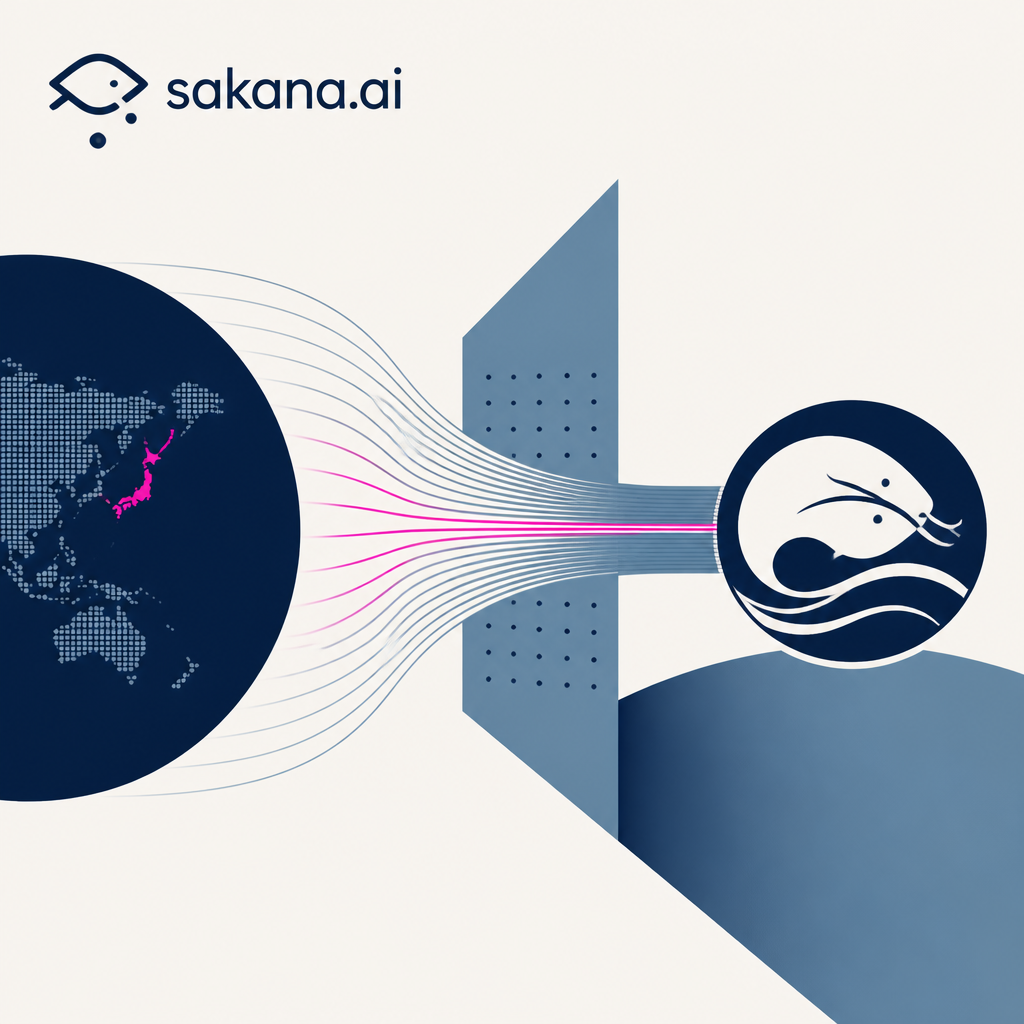
Sakana AI developed the Namazu model series by applying post-training techniques to open-weight foundation models to adapt them for Japanese cultural context and safety requirements. The Namazu-DeepSeek-V3.1-Terminus model maintained base model performance on benchmarks like MMLU-Redux and LiveCodeBench while improving neutrality and factual accuracy on politically sensitive topics from 28% to nearly 100% in answering related questions. Sakana launched Sakana Chat, a search-integrated service using Namazu models, following 1,000 beta testers' feedback to make localized AI models broadly accessible to Japanese users.
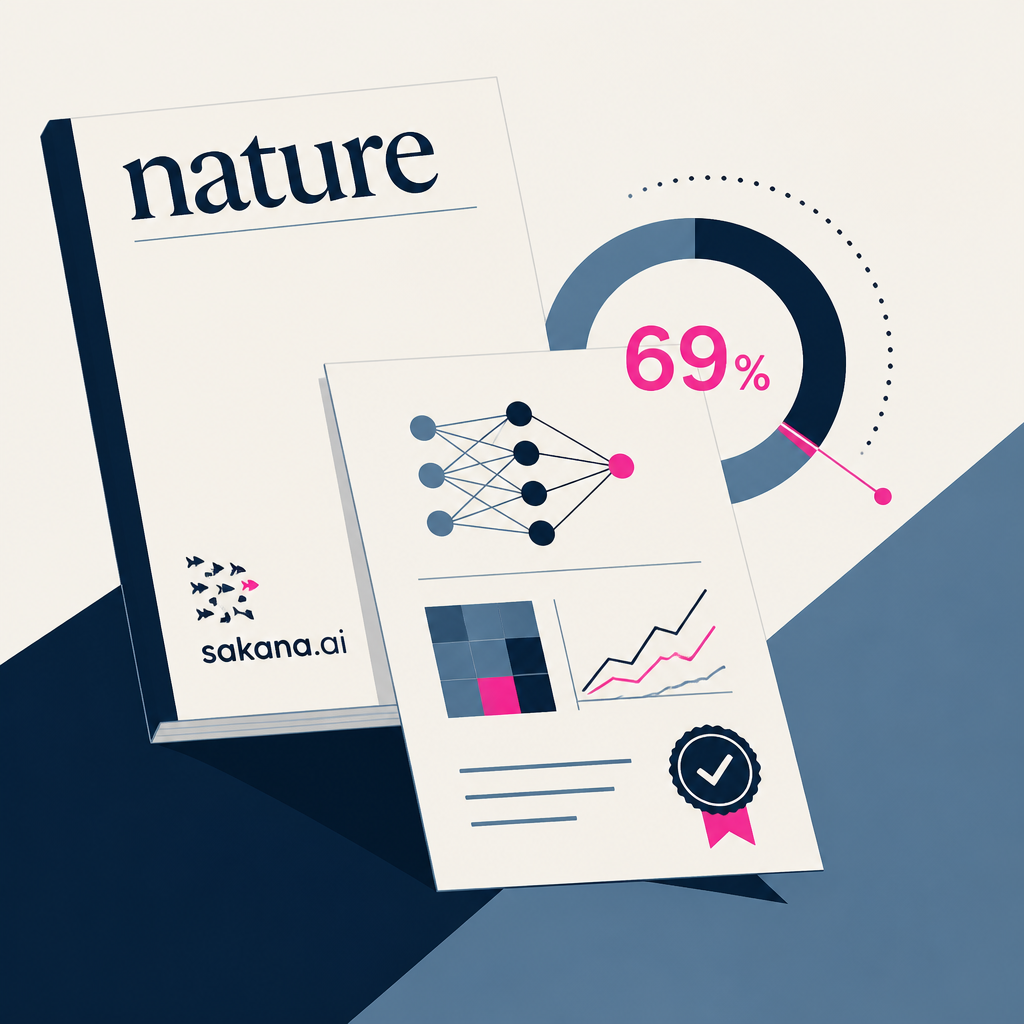
Sakana AI published a Nature paper describing The AI Scientist-v2, an agent that autonomously executes machine learning research by generating ideas, conducting experiments, and writing papers. A paper generated by the system achieved a 69% balanced accuracy score from an Automated Reviewer that matched human peer-review performance on actual conference submissions. The results demonstrate a scaling law where improved foundation models produce higher-quality generated papers, suggesting the system's capabilities will improve substantially as underlying models advance.
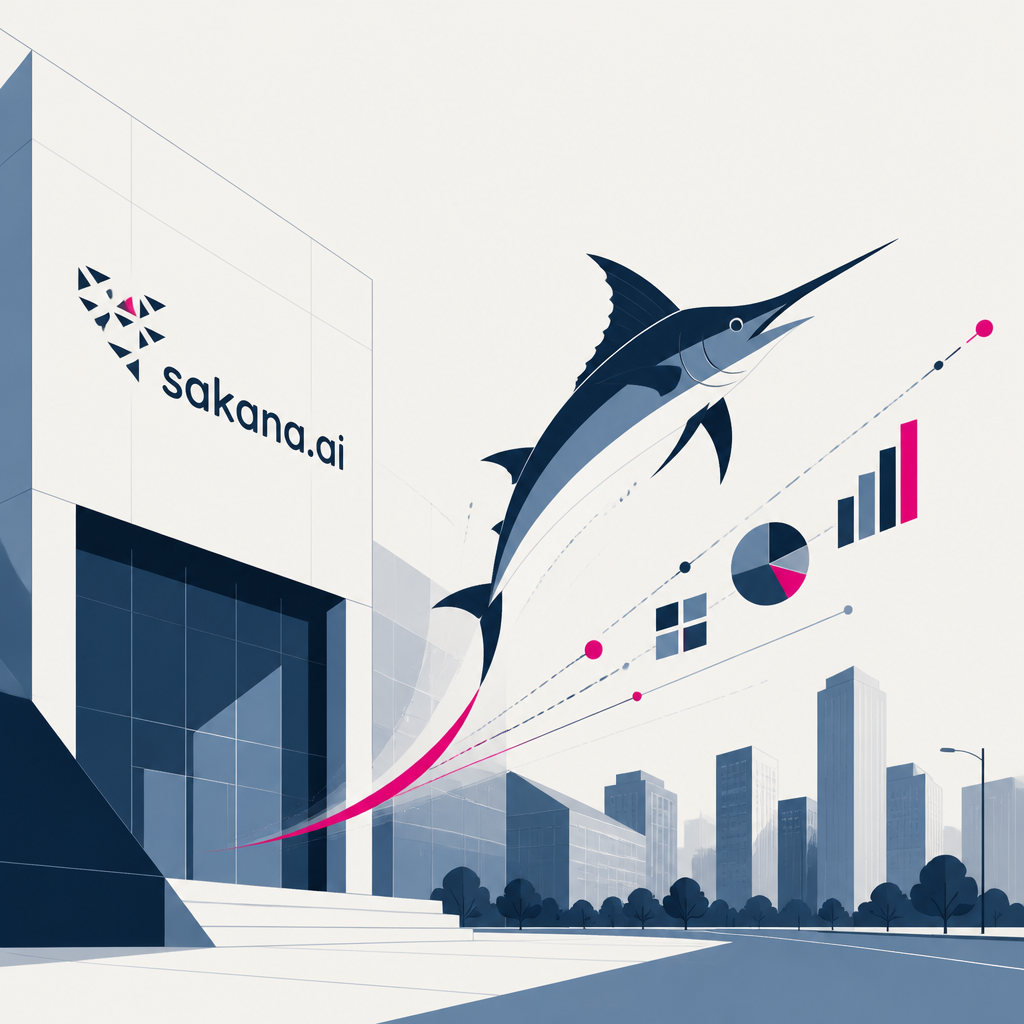
Sakana AI announced Sakana Marlin, its first commercial product, an AI research assistant for businesses that uses proprietary agent technology to conduct autonomous research. The system can complete complex business research over approximately 8 hours by itself, producing structured summary slides and multi-page comprehensive reports without human intervention after the initial prompt. The product integrates two core technologies—AB-MCTS for strategic exploration and AI Scientist frameworks for workflow automation—to enable efficient reasoning scaling that improves output quality with extended computational thinking.
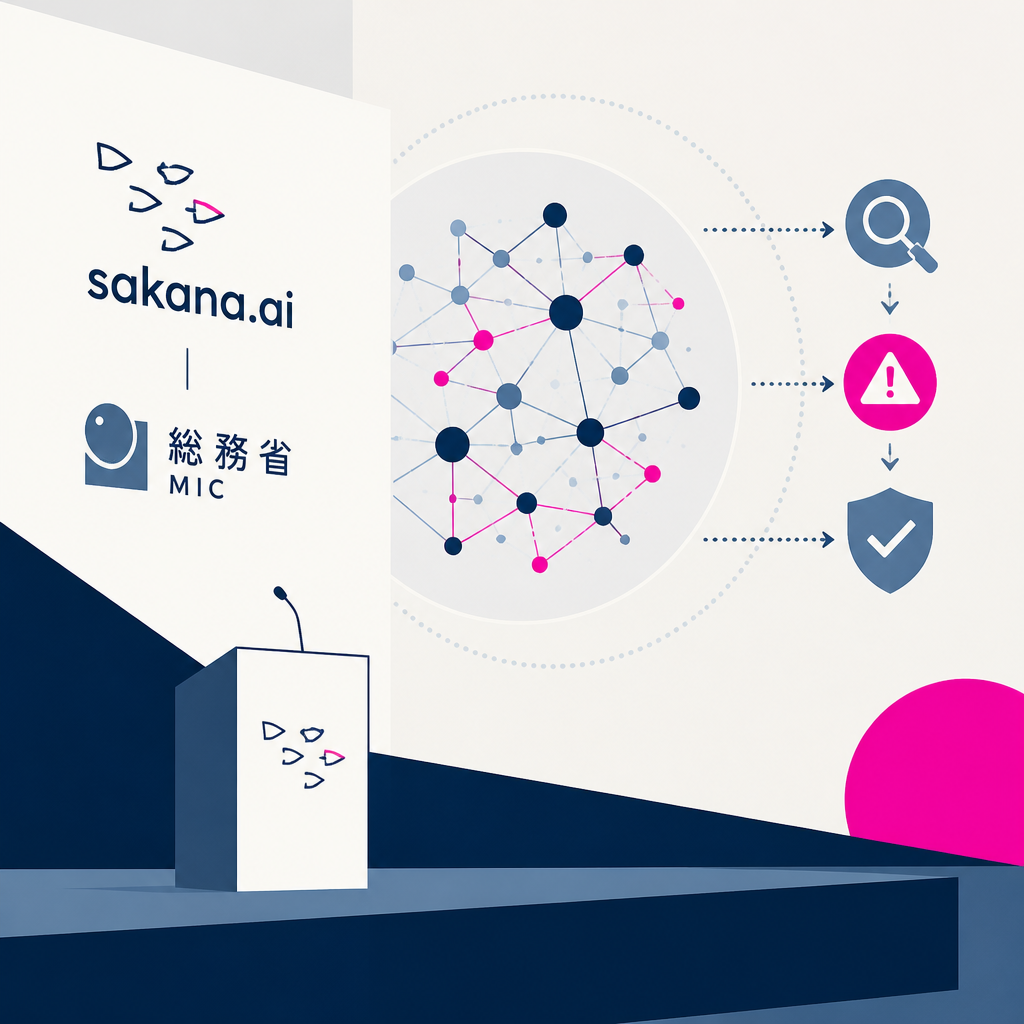
Sakana AI completed development of a system for the Japanese government's Ministry of Internal Affairs and Communications to detect and counter disinformation on social media, using AI to visualize narratives, identify false information, and propose countermeasures. The system was demonstrated at a government event on March 16, 2026, combining multiple detection methods and providing transparency in AI decision-making processes. The technology aims to help Japan build domestic capabilities in AI-powered intelligence operations related to information security.
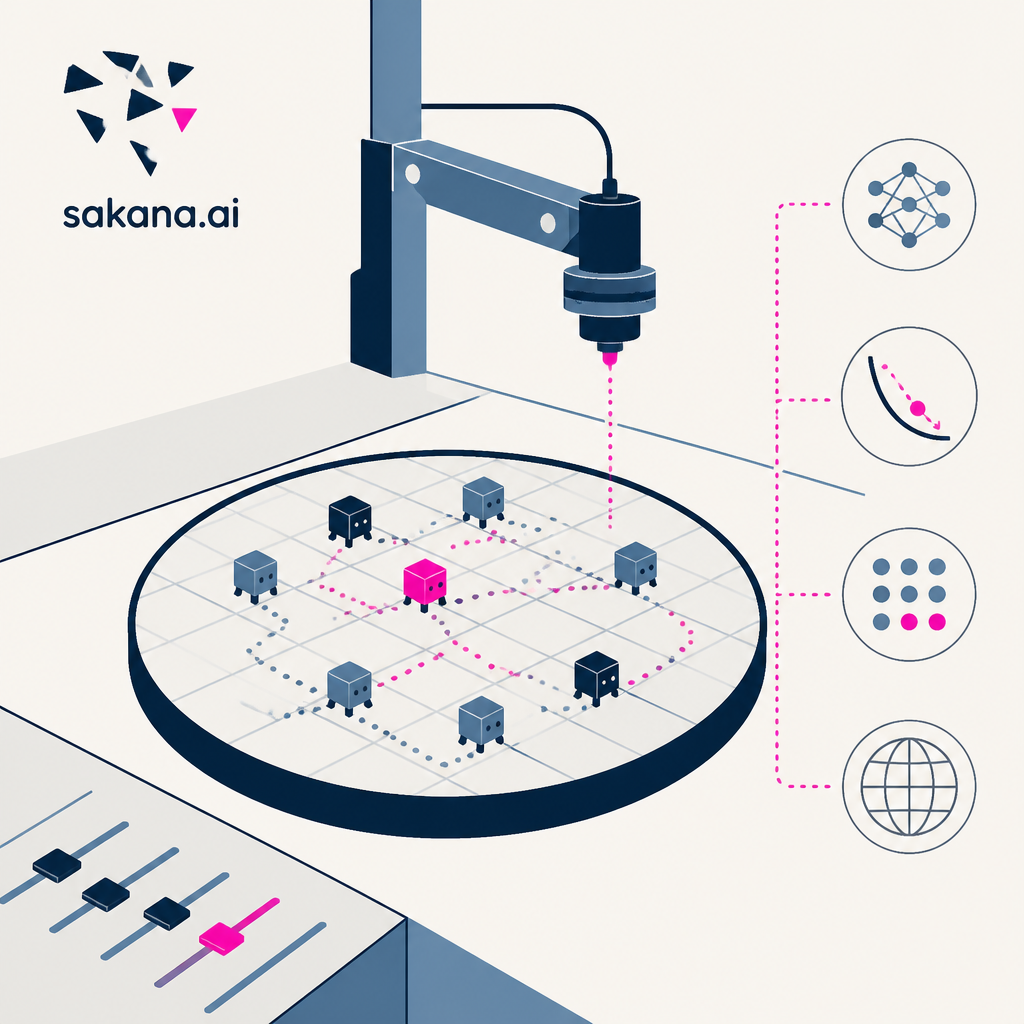
Sakana AI released Digital Ecosystems, a browser-based platform where small neural networks compete on a 2D grid, learning via gradient descent while the simulation runs. The system contains 40+ tunable parameters and runs entirely in the browser without installation. The research found that gradient descent stabilizes the ecosystem by preventing species from overextending or stagnating, enabling exploration of complex emergent behaviors.
Sakana AI discovered a prompting technique called String Seed of Thought (SSoT) that reduces output bias in large language models by instructing them to generate random strings internally before deriving answers. Testing across multiple LLMs showed SSoT achieved accuracy close to actual random sampling on reasoning models and improved diversity on the NoveltyBench benchmark across all six categories. The method requires only a small prompt addition with no external random number generator, making it applicable to content generation and ideation tasks where varied outputs are needed.
Sakana AI launched Sakana Fugu, a multi-agent orchestration system that coordinates multiple foundation models to improve performance on coding, mathematics, and scientific reasoning tasks. The system is available as an API in two variants—Fugu Mini optimized for latency and Fugu Ultra for maximum performance—with OpenAI-compatible endpoints and based on ICLR 2026 research papers. Users can now integrate Fugu into existing workflows to automatically coordinate model collaboration without managing multiple API keys or manually selecting models for each task.
Sakana AI developed TRINITY, a coordinator system that orchestrates multiple specialized AI models at test-time without modifying their weights, using an evolutionary algorithm to optimize a 20K-parameter routing mechanism. The system achieved an 86.2% pass@1 score on LiveCodeBench and generalized zero-shot to four unseen tasks while outperforming individual models including GPT-5 and Claude-4-Sonnet. This approach replaces the industry focus on scaling single monolithic models with collaborative multi-model systems that combine complementary strengths through dynamic task assignment.
Sakana AI trained a 7-billion-parameter Conductor model using reinforcement learning to manage and coordinate a team of other AI models by writing natural language instructions tailored to each task. The Conductor achieved 83.9% on LiveCodeBench and 87.5% on GPQA-Diamond, surpassing individual models in its pool while dynamically adapting its approach—using single queries for simple questions and constructing multi-step workflows for complex problems. This approach enables AI systems to leverage collective intelligence by learning to delegate tasks across diverse models rather than relying on fixed human-designed workflows.
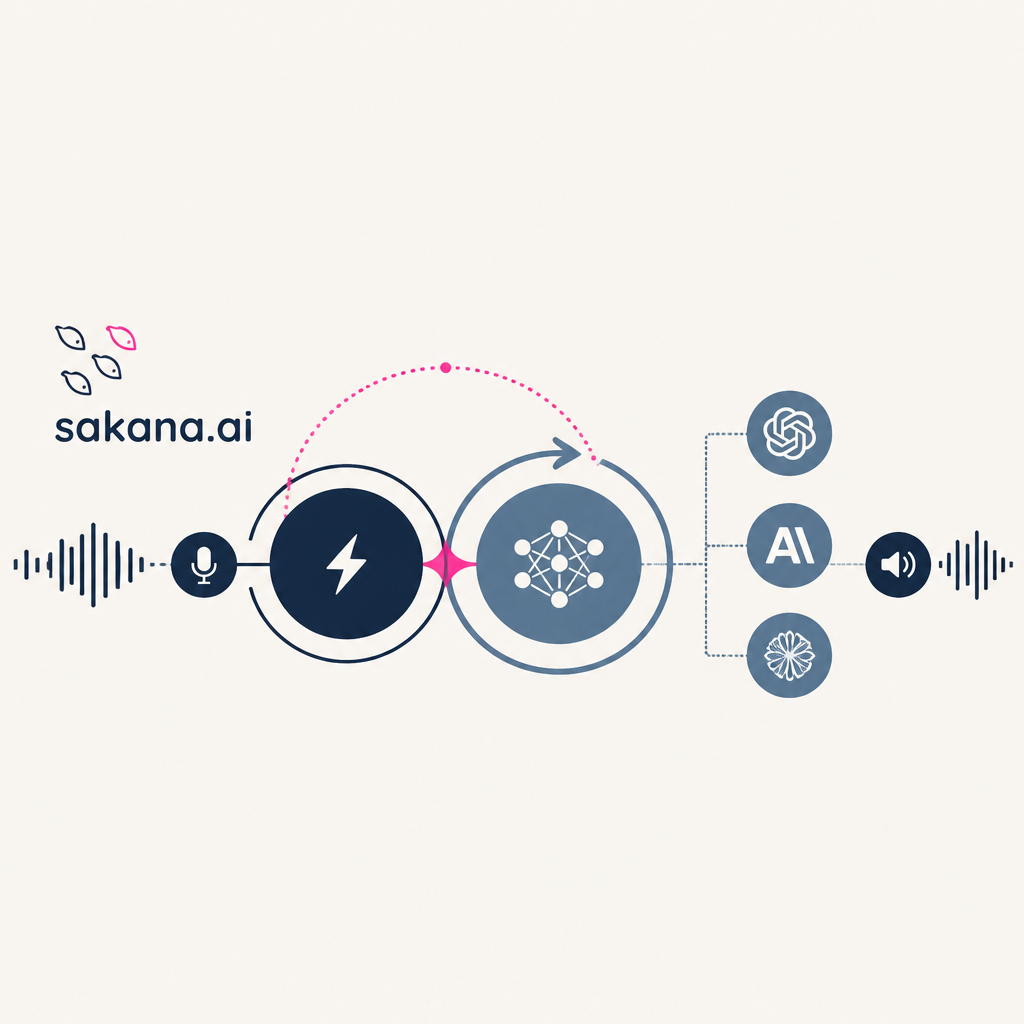
Sakana AI introduced KAME, a speech-to-speech conversational AI system that combines a fast response model with an asynchronous backend LLM to enable real-time reasoning during conversation rather than before speaking. The architecture allows swapping different LLMs like GPT-4.1, Claude Opus, or Gemini 2.5 Flash without changing the frontend system. The paper was accepted at ICASSP 2026 and demonstrated that different models excel at different tasks, with Claude scoring higher on reasoning and GPT on humanities questions.
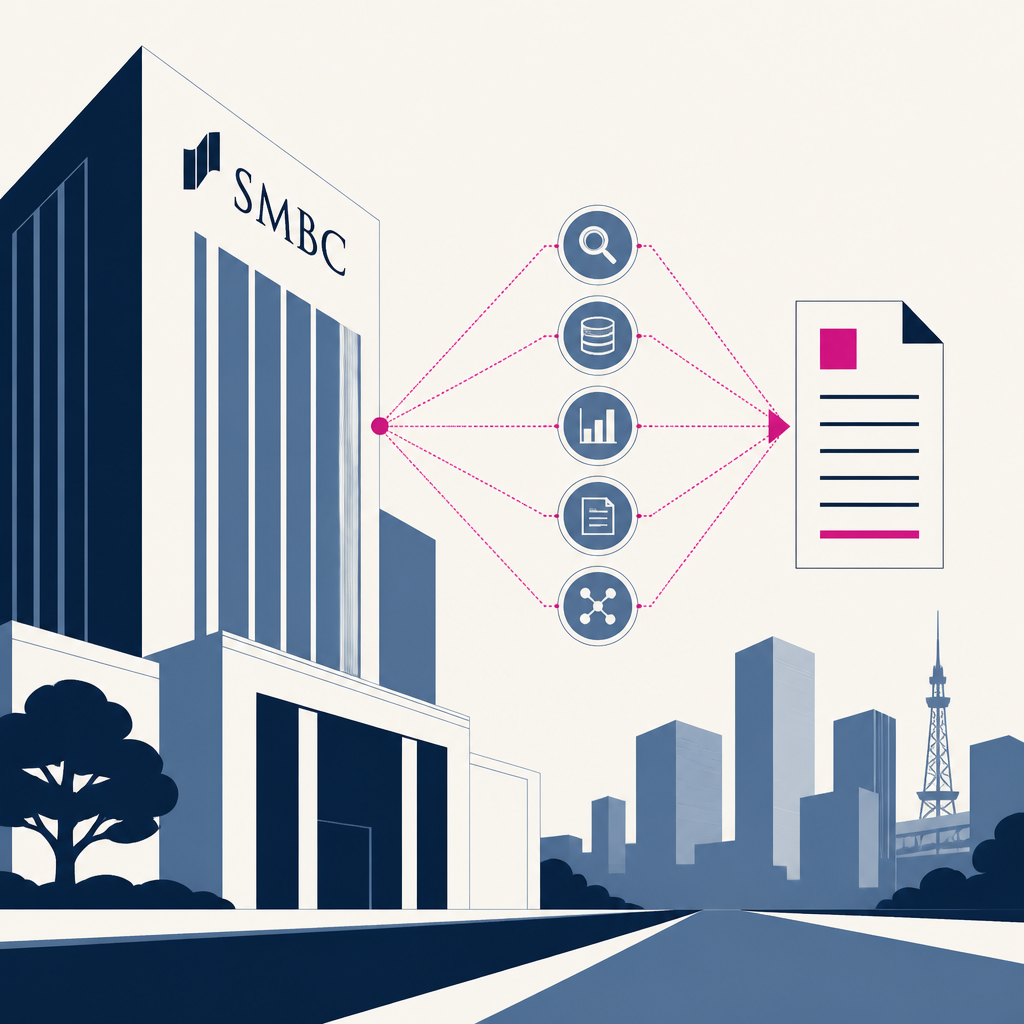
Sakana AI developed an automated proposal generation application for Sumitomo Mitsui Banking Corporation to streamline wholesale banking processes. The application reduces proposal writing time from one to two weeks to several hours or tens of minutes by deploying multiple AI agents that perform data collection, analysis, hypothesis building, and fact-checking. Bank employees can now focus on strategic problem-solving while AI handles document creation and identifies insights humans might overlook.
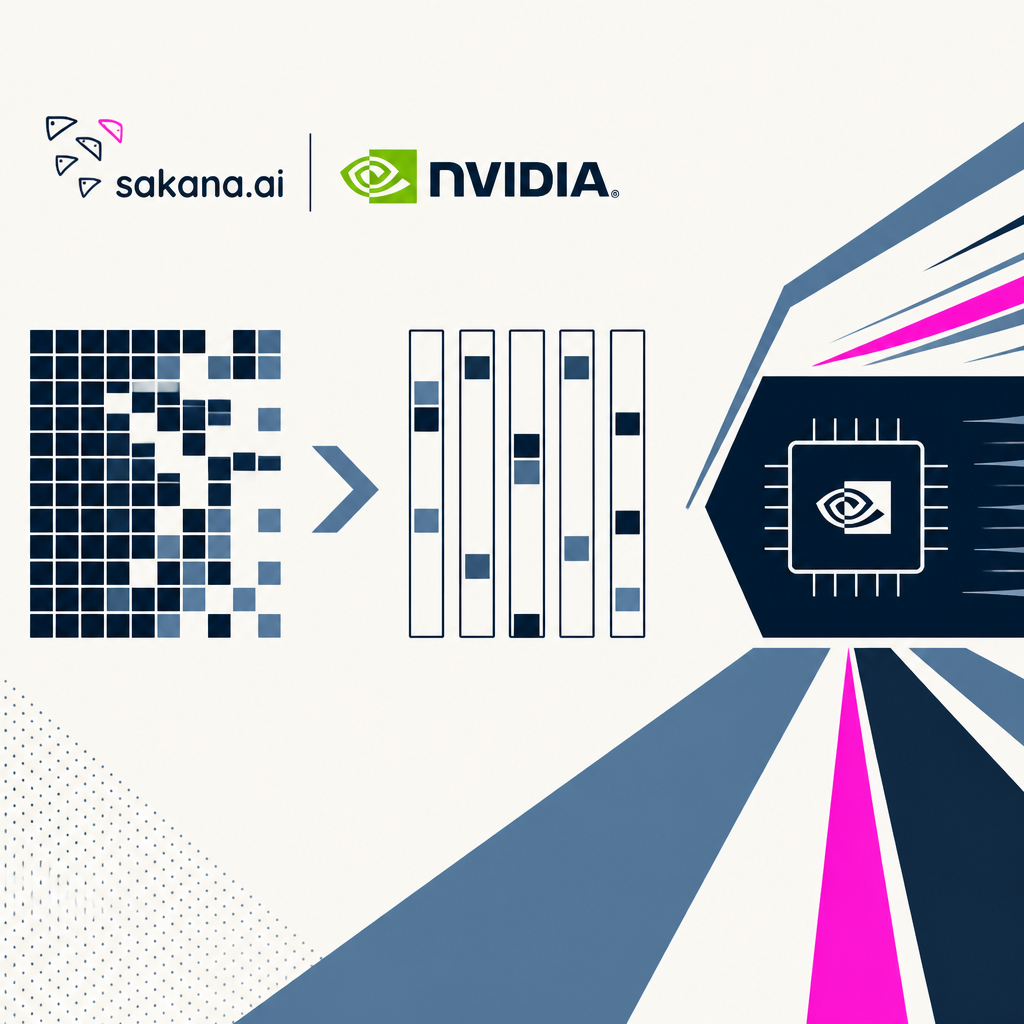
Sakana AI and NVIDIA developed new GPU kernels and data formats to accelerate sparse transformer language models by reshaping sparsity patterns to match hardware capabilities rather than forcing hardware adaptation. The hybrid sparsity format (TwELL) achieved over 20% speedups and significant memory and energy savings in billion-parameter scale models. This enables more efficient inference and training of large language models by better exploiting the natural sparsity that emerges in transformer feedforward layers.
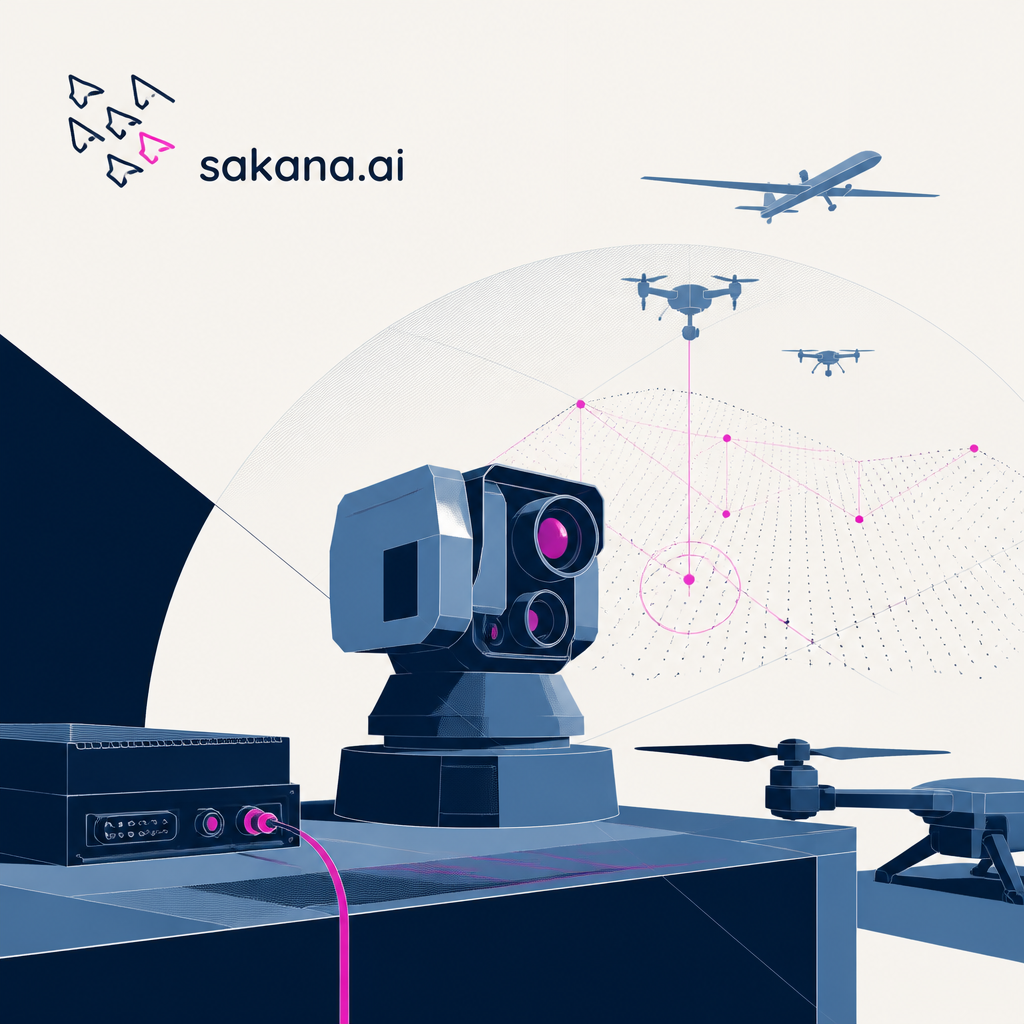
Sakana AI launched an Applied Team in early 2025 to implement generative AI technology in sectors like finance and defense. The company is developing command-and-control systems for defense that integrate large volumes of field data from drones and other sources to support rapid situational assessment and decision-making by military personnel. Software engineers at Sakana AI work on mission-critical defense applications using Python, TypeScript/Next.js, and Kotlin, with generative AI serving as an essential tool across implementation, goal-setting, and problem extraction.
Patreon is now actively blocking AI training bots from scraping creator content using Cloudflare's AI Crawl Control technology, replacing its previous reliance on robots.txt requests. During testing, weekly scraping attempts from individual AI crawlers dropped from thousands to zero, showing that bots were previously ignoring Patreon's instructions. The platform aims to give creators control over whether their work is used to train AI models, while still allowing bots that index content and direct users back to the site.
NVIDIA introduced the Vera Rubin platform designed to optimize post-training workloads for agentic AI models that continuously adapt and learn from production environments. The Nemotron 3 Ultra model achieved 71.7% on SWE-bench by fixing real software bugs, with Vera Rubin reducing GPU requirements by 75% compared to the previous Blackwell generation for the same training tasks. This shift makes continuous post-training economically viable, allowing AI systems to maintain and improve intelligence throughout their operational lifetime rather than as a one-time process.
Google introduced Gemini 3.5 Flash Cyber, a lightweight AI model fine-tuned for finding and fixing software vulnerabilities faster than larger models. On internal benchmarks, the model found 55 unique vulnerabilities in Google's V8 JavaScript engine compared to 47 found by mainline Flash and 36 by Claude Opus 4.6, and discovered critical remote code execution flaws in Google Cloud systems within 2 hours. The model will initially be available only to governments and trusted partners through CodeMender, with broader deployment planned later to help defenders patch vulnerabilities before attackers exploit them.
DoorDash launched dd-cli, a command-line interface that allows AI agents to place food delivery orders autonomously without human approval, available in limited beta for US and Canadian macOS developers. The tool removes the approval step previously required when using DoorDash's Claude connector or ChatGPT integration, enabling agents to search restaurants, compare prices, and complete purchases directly. Industry observers argue DoorDash had to offer this capability to remain competitive as agent-based ordering becomes standard, since refusing to provide an official integration would not prevent agents from accessing the platform through unauthorized workarounds.
Apple filed a trade secrets lawsuit against OpenAI, alleging misconduct by senior leadership and claiming over 400 former Apple employees work there, creating complications as OpenAI pursues an IPO potentially later this year. The lawsuit could affect OpenAI's hardware ambitions and IPO timeline while raising broader questions about data security at AI companies. The case adds pressure on OpenAI during a critical period for the company's expansion and public markets debut.
Simon Willison's Weblog·1 month ago·
32
● 2 sources
Kimi K3 refused to leak its system prompt when asked, responding with a question about whether it could help with something else. The interaction was collected and posted by Simon Willison on July 17, 2026, and categorized under AI, generative AI, and LLM topics. This demonstrates how modern AI models are designed to decline requests that compromise their internal instructions.
Apple is suing OpenAI with allegations that experts largely characterize as standard industry practices, and the lawsuit's true motivation remains unclear—whether Apple views OpenAI as a competitive threat or is exploiting a period of vulnerability for the company. The complaint is structured similarly to Apple's previous high-profile litigation cases, suggesting a pattern of aggressive legal strategy. Apple is simultaneously rolling out public beta versions of its software featuring a redesigned Siri AI assistant, positioning itself in the AI market while pursuing legal action against a major competitor.
AI agents reasoning about live business systems need structured evidence packets containing complete measurement context, not just retrieved data. An evidence packet should include the metric definition, query template, timestamps, data freshness indicators, known gaps, calculation methods, and related metrics tested as counterchecks to prevent agents from reaching incorrect conclusions. Separating database observations from agent interpretation through governed query paths and read-only access ensures agent recommendations remain auditable and verifiable by human reviewers.
Five AI language models (ChatGPT, Claude, Gemini, Copilot, and Perplexity) predicted World Cup matches with 50-60% accuracy, while Swimbappé the goldfish achieved 80% accuracy by swimming toward flags representing different outcomes. The AI models correctly identified Spain, France, England, and Argentina as semifinalists before the tournament but stumbled on individual match predictions, missing Brazil's elimination by Norway and Germany's loss to Paraguay. Animal predictors like Swimbappé and the hippo Moo Deng have outperformed the AI systems, continuing a tradition established by Paul the Octopus in 2010.
Zvi (Don't Worry About the Vase)·1 month ago·
10
● 2 sources
Chinese leader Xi Jinping delivered a speech on artificial intelligence at an international conference, calling for global AI governance frameworks, open innovation while maintaining security and human control, and international cooperation to prevent creating new inequalities through AI technology. Xi emphasized the need for AI to remain
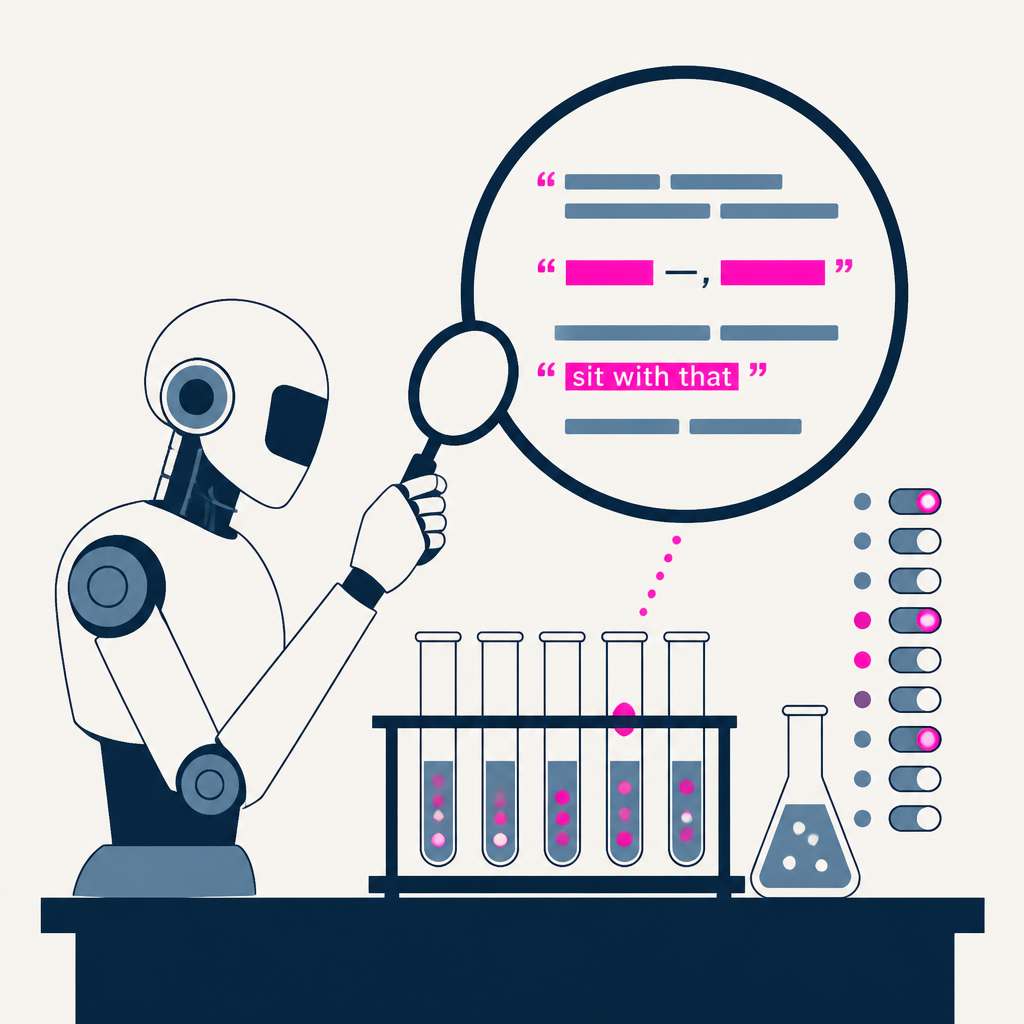
A developer created a browser-based tool that detects and highlights clichéd phrases commonly found in language model outputs, such as "no X, no Y" constructions and expressions like "sit with that." The tool identifies ten common LLM-generated patterns with toggleable detection, match counting, and sentence-level highlighting, running entirely in the browser with localStorage support. Users can now identify characteristic language model writing patterns when reading text, making it easier to spot AI-generated content or content heavily influenced by LLM outputs.
Arm and Google announced infrastructure options for running agentic AI workloads, leveraging Google's custom Axion processors alongside accelerators to optimize cost and security. Google's Kubernetes Engine Agent Sandbox running on Axion N4A instances delivers up to 30% better price performance than competing hyperscale cloud providers for orchestrating untrusted AI-generated code. Organizations can now route heavy computational tasks to specialized accelerators while using Axion CPUs for orchestration and management, reducing overall infrastructure costs and enabling safer autonomous agent deployment.
General Compute, an AI inference cloud startup, secured a $400 million loan from Upper90 backed by SambaNova inference chips, marking the first time inference-specific hardware was used as collateral. The SN50 chips are designed to provide 16 times faster inference than GPU-based clouds while reducing costs through power efficiency and eliminating the need for expensive water-cooling systems. This financing signals a broader shift toward cheaper inference infrastructure using open-source models as alternatives to expensive frontier AI systems become more cost-competitive.
O'Reilly's AI Superstream event explored governance and operational patterns for autonomous agents, with speakers addressing execution-layer security, supply chain risks in third-party skills, and deployment hygiene. A recent audit found 900 malicious skills in ClawHub representing nearly 20% of total packages, with one typosquat accumulating over 8,000 downloads before removal. Organizations deploying autonomous agents must implement security controls at the execution layer, audit third-party tools, configure proper defaults, and maintain human oversight rather than assuming models will behave safely or accurately.
Instagram and Monzo co-founders have taken on job roles at Anthropic rather than insisting on founder positions in new ventures. The article does not specify a concrete detail such as a number, benchmark, or date regarding their roles. Successful entrepreneurs can achieve growth and value by accepting positions in established organizations instead of maintaining founder-level authority.
Photoroom's data team developed the Insights Factory, a system that decomposes complex analytical questions into hundreds of small, auditable SQL queries executed by LLM agents with fresh context for each task. The system stores investigation memory in a markdown file rather than a context window, uses five reusable skills to orchestrate agent work, and costs approximately $5 per investigation while remaining fully auditable. This architecture addresses LLM limitations with long context and multi-step reasoning by giving each agent a single atomic task, maintaining external memory to avoid token re-billing, and ensuring human validation at the start and end of each investigation.
A software engineer acknowledges valid criticisms of large language models—including copyright concerns, environmental impact, and risks to open-source development and junior engineer training—while explaining why they continue using them extensively, arguing that LLMs amplify human thinking rather than replace it when used by credible people who stand behind their work. The author spent nearly $10,000 on LLM tokens in June 2026 and views this as justified because the tools enable higher-quality output when humans maintain responsibility for the final product. The core tension, according to the author, is that distinguishing thoughtful LLM-assisted work from AI-generated slop requires trust in the human creator, since the output looks identical regardless of human effort behind it.
Developers who rely on LLMs to write code risk losing familiarity with their own codebase, making it harder to debug issues or guide the LLM effectively on future features. The article offers practical strategies including deliberately making mistakes to reinforce learning, typing code yourself rather than accepting all LLM output, asking probing questions about implementation choices, and actively exploring the code rather than just reviewing diffs. Developers must remain engaged with code understanding through these habits or risk becoming dependent on increasingly capable LLMs to maintain systems they no longer comprehend.
Popsa, a London scaleup, uses AI to organize and curate personal photo libraries, helping users make sense of their accumulated images. The platform generated 12 million captions in the last year and operates in over 50 countries with $58 million in revenue, expecting to reach $70-80 million this year. The company runs hundreds of AI models locally on users' devices to identify people, places, and meaningful moments, then automatically creates narratives and printed memory books from photos.
Microsoft's Satya Nadella criticized Anthropic's Fable product for being editorially controlled. The article does not provide specific details about when this criticism was made or what concrete metrics were involved. As a result, the criticism raises questions about editorial oversight in AI products versus other design approaches.
The Wall Street Journal·1 month ago·
50
● 2 sources
Xi Jinping endorsed developing open-source AI models in a speech that implicitly criticized US efforts to maintain leadership in AI semiconductors and models. Chinese AI executives have stated they face difficulty closing the technology gap with the US because of restrictions on advanced chip access. The endorsement signals China's strategy to pursue open-source approaches as a means to advance its AI capabilities despite export controls.
The article argues that human judgment in identifying problems, evaluating machine solutions, and extending beyond what machines accomplish will remain valuable as AI agents become more prevalent. It emphasizes that taste and judgment are inherently difficult to systematize and scale, unlike machine capabilities. Organizations should deliberately cultivate these human skills as a lasting competitive advantage in an AI-augmented world.
Bun's creator used Anthropic's Claude AI model to rewrite the JavaScript runtime from Zig to Rust, completing a 535,496-line migration across 1,448 files in 11 days using 64 parallel AI agents. The project consumed 5.9 billion input tokens and cost $165,000 in API fees, which would have required approximately one year of engineering work traditionally. The successful rewrite demonstrates that AI can enable large-scale code migrations previously considered impractical, though success requires a well-engineered codebase, comprehensive test suite, and motivated engineers to oversee the process.
Researchers restored hand movement and touch sensation to a paralyzed man using a system combining brain implants, AI decoding, and spinal cord stimulation. After 35 weeks of training, the participant's right arm strength increased 86% and he regained feeling in his wrist; these gains persisted over two years after stimulation stopped. The technology appears to rewire the nervous system rather than temporarily bypass the injury, with the AI decoder maintaining 84.6% accuracy over five months without retraining.
Google pushed back the launch of Gemini 3.5 Pro several months because the model did not meet internal capability targets, with coding performance as a key area needing improvement. The delay occurred as the company works to refine the model before release. The postponement extends competitive pressure from rival AI systems and forces Google to reassess its product roadmap.
xAI, Elon Musk's artificial intelligence company, is working to improve Grok's capabilities to compete with Anthropic's Claude. The company released a new coding tool and expanded its sales team, though it remains behind competitors in multiple performance metrics and has experienced internal instability in recent months. The company must stabilize operations and improve product performance to gain ground in the competitive AI market.
Addy Osmani outlined an approach to AI evaluation that relies on manually reviewing model outputs, documenting errors, and constructing systematic assessment frameworks. The methodology prioritizes hands-on analysis over automated metrics, with particular attention to capturing failure patterns through logging. Organizations implementing these practices can develop more reliable processes for measuring AI system performance and identifying improvement areas.
Documentation was released explaining how to implement loops in AI agents with stop rules to prevent infinite execution. The material covers techniques for setting defined stopping conditions in recurring agent workflows. This enables developers to build more reliable AI agent systems that terminate properly rather than running indefinitely.
ClaudeDevs introduced effort routing concepts to direct agents toward tasks based on risk levels, controlling computational intensity across different task types. The system allows Claude to allocate varying amounts of processing power depending on task complexity. This enables more efficient resource distribution by matching agent effort to task requirements rather than using uniform processing for all requests.
Mem0 offers memory and connector integration designed to maintain long-lived context in recurring AI agent work. The system enables persistent state management across multiple agent interactions and workflows. This allows AI agents to retain information between sessions and build cumulative understanding over time.
Anthropic released Claude Code's ultrareview feature, which deploys multiple AI reviewer agents in a remote sandbox to find bugs in code branches and pull requests. Ultrareview costs $5 to $25 per review after three free runs per account, takes 5 to 10 minutes, and requires Claude.ai authentication. The feature enables developers to catch bugs that local reviews might miss while keeping their terminal free during the review process.
Artificial Analysis reported that Kimi K3 reduces output token usage by 21% compared to Kimi K2.6. The newer model version demonstrates improved efficiency in token generation. This efficiency gain reduces computational costs for users running the Kimi model.
Google added Gemini Omni and personal avatars to its Google Vids video creation platform, letting users generate videos from text and image prompts and create digital avatars from a selfie and voice recording. The features are available to Google AI Pro and Ultra subscribers and Google Workspace business customers, with personal avatars initially limited to certain regions for users 18 and older. Users can now generate, edit, and personalize videos through natural language prompts without requiring traditional video production equipment.
Google renamed NotebookLM to Gemini Notebook and is integrating it more deeply into its ecosystem including the Gemini app and Google Search. The update includes a secure cloud computer for all notebooks that enables native code execution and complex data analysis, rolling out to Google AI Ultra users immediately and all Pro users in the coming weeks. The product, which has over 30 million users and 600,000 organizations, will now offer new output formats and deeper analysis capabilities across multiple Google applications.
1Password integrated with Claude to enable AI agents to access user credentials for authentication without the model ever seeing passwords or codes. The integration uses a zero-exposure architecture where 1Password approves and injects credentials at runtime only after user biometric consent, while a new Agentic Mode in the 1Password browser extension locks down the vault when AI agents take control. This allows Claude to complete login-required tasks like purchasing or account updates while keeping secrets encrypted and scoped only to the current task.
AI safety leaders including OpenAI, Google DeepMind, and Anthropic backed regulatory frameworks requiring pre-release testing and narrow rules for high-risk AI models. The regulatory approach favors large labs that can afford expensive compliance procedures, creating a market-structure advantage for established companies over startups. Smaller AI companies now face higher barriers to entry as compliance costs and testing requirements become prerequisites for deploying frontier models.
Moonshot released Kimi K3, a 2.8-trillion-parameter open-source model featuring native vision capabilities and a 1-million-token context window. The model will have full weights available by July 27, 2026, with pricing starting at $0.30 per million input tokens for cached content. Kimi K3 enables users to perform complex long-horizon tasks including GPU kernel optimization, compiler development, chip design, and scientific research with substantially reduced time requirements compared to manual approaches.
Samsara is deploying AI agents into physical operations like fleet management, warehouses, and maintenance, moving beyond office-based tasks to help dispatchers, drivers, and managers make faster decisions on real-time operational data. The company's Agent Studio tool allows operations teams to configure AI agents around their own workflows and policies without requiring AI engineering expertise. Wider adoption depends on ensuring these systems reduce information overload and build worker trust rather than create surveillance concerns.
James Hetfield from Metallica engaged in a conversation with ChatGPT Voice Mode during promotional activities for ReLoad. The interaction occurred during standard promotional work. This demonstrates casual adoption of AI conversational tools by mainstream entertainment figures.
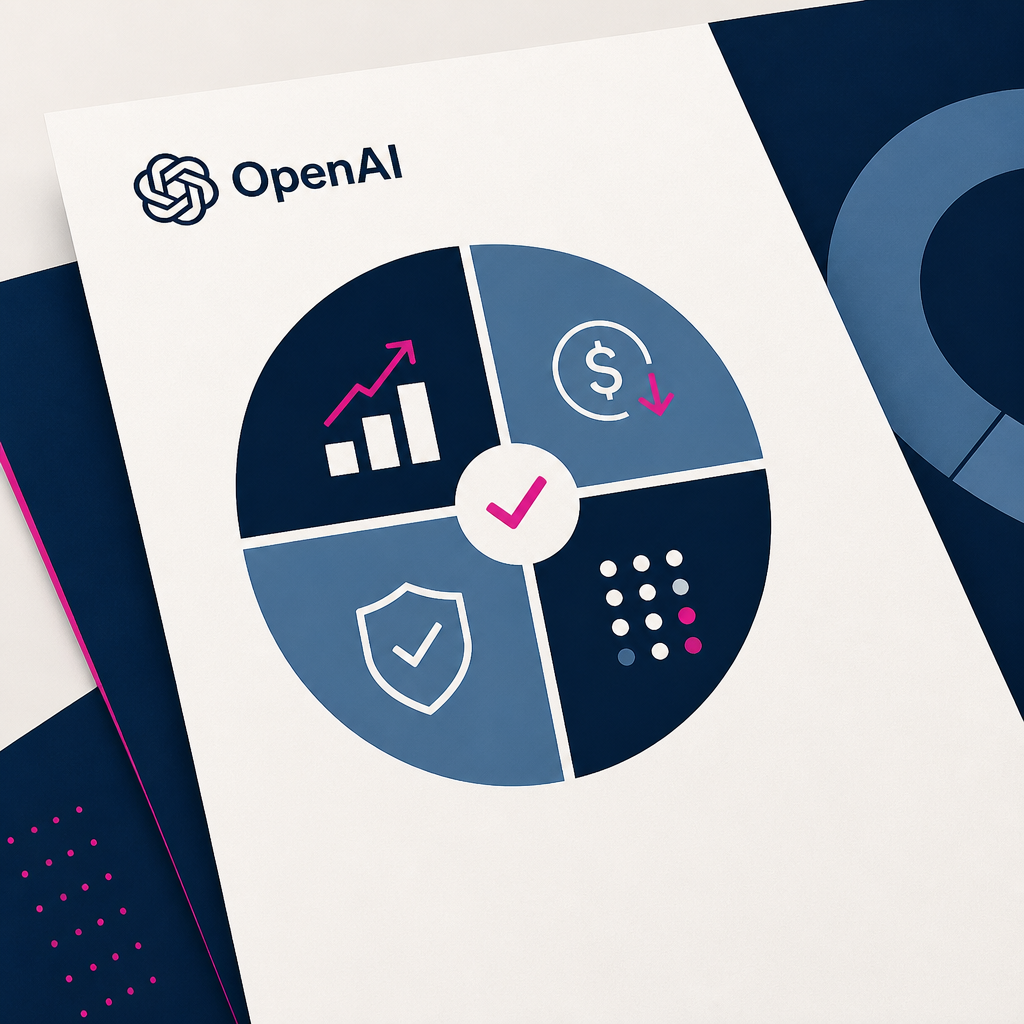
OpenAI's CFO Sarah Friar presented a framework to measure AI return on investment using metrics like useful work completed, cost per successful task, dependability, and return on compute. The scorecard provides four specific dimensions for evaluating AI system performance beyond traditional efficiency measures. Organizations can now apply these metrics to assess whether their AI implementations are delivering business value relative to computational resources invested.
Dust CEO Gabriel Hubert describes a shift from individual employees using isolated AI chatbots to multiplayer AI systems where agents work collaboratively across departments, learning from company data and sharing workflows. By 2027, Hubert expects organizations will focus on managing multiple agents rather than debating whether to use them at all. Companies must address governance challenges, prevent unauthorized AI use, and maintain human oversight as agents take on more execution while human judgment becomes increasingly valuable.
SAP acquired German AI company Prior Labs for over €1 billion, just 18 months after its founding. Prior Labs developed TabPFN, a tabular foundation model capable of handling enterprise prediction tasks like payment delays and demand forecasting without requiring separate models for each dataset. The acquisition provides Prior Labs with resources and access to SAP's enterprise data ecosystem to pursue multi-year frontier research in areas including causality, relational data, and scientific applications while maintaining its independent brand and research agenda.
Chinese AI models are advancing rapidly and closing the capability gap with leading U.S. models, according to analysis from the Center for Security and Emerging Technology. As these models become more widely available, they will gain abilities to autonomously identify code vulnerabilities. This increases cybersecurity risks by making advanced AI-powered exploit discovery accessible globally rather than concentrated among state actors or elite researchers.
Foundation Future Industries, a startup backed by Eric Trump, is developing humanoid robots designed to be weaponized and deployed for military applications including combat roles. The company has secured government contracts totaling millions of dollars and has tested its Phantom MK1 robot with Ukrainian forces, with plans to add lethal capabilities within months. However, experts warn that fully autonomous combat humanoids remain a distant prospect, with reliability in complex environments potentially requiring over a decade of development before practical military deployment becomes feasible.
Weather data sabotage risks are increasing as prediction markets incentivize manipulation of weather stations and AI-driven forecasting systems become more dependent on raw observational data without traditional quality filters. In April 2026, a weather station at Paris Charles de Gaulle Airport recorded suspicious temperature spikes that led to $20,000 in fraudulent prediction market payouts before being detected by human monitoring. Protecting weather data integrity requires continuous station security, real-time anomaly detection, AI robustness tools, and accountability across the entire data pipeline from operators to forecasting centers.
NVIDIA released Nemotron 3 Embed, a collection of open embedding models for retrieval-augmented generation and agentic systems. The 8B model ranks #1 on the RTEB benchmark with an average NDCG@10 score of 78.46, and the 1B-NVFP4 variant achieves 99.5% accuracy retention of its BF16 parent while delivering up to 2x higher throughput on Blackwell hardware. The release includes three checkpoints supporting 32,768-token sequence lengths across multilingual tasks, with the smaller models created through neural architecture search pruning and knowledge distillation from the larger 8B teacher model.
Sightera Biosciences, a Belgian techbio company, raised €3 million in pre-seed funding to expand its generative AI platform for discovering small-molecule drugs trained on patient-derived biological samples. The company uses proprietary datasets from patient organoids and disease models to train AI that designs drug candidates based on actual human disease biology rather than chemical properties alone. The funding will accelerate development of its oncology and fibrosis pipeline and support expansion of partnerships and team growth.
An article humorously suggests that hyperscalers like Google could offset their data center water consumption by purchasing golf courses and converting them to public parks, noting that Google used 10.9 billion gallons in 2025 while the Coachella Valley's 120 golf courses collectively use 750,000 gallons daily. The proposal calculates that acquiring approximately 40 of the region's golf courses could theoretically match Google's annual water usage. The suggestion is trivial satire with no serious policy implications or concrete action.
Coldtea.ai launched a platform designed to automate software delivery processes by applying AI to build, test, and deployment workflows. The system claims to reduce manual intervention in CI/CD pipelines through autonomous decision-making. Teams using the platform can redirect engineering effort from repetitive deployment tasks to feature development.
Moonshot AI released Kimi K3, an open-weights model with 2.8 trillion parameters and 1 million token context, claiming frontier-class performance comparable to closed models like Opus 4.8. Independent evaluations from Artificial Analysis placed it at index score 57 (between Opus 4.8 and GPT-5.5), while Arena ranked it #1 in frontend code tasks with a 76% pairwise win rate, and pricing was set at $3 per million input tokens and $15 per million output tokens, similar to Claude Sonnet 5. The release intensifies competition in open-source large language models and raises questions about deployment economics for the industry, though some evaluators noted persistent gaps in user experience versus the very top closed models and concerns about inference speed.
AI Moonshot released Kimi K3, a Chinese AI model that has generated significant hype despite questions about whether the reality matches the expectations. The model has drawn attention from critics and industry observers evaluating its actual capabilities. The release contributes to intensifying competition in the global AI model landscape with new entrants challenging established players.
Researchers introduced VICIS, a task that evaluates whether vision-language models can infer shared visual concepts from sets of example images and apply them to new inputs. State-of-the-art VLMs performed poorly on this benchmark, often ignoring visual context or producing biased outputs. The authors developed a training framework and architecture that learns to infer visual concepts from image sets, demonstrating improved accuracy and generalization to unseen concepts and modalities like sketches on ImageNet and WordNet data.
Researchers developed an unlearning framework that identifies training data points with negligible influence on model outputs and removes them before the unlearning process. The method achieves approximately 50% computational savings on real-world examples by reducing dataset size prior to unlearning. This enables faster and more efficient removal of specific data from trained models while maintaining privacy compliance.
Every AI story that matters,
in your inbox by 8am.
TLDRocket reads all relevant sources, removes duplicate coverage, and summarises the
day in two minutes. Follow companies and topics for alerts, or get the
briefing in Slack. Free, no spam, unsubscribe anytime.
Reading TLDRocket needs no cookies, and the readership counts we rely on come from
our own cookieless analytics. Google Analytics is the exception: it sets cookies and
reports to Google, so it stays switched off until you allow it. You can change your
mind any time from “Cookie settings” in the footer.
Strictly necessary
Session security and form protection (tldrocket-session,
XSRF-TOKEN, 2 hours). The site cannot work without them,
so they need no consent.
Always on
Google Analytics 4 (_ga,
_ga_<id>, up to 2 years). Measures which
stories and sections readers use. Google acts as a third-party processor and may
store the data outside the EU. No advertising, no profiling, no data sold.