The risk of weather data sabotage is rising
MIT Technology Review Monique Kuglitsch, Jesper Dramsch, Franz G. Kuglitsch, Andrea Toreti
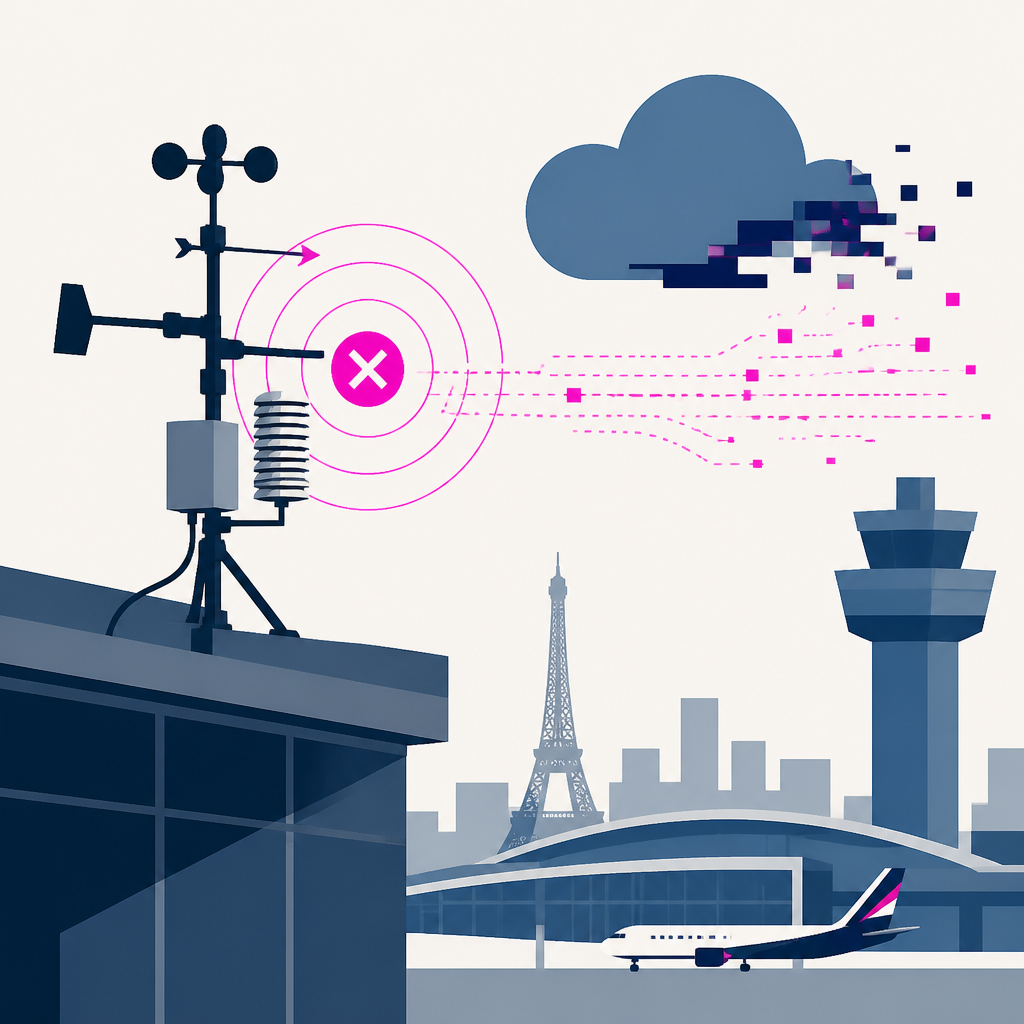
Someone tampered with a Paris airport weather station to fake a heat spike and win a betting payout. Experts warn AI forecasting makes this kind of manipulation harder to catch and more dangerous.
Based on reporting by MIT Technology Review, Monique Kuglitsch, Jesper Dramsch, Franz G. Kuglitsch, Andrea Toreti — read the original for the full story.
Summary, retelling and take written by AI under human oversight; images are AI-generated illustrations. How we work · Report an error
Weather forecasts feel like background noise until you realize how much rides on them. Farmers time planting around them, utilities price electricity based on them, and emergency agencies decide when to sound alarms. So when someone quietly tampers with the data feeding those forecasts, it's not a prank — it's a crack in infrastructure most people never think about.
That crack showed up earlier this year at Paris Charles de Gaulle Airport. On April 6 and April 15, 2026, the station there recorded temperature spikes that didn't match reality — readings near 22°C on days when it was actually closer to 18°C. Authorities suspect something as crude as a hairdryer or lighter near the sensor. Crude or not, it worked: bettors on weather prediction markets cashed in, one to the tune of $20,000. The only reason anyone caught it was a French climate nonprofit noticing something odd and raising a flag.
That's the reassuring part of the story. Traditional forecasting systems have built-in checks — data assimilation weighs each reading against physical models and nearby stations, and humans can catch outliers like the CDG spike. But those safeguards assume tampering happens at one station, in an obvious way, with someone eventually paying attention. Coordinated manipulation across many stations, each nudged just enough to look normal, is a different problem entirely. Verifying data and metadata takes time, and forecasts don't wait.
The push toward AI-driven weather models raises the difficulty further. These systems lean even harder on raw observational data, and researchers at ECMWF are already testing whether forecasts can skip the assimilation step altogether — removing one of the few filters currently standing between bad data and a bad forecast. Combine that with agentic AI systems increasingly used to make real-time calls during storms and other extreme events, and you get speed and efficiency, sure, but also a system with fewer humans positioned to notice when something's wrong.
The scenarios escalate from there. An individual gaming a betting market is one thing. Traders coordinating to bias renewable energy forecasts and shift wholesale electricity prices is another. And a state actor manipulating stations to trigger — or silence — an early warning system is a different category of problem altogether, one that edges toward national security. The authors argue the fix isn't exotic: keep watching the stations, build faster anomaly detection into the data pipeline, and make sure every link in the chain — from station operators to national weather services to forecasting centers — stays accountable to the others. None of that is glamorous. But the CDG incident got caught because a human happened to notice. Relying on happening to notice isn't a strategy.
My take — AI-written commentary, not fact-checked reporting
The CDG story is almost funny — a hairdryer near a sensor turning into a $20,000 payday — until you realize the same trick, scaled up and aimed at grid pricing or storm warnings, stops being funny at all. Betting markets have quietly created a financial incentive to mess with public infrastructure, and the industry's response so far seems to be hoping a nonprofit notices before disaster does. Stripping human oversight out of forecasting in the name of AI efficiency, right as the incentive to cheat is growing, looks like exactly the wrong moment to remove the people who caught this in the first place.
Read more about this at: MIT Technology Review