KAME: Tandem Architecture for Enhancing Knowledge in Real-Time Speech-to-Speech Conversational AI
Sakana AI
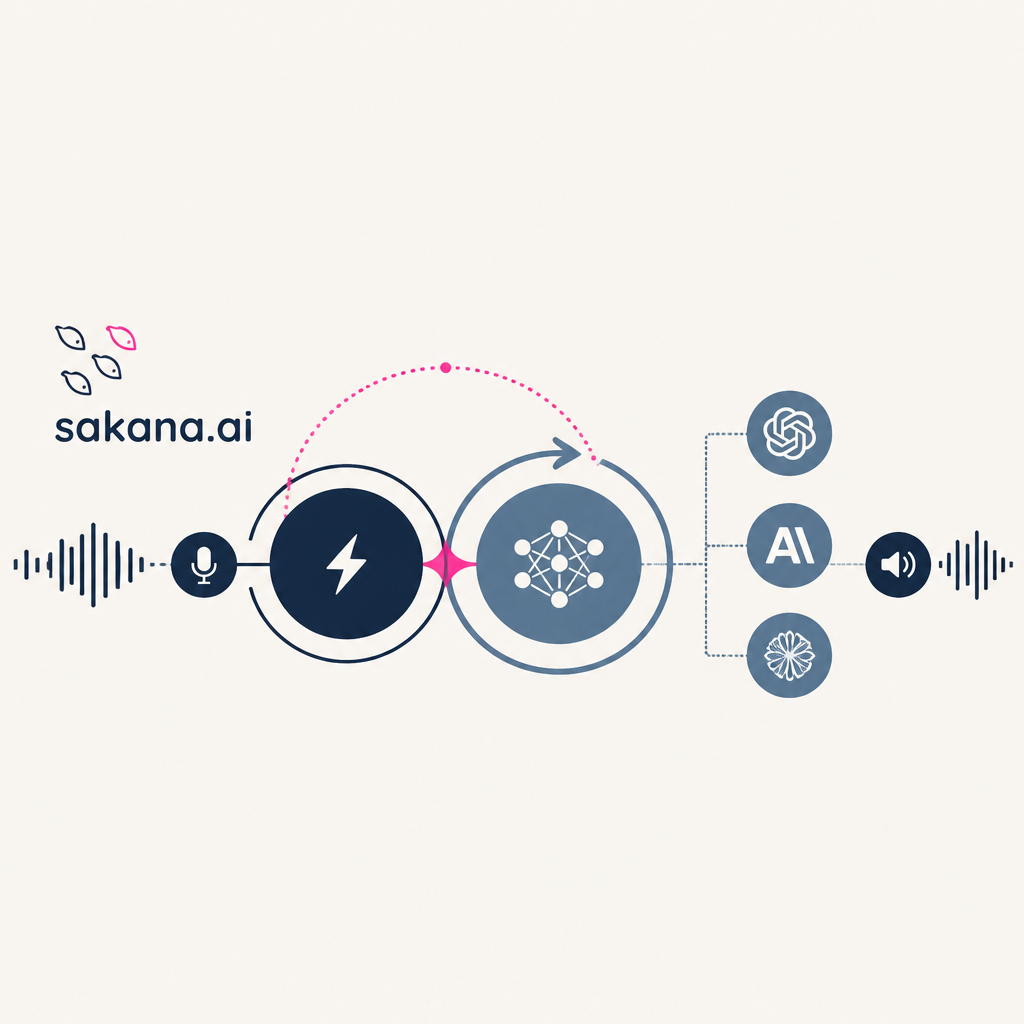
Sakana AI built KAME, a voice AI that starts talking instantly while a smarter backend LLM keeps feeding it better answers mid-sentence. It's a fix for the old choice between fast-but-shallow voice bots and smart-but-laggy ones.
Based on reporting by Sakana AI — read the original for the full story.
Summary, retelling and take written by AI under human oversight; images are AI-generated illustrations. How we work · Report an error
Anyone who has ever talked to a voice assistant knows the tension. Fast ones blurt out something quick and often dumb. Slow ones think it through with a big language model and then answer, but by the time they do, the conversation already feels broken. Sakana AI's new paper, accepted at ICASSP 2026, tries to close that gap with something they call KAME, Japanese for turtle, which is a funny name for a system built entirely around speed.
The trick is running two systems at once instead of one after the other. A speech-to-speech model handles the real-time back-and-forth, replying the moment it needs to, the way humans start talking before they've fully mapped out the sentence. Meanwhile, a separate backend LLM works in parallel, chewing on the harder reasoning and quietly injecting better response candidates into the fast model as they become ready. Sakana calls these injections oracle signals. The frontend never stops to wait for them, it just gets smarter as the conversation goes on.
What's notable is how modular the backend is. Sakana swapped in GPT-4.1, Claude Opus, and Gemini 2.5 Flash without touching the fast-response frontend at all, and each model showed different strengths. Claude edged ahead on reasoning-heavy questions, GPT-4.1 did better on humanities and softer topics. That kind of plug-and-play flexibility matters more than it might seem, since it means a product team could route different conversation types to whichever backend model performs best, without redesigning the real-time layer every time a better LLM ships.
The bigger idea here is a shift in how these systems are framed. Instead of "think, then speak," which is basically what cascaded pipelines do and why they lag, KAME aims for "speak while thinking." It's a small phrase but it captures something real about how conversation actually works for us, and it suggests Sakana is chasing a fairly practical goal: voice AI that doesn't feel like it's on a satellite delay every time you ask something that requires actual thought.
My take — AI-written commentary, not fact-checked reporting
I like this because it treats latency as the actual product problem it is, rather than something to paper over with a faster but dumber model. The swappable-backend design is the smart part — it turns the frontier LLM race into an ingredient you can substitute instead of a bottleneck you're stuck with, which is exactly the kind of architecture that ages well as GPT, Claude, and Gemini keep leapfrogging each other.
Read more about this at: Sakana AI