Digital Ecosystems: Interactive Multi-Agent Neural Cellular Automata
Sakana AI ● Covered by 2 sources
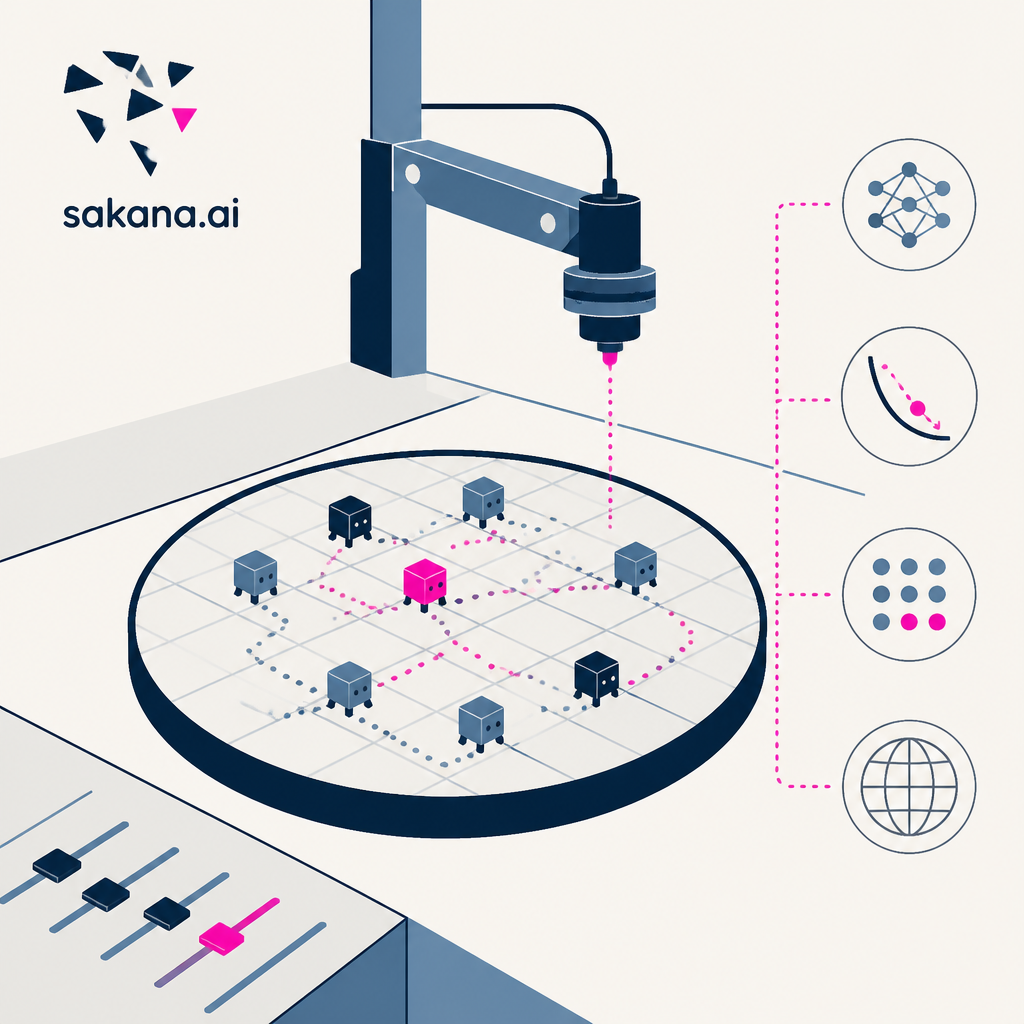
Sakana made a live grid where tiny neural nets battle for turf, learning as they go. Learning keeps the chaos stable, so you can poke it in real time.
Based on reporting by Sakana AI — read the original for the full story.
Summary, retelling and take written by AI under human oversight; images are AI-generated illustrations. How we work · Report an error
Sakana AI has a habit of building tiny, weird worlds instead of bigger models, and its latest release keeps that streak alive. Digital Ecosystems is a browser-based artificial life sandbox where dozens of small convolutional neural networks live on the same 2D grid, each one blind to everything beyond its own 3x3 patch of cells. There's no central controller, no master strategy. Each species just tries to survive: grabbing territory from neighbours, defending its patch, and adjusting its behaviour on the fly through gradient descent while the simulation is running.
The interesting finding isn't that the networks compete — that was the plan. It's what the learning process ends up doing to the system as a whole. Sakana's team noticed that gradient descent doesn't just tune each species' individual strategy in isolation; it functions almost like a thermostat for the entire grid. When a species gets too aggressive and overextends, its own loss function starts pulling it back. When one stalls out and stagnates, the same mechanism nudges it to expand again. The result is a self-correcting system that can be pushed toward the 'edge of chaos,' that fragile zone where complex, unpredictable behaviour emerges without the whole thing collapsing into either stasis or total anarchy.
That stability is what makes the platform usable as a toy rather than just a research artifact. Users can draw walls straight into the grid to carve out artificial niches, erase entire regions mid-simulation to see how species recolonize, and fiddle with more than 40 parameters governing growth, attack, and defense. Because the learning keeps rebalancing things in the background, you can crank settings toward genuinely chaotic territory and the ecosystem still holds together, reorganizing itself around whatever damage or new terrain you throw at it.
This builds on Sakana's earlier Petri Dish NCA project, but the shift here is significant: last time the neural networks were the organisms being observed, this time the learning itself is doing structural work, acting less like an optimizer and more like a stabilizing force for a living system. It's also entirely client-side — no install, no backend, just a browser tab and some patience for watching pixels colonize each other.
My take — AI-written commentary, not fact-checked reporting
I like this precisely because it isn't chasing benchmark supremacy or another 'frontier model' press release — it's small, weird, and runs in a tab on your phone, which is the kind of open, poke-at-it research culture I wish more labs still had time for. The real finding, that learning stabilizes emergent chaos rather than just optimizing toward a goal, is a much bigger deal for anyone thinking about self-organizing AI systems than another leaderboard score, and I bet half the industry will ignore it because there's no eval to screenshot.
Read more about this at: Sakana AI