
Learning to Orchestrate Agents in Natural Language with the Conductor
Sakana AI
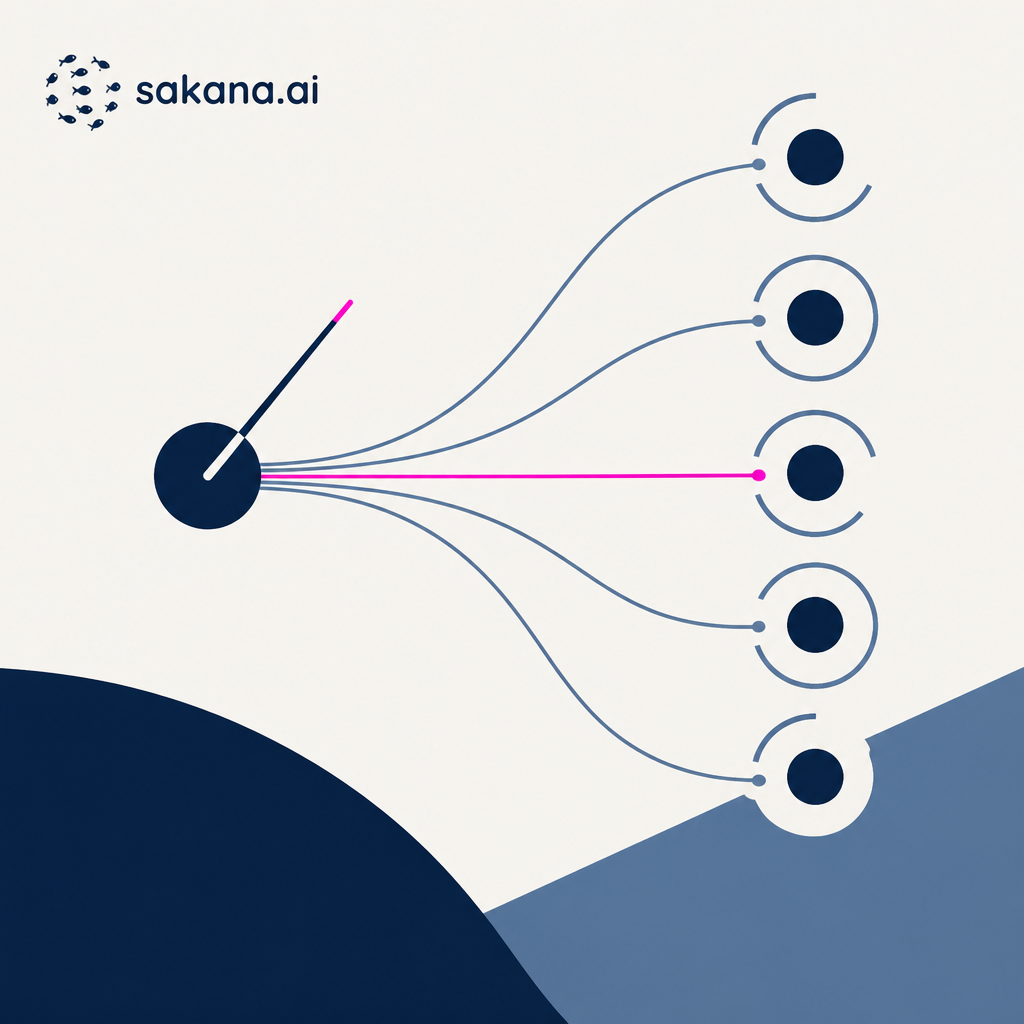
Sakana AI trained a small 7B model to boss around GPT-5, Gemini and Claude like a manager instead of solving tasks itself. It beats every model it's directing and even catches its own mistakes mid-task.
Based on reporting by Sakana AI — read the original for the full story.
Summary, retelling and take written by AI under human oversight; images are AI-generated illustrations. How we work · Report an error
Prompt engineering has always been a human chore: figuring out the exact wording that gets an LLM to behave. Sakana AI's latest paper flips that job onto a machine. They built a 7B parameter model called the Conductor and trained it with reinforcement learning to write natural-language instructions for a whole roster of other models, essentially teaching it to manage a team rather than do the work itself.
The setup is deceptively simple. Instead of running code or picking a single model to answer a query, the Conductor writes out a workflow in plain English, deciding who does what, in what order, and how the pieces fit together. Its pool includes GPT-5, Gemini, Claude, and various open-source models that were available in the run-up to ICLR 2026, where the paper was accepted. For an easy factual question, the Conductor just asks one model and moves on. For a gnarly coding problem, it builds its own pipeline of planners, coders, and verifiers on the fly, no human template required.
The numbers back up the idea. The Conductor beat every individual worker model in its pool, hitting 83.9% on LiveCodeBench and 87.5% on GPQA-Diamond, both records at time of publication. It also outpaced pricier multi-agent setups like Mixture-of-Agents while spending far less compute, which matters given how quickly multi-agent inference costs can spiral.
The detail that stands out most is what Sakana calls recursive test-time scaling. The Conductor can nominate itself as one of the workers, read back its team's earlier output, notice when something went wrong, and then spin up a fix-it workflow without being told to. That's a genuinely new lever for scaling compute at inference time, separate from just throwing bigger models or more tokens at a problem.
Sakana frames this as proof that language models can become their own meta-prompt engineers, and they're already folding the idea into a broader system called Fugu, alongside their earlier Trinity work. Whether Conductor-style orchestration becomes a standard layer above frontier models, or just a clever research demo, probably depends on how well it holds up outside curated benchmarks.
My take — AI-written commentary, not fact-checked reporting
This is the most interesting kind of automation: not replacing the model, but replacing the human middleman who spent two years writing chain-of-thought prompts by hand. If a 7B model can out-orchestrate GPT-5 and Claude just by talking to them better, that's a quiet admission that a lot of "prompt engineering" was never that deep to begin with, it was pattern-matching that RL can learn faster and cheaper than we can.
Read more about this at: Sakana AI
Related stories
 Sakana AI Agent Wins AtCoder Heuristic Contest (First AI to Place 1st)
Sakana AI ·
9
Sakana AI Agent Wins AtCoder Heuristic Contest (First AI to Place 1st)
Sakana AI ·
9
 AI Agent Wins First Place in Optimization Programming Contest
Sakana AI ·
8
AI Agent Wins First Place in Optimization Programming Contest
Sakana AI ·
8