
[Yomiuri Shimbun] Sakana AI's Proprietary System Visualizes "Cognitive Warfare" on SNS
Sakana AI ● Covered by 2 sources
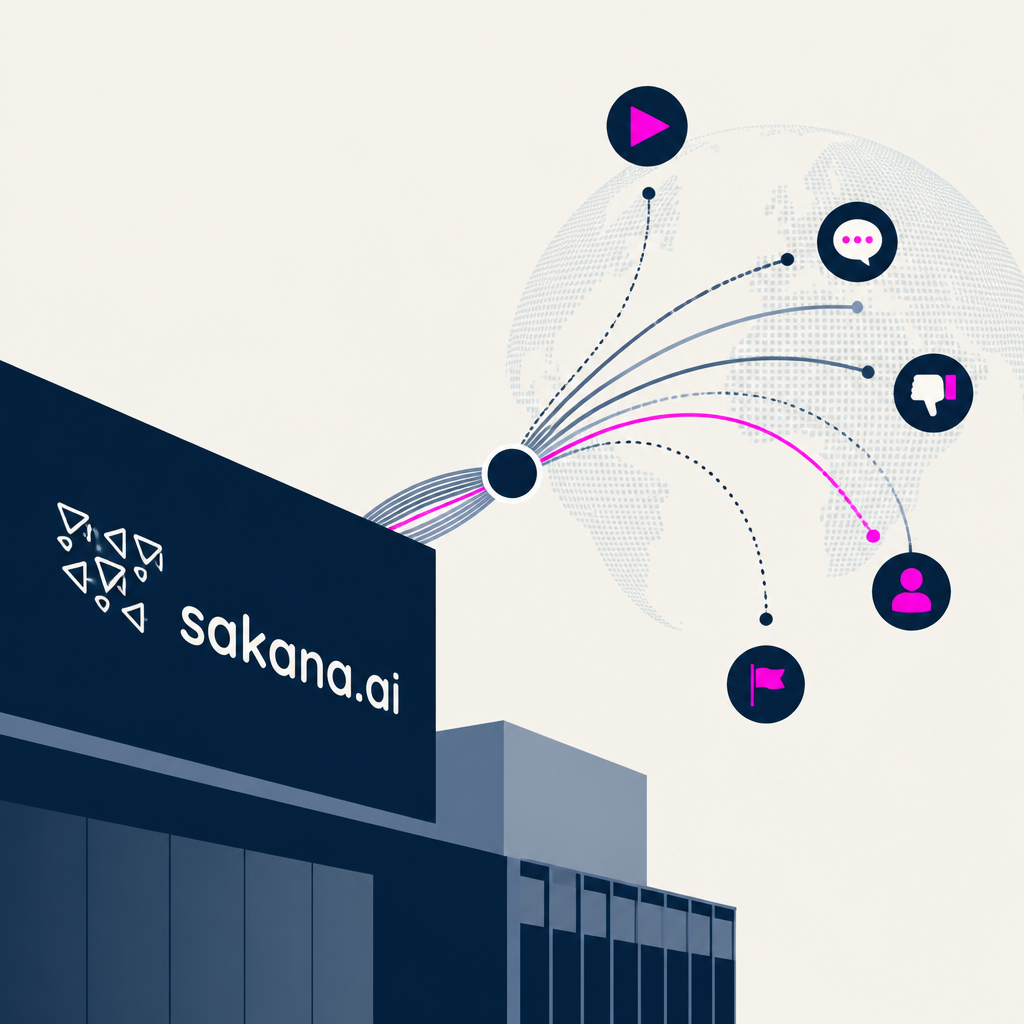
Sakana AI teamed with a major Japanese newspaper to build an AI system that maps online criticism campaigns from China. It caught hidden political narratives that plain keyword searches would have completely missed.
Based on reporting by Sakana AI — read the original for the full story.
Summary, retelling and take written by AI under human oversight; images are AI-generated illustrations. How we work · Report an error
Sakana AI just showed off a tool built for a very specific, very modern job: reading the internet's mind during a diplomatic spat. Working with The Yomiuri Shimbun, the Tokyo-based startup ran its proprietary system over 1.1 million social media posts tied to Chinese criticism of Japan, and the results went well beyond a simple sentiment count.
The interesting part isn't the volume of data, it's what the system pulled out of it. Take a post demanding that a Japanese official retract a supposedly erroneous statement. A keyword search for "Taiwan" would find nothing there. But Sakana's system flagged it as part of a broader narrative about interference in the Taiwan issue, connecting dots that live in implication rather than explicit text. That's the whole pitch: context and nuance over brute-force pattern matching.
Under the hood, three different large language models work in tandem, cross-checking each other to surface granular narratives before clustering them into bigger thematic groups. That layered structure lets analysts zoom from thousands of individual posts up to a handful of dominant storylines, which is presumably the only way to make sense of over a million posts without drowning in them. From there, the AI generates hypotheses with supporting evidence attached, and human analysts pick through them, asking for more digging where something looks promising and discarding what doesn't hold up.
One hypothesis to come out of this run: that Chinese criticism of Japan escalated only after officials debated a coordinated response following remarks by Prime Minister Takaichi in the Diet. Yomiuri reporters didn't just take the AI's word for it. They went and interviewed government sources on both sides and consulted outside experts to confirm the timeline actually held up, which is a good reminder that even sophisticated AI output still needs old-fashioned shoe-leather verification before anyone treats it as fact.
Sakana frames this as a template for a new kind of intelligence work, where AI surfaces patterns humans would never catch by hand, and humans stay in the loop to stress-test and act on them. The company is now naming defense and intelligence as a core business line alongside finance, language that signals it wants a piece of Japan's growing appetite for AI-driven information warfare tools, not just chatbots and coding assistants.
My take — AI-written commentary, not fact-checked reporting
Cognitive warfare analysis is a legitimate and probably overdue use of LLMs, but I'd watch how fast "detect foreign narratives" tooling turns into "detect any narrative we don't like" once governments start funding it directly. Sakana pairing this with a real newsroom doing independent verification is the right instinct — the moment AI-generated hypotheses get treated as finished intelligence instead of leads, this stuff turns dangerous fast.
Read more about this at: Sakana AI
Related stories
 Sakana AI Wins Award at US-Japan Competition for Defense Innovation
Sakana AI ·
48
Sakana AI Wins Award at US-Japan Competition for Defense Innovation
Sakana AI ·
48
 Sakana AI Begins Commissioned Research from Defense Innovation Science and Technology Institute
Sakana AI ·
13
Sakana AI Begins Commissioned Research from Defense Innovation Science and Technology Institute
Sakana AI ·
13
 Sakana AI Wins Contract for Survey and Proof-of-Concept of AI Functions Needed for Comprehensive Analysis Work from the Ministry of Defense
Sakana AI ·
24
Sakana AI Wins Contract for Survey and Proof-of-Concept of AI Functions Needed for Comprehensive Analysis Work from the Ministry of Defense
Sakana AI ·
24