Zvi (Don't Worry About the Vase)
·
2 weeks ago
● 7 sources
OpenAI released GPT-5.6-Sol and upgraded its voice mode, while Anthropic extended Claude Fable 5 access through July 12, and Grok 4.5 launched with 1.5 trillion parameters at $2/$6 pricing. Early testers report Sol and Fable represent significant jumps over previous models, with users finding distinct advantages for each depending on task type. The new voice mode and model improvements are reshaping how people interact with AI systems and the competitive landscape among top model providers.
Ben's Bites
·
2 weeks ago
● 5 sources
SpaceX AI and Cursor released Grok 4.5, an Opus-class model that performs between Claude Opus 4.7 and 4.8 while costing 6 times less than Opus models and 3 times less than GPT-5.5. The model processes tokens at a lower cost per unit while maintaining comparable performance, with availability through Cursor with increased limits and via API. This pricing structure makes it a competitive alternative for developers seeking cheaper inference costs without sacrificing model capability.
OpenAI Blog
·
2 weeks ago
Microsoft has made GPT-5.6 the default model in Microsoft 365 Copilot across its office applications. The model is now integrated into Word, Excel, PowerPoint, Chat, and Cowork. Users of these applications will experience faster processing and improved output quality for AI-assisted tasks.

TLDR
·
2 weeks ago
Meta is testing prototype smart glasses that continuously photograph the wearer's surroundings without requiring manual activation or displaying an LED indicator. The glasses would capture photos every few seconds and use the data to train AI systems, with internal disagreement at Meta over whether to store full images or only metadata on its servers. The shift represents a significant escalation from Meta's current smart glasses, which require voice or button activation to record and display a lit indicator when active.

TLDR
·
2 weeks ago
● 5 sources
SpaceXAI released Grok 4.5, a new AI model positioned as comparable to Anthropic's Opus in capability. The model costs $2 per million input tokens and $6 per million output tokens, roughly one-third the price of Opus 4.7 while claiming twice the token efficiency of competing models. This pricing advantage could reduce operational costs for companies deploying AI for routine knowledge work including coding, research, and writing tasks.
OpenAI Blog
·
2 weeks ago
● 2 sources
ChatGPT Work is an agent designed to execute tasks across multiple applications and files while maintaining focus on a single project for extended periods. The agent can operate for hours on sustained projects without losing context or requiring manual intervention between steps. Users can now delegate complex, multi-step work to ChatGPT rather than managing each application switch and file operation manually.
The Neuron
·
2 weeks ago
● 6 sources
OpenAI launched GPT-Live, which converts voice input into a practical interface rather than a demonstration feature. The system supports live tutoring, interview preparation, sales practice, and real-time language learning without specified performance metrics or availability dates. Users can now practice conversations and receive immediate feedback across educational and professional training scenarios.
The Neuron
·
2 weeks ago
● 6 sources
The article provided contains only pricing tables and technical details without narrative content describing what GPT-Live is, when it launched, or what changes result from its availability. The title claims GPT-Live is now available on iOS, Android, and ChatGPT.com, but the article text does not support or expand on this announcement.
The Neuron
·
2 weeks ago
● 6 sources
OpenAI is making GPT-Live-1 the default voice model for Go, Plus, and Pro subscription tiers. Free users will receive GPT-Live-1 mini, while Business, Enterprise, and Education users will not have access to Live at launch. This tiering means paid subscribers get the full-capability voice model while other user categories face either reduced functionality or no access.
Latent Space
·
2 weeks ago
● 5 sources
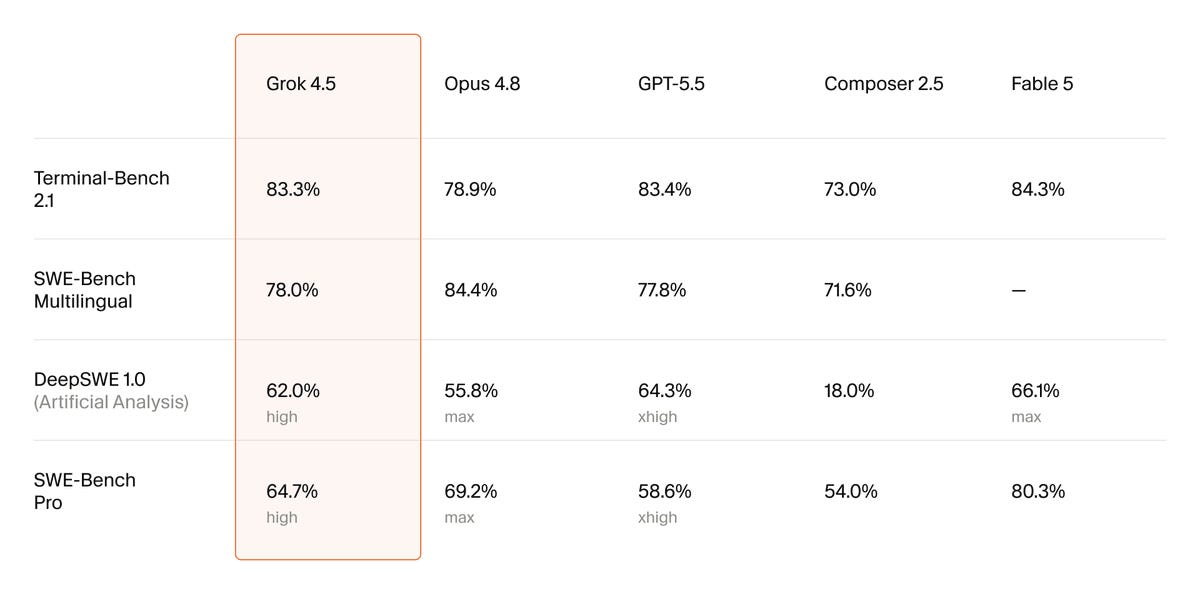
SpaceX's xAI launched Grok 4.5, a coding-focused frontier model developed in partnership with Cursor, positioned for cost-efficiency and speed rather than benchmark supremacy. The model costs $2 per million input tokens and $6 per million output tokens, with a 1.5 trillion parameter size that is 3 times larger than its predecessor Grok 4.3. Grok 4.5 becomes available immediately across Grok Build, the Cursor IDE, and various API platforms, competing directly with Anthropic's Opus and OpenAI's GPT models in the coding-agent workflow market.
