
NVIDIA Open Models Power a New Wave of European Public Sector Projects
NVIDIA Blog Eva-Maria Hempe ● Covered by 2 sources
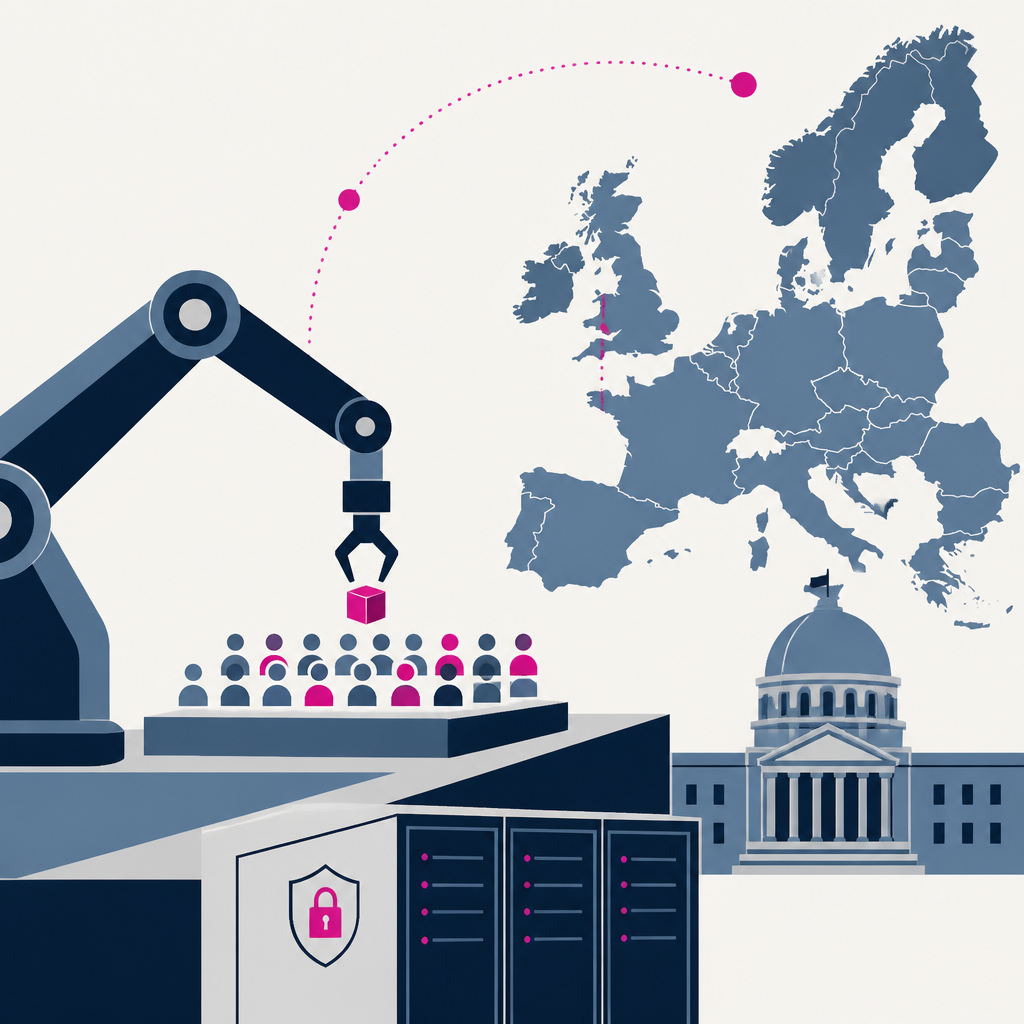
NVIDIA is pushing open AI models into European government projects. The pitch: keep data local, tune models to each country, and still get useful tools.
Based on reporting by NVIDIA Blog, Eva-Maria Hempe — read the original for the full story.
Summary, retelling and take written by AI under human oversight; images are AI-generated illustrations. How we work · Report an error
NVIDIA is leaning hard into a simple message: governments want modern AI, but they don’t want to hand over the keys to their data. Across Europe, it’s backing public-sector projects built around open models, local infrastructure and controls that stay inside national or organizational walls.
In Brussels, Berlin-based deepset is expanding Haystack Enterprise Platform for AI@EC, the European Commission’s shared system for building and running AI apps on commission-managed infrastructure. The new setup ties together agent development, execution, optimization and governance, and adds tools for comparing operating costs, checking answer quality and tracing problems. NVIDIA Triton Inference Server supports the shared retrieval services underneath it. The broader idea is familiar, but the mechanics matter: reusable components, role-based access, audit trails and guardrails are already part of deployments like AI@EC.
Poland is taking a more operational route. Deloitte is helping build agentic systems for healthcare and employment services, while the eHealth Centre is using NVIDIA DGX BasePOD and the MONAI framework for medical imaging. That system is meant to help physicians read X-rays, CT scans and MRI images, spot abnormalities and move urgent cases up the queue. Separately, Poland’s Ministry of Family, Labour and Social Policy is working on an agentic factory for more than 400 labor offices, using models including PLLuM, GPT OSS and Inkling for document search, summarization and digital assistants.
The pattern repeats elsewhere. In the U.K., Locai Labs released Nemotron-Personas-UK, a dataset of 1 million synthetic personas built to reflect demographic and geographic diversity while reducing privacy risk. In Germany, Materna is building Sinfonie, an on-premises platform with generative AI, voice interaction and 3D avatars, while secunet, NVIDIA, Red Hat and deepset are working on a sovereign cloud offering for classified information. France’s CANUT selected LINAGORA and Docaposte for a sovereign collaborative workspace, and Greece’s KIEFER is building an agentic factory with Greek-language tools. Different countries, same demand: useful AI, but on their terms.
That’s the real story here. Europe is not asking for bigger chatbots; it is asking for controllable ones. NVIDIA seems to understand that the procurement team, not the demo video, is the audience that matters.
My take — AI-written commentary, not fact-checked reporting
This is the rare AI strategy that sounds like it was written by someone who has actually met a public procurement office. Open models plus local control is the right answer for governments, because “trust us” is not a security policy. The amusing part is how often the industry still treats sovereignty like a branding exercise instead of the main event.
Read more about this at: NVIDIA Blog
Related stories
 European Cities Deploy NVIDIA-Powered AI Agents to Run Smarter Urban Operations
NVIDIA Blog · 1 week ago ·
4
 NVIDIA Cloud Partners Scale Across Europe — Sovereign, Open and Built for Safe AI Agents
NVIDIA Blog · 1 day ago ·
2
 NVIDIA Expands Advanced Technology Access for Europe’s Scientific Community Through Open Learning Resources, Collaborations and Compute
NVIDIA Blog · 1 week ago ·
34