Amazon Bedrock added cross-Region inference support for OpenAI GPT-5.6 models across more than 25 AWS Regions using inference profiles that route requests to destination Regions. GPT-5.6 variants Sol, Terra, and Luna have a 1 million token context window. This lets apps scale across a larger compute pool for higher throughput (and choose US geographic or global routing) without changing the request APIs aside from using the inference profile ID.
GitHub reported an August 17 outage that lasted almost eight hours as its platform hit new scaling limits and the failure cascaded into authentication issues and service disruption.
GitHub now sees 2.9 billion commits per month, up from 1.4 billion in April.
It is accelerating migration to Azure (58% of platform load), adding 3 million CPU cores and 120 petabytes of high-speed storage, and changing retry limits, timeouts, and reducing shared dependencies to prevent cascading load.
Amazon SageMaker Canvas connected to a Snowflake fraud dataset, prepared features with Data Wrangler’s visual transformations, and exported a training dataset to build a fraud detection model.
Callosum announced a $100 million funding round to support its cloud service, Tailored Inference, for optimizing AI inference workloads. Tailored Inference claims it can complete some inference tasks 3.7 times faster than GPT-5.6 Luna while improving output quality. The funding enables it to further route task steps to different models and deploy them to the most efficient chips, including integration with Cerebras WSE-3 Turbo accelerators.
Liquid Death and Jason Kelce ran a joke campaign suggesting people’s urine could be used to cool AI data centers, while experts noted that data centers can already rely on non-potable sources like recycled water. Meta will invest at least $270 million in wastewater infrastructure near its data centers. The focus shifts from a prank to scaling recycled-water infrastructure, including possible government support such as a 30% tax credit to expand treatment capacity for data center cooling.
Runlayer and Rippling dropped their lawsuits against each other without any settlement or payments. Court documents cited by TechCrunch say no money changed hands and no lawyers’ fees were paid. The firms instead moved on publicly with Rippling releasing its MCP gateway, highlighting a caution that AI product competition can shift quickly during legal disputes.
Supermicro’s Open Storage Summit discussion focuses on storage modernization to remove bottlenecks that limit enterprise AI readiness on legacy infrastructures. The interview cites GPU utilization averaging 30% to 50% as a key driver for choosing lower-latency, higher-performing storage stages, including QLC SSDs and NVMe over Fabrics. The work shifts enterprises toward composable, standardized storage stacks with software data orchestration and flash tiers that can feed AI workloads more efficiently and reduce data copy/migration.
OpenSearch introduced new alerting capabilities in its Observability Stack, adding Piped Processing Language (PPL) and a unified Alert Manager for more advanced alert conditions and centralized rule handling. PPL and the Alert Manager are scheduled to be covered in a live session on September 10, 2026. These changes aim to reduce false-positive triage by enabling multi-signal correlation across logs, metrics, and traces and by routing, suppressing, and escalating alerts from one interface.
Stripe confirmed it has tabled a bid to acquire OpenRouter, an AI model gateway platform focused on routing and token spending for AI requests. The reports it cited place the acquisition price at $8 billion. Once the deal closes, Stripe will own OpenRouter, but OpenRouter says its brand, product, roadmap, and model-neutral approach will stay in place while its routing layer becomes part of Stripe’s AI billing infrastructure.
Liquid AI released DSpark draft model checkpoints for three LFM2.5 models, adding a speculative-decoding path intended to speed up inference without changing greedy output quality. The LFM2.5-2.6B checkpoints reportedly cut multi-tool function-calling latency by an average of 57% while also delivering up to 2.87x on-device throughput on an M4 Max. This results in day-one DSpark support in llama.cpp and SGLang and open-source LFM-compatible integration plus faster throughput across the listed benchmarks.
Ramp launched its AI model routing service, Router, letting users switch between large language models via an API. The service is free through the remainder of 2026 and includes a $26 launch credit. Router adds model-selection strategies and a dashboard while recording inputs/outputs/tool calls for one year by default unless users opt out, and it does so only in the United States.
The post outlines architectural patterns for scaling agentic (multi-agent) AI across enterprises without locking teams to a single framework or model provider. It is Part 2 of a series on multi-agent systems at scale. It recommends standardizing below the application layer with shared control-plane capabilities (like identity, policy, observability, and routing) and using AWS services—especially SageMaker for customization/inference and Bedrock for foundation-model access—to reduce fragmentation while letting execution remain flexible.
AWS Professional Services describes a multi-agent setup on Amazon Bedrock AgentCore that applies agentic AI across application discovery, infrastructure-as-code generation, governance reporting, and post-migration operations. The agents reduced infrastructure-as-code development time from 3–4 weeks per application to minutes across a portfolio of over 300 applications. As a result, migration teams shift repetitive work from engineers to the agents while keeping decision authority, and post-migration operations move toward proactive monitoring and automated remediation instead of reactive firefighting.
AWS is positioning “AWS vector solutions” as a way to add retrieval for agentic AI without moving or duplicating data across systems. The announcement highlights that Amazon OpenSearch Serverless autoscales 20x faster than its previous generation and can provision in seconds. As a result, teams can choose among different AWS vector engines (including OpenSearch, S3 Vectors, and DynamoDB vector search) to match latency, cost, and access patterns for RAG and semantic retrieval workloads.
Amazon Bedrock was used to build intelligent security monitoring for FHIR APIs that evaluates requests against user history, role, and data sensitivity. The deployment is estimated to take 10–15 minutes. The result is context-aware anomaly detection, automated sensitivity classification, and natural-language compliance reports added asynchronously without increasing API latency for clinical workflows.
Token-efficient multi-agent systems article argues that production costs come less from the model itself and more from workflow inefficiencies like repeated retrievals, duplicate prompts, oversized contexts, and redundant model calls. It proposes a context budget capped at 2500 tokens when building the context for the final LLM call. The recommended architecture changes by adding routing, semantic caching, single retrieval shared across agents, context budgeting, token estimation telemetry, and model selection so the LLM is used only as a final, most-expensive step.
The article argues that SpaceX’s proposed “AI1” orbital data center megaconstellation would create a new kind of e-waste by disposing of satellites outside recycling and, at least in part, by deorbiting them to burn up in Earth’s atmosphere. About 40,000 satellites would be deorbited under the May 29 FCC filing, and GPU lifetimes of roughly five years imply around 200,000 would be decommissioned annually. As a result, material value would be removed from Earth’s material life cycle, with dispersed re-entry debris and potential long-term ozone impact from components like aluminum.
Big Tech is shifting AI competition from improving large language models to financing and operating the AI infrastructure that supports many interchangeable models. Since the AI boom began in 2023, Amazon, Microsoft, Alphabet, and Meta have collectively put $1.1 trillion into AI infrastructure. As a result, cloud providers and Wall Street financing are capturing returns while software buyers delay purchases and some investors question whether the spending will ultimately pay off.
Ypsilanti Township in Michigan approved a six-month moratorium to pause major electric utility infrastructure as it continues opposing a data center backed by the University of Michigan and Los Alamos National Laboratories. The delay lasts 180 days. The power authorities are required to use the moratorium period to study noise pollution and customer impacts before building the needed substations, shifting the project timeline.
Ben’s Bites reports poll results and argues that personal AI agents mostly consist of a folder of files plus tools wired into an agent platform. The post references 996 total votes in its poll about whether readers use a personal agent. It shifts the focus from complex agent systems to setting up a simple “personal agent” by organizing context files and pointing to whichever tool the user prefers, with Slack and other apps positioned as more collaborative interfaces for agents.
Edge Kubernetes deployments are bogging down teams with many snowflake clusters that require per-cluster audits and manual fixes when updates or security patches are needed. CNCF’s 2025 Annual Survey says 66% of organizations are running generative AI workloads on Kubernetes. Moving to fleet management treats clusters as a centrally governed unit with standardized lifecycle, pull-based GitOps reconciliation during connectivity loss, and fleet-scale observability and policy enforcement.
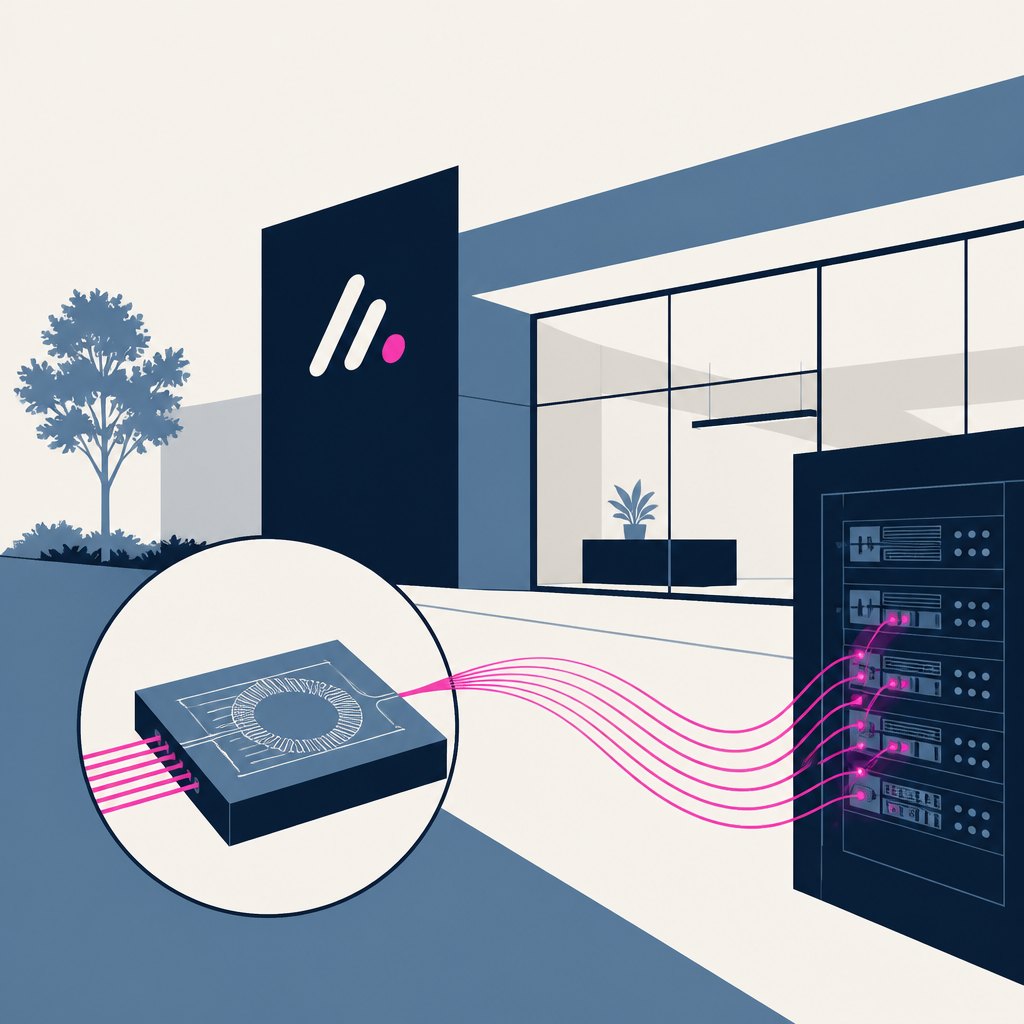
Solinide Photonics raised seed funding to commercialise its silicon nitride photonic integrated circuit and microcomb technology for optical interconnects in AI data centres. The company secured €4 million and says its microcomb tech has been demonstrated in a rack-mounted system. This lets it expand teams, improve prototyping, and prepare scalable European manufacturing for real-world deployment.
Fractile entered advanced talks to raise $600M at a $6.5B pre-money valuation after securing a $250M AI inference chip deal with Anthropic. The talks would value the company at six times its May valuation. The higher valuation is tied to demand for inference hardware despite Fractile’s chips not shipping until 2027, increasing pressure as it competes with other inference-chip and system vendors.
The Sequence publishes an opinion on how future AI scaling is governed by real-world energy systems instead of just model parameters. Issue 918 focuses on energy conversion efficiency from photons and atoms into intelligence. It reframes AI “scaling laws” to include how power, cooling, and network losses limit what the next wave can achieve.
Waymo published details about the compute “brain” inside its robotaxis, including chip architecture, processor specifications, and internal components. The system is described as performing up to one quadrillion operations per second. The disclosure adds public information about the hardware powering its driverless fleet and names hardware suppliers used for those computers.
Mark Zuckerberg published a letter outlining how Meta plans to broaden access to AI and distribute its benefits “for everyone,” then six AI observers criticized the claim. The letter appeared on August 10. They argue that access alone won’t fix unequal digital power, citing limited local economic gains from data centers, exclusion of people at the margins, and missing trust and accountability details—so Meta’s approach may widen digital divides rather than make AI broadly beneficial.
France’s top-funded tech companies in H1 2026 concentrated large investments across AI, space, fintech, healthcare, software and security, led by several standout financings. Eutelsat secured €975 million to procure 340 new LEO satellites and expand its OneWeb constellation. The funding mix shifts toward scale AI and infrastructure deals, alongside continued activity in fintech, healthcare, deeptech/space and defence-linked security rounds.
Callosum, a UK AI software infrastructure startup, raised a $100m seed round led by Atomico. The funding is $100m. The new capital is intended to support its platform that lets AI workloads run across different chips and AI models, including a partnership announced with Cerebras.
Velatir raised €5M in seed funding to expand its AI infrastructure platform across Europe and grow its team. The round co-led by Spintop Ventures and Ugly Duckling Ventures brought in €5 million total. It will be used to accelerate European expansion and hire more staff as demand increases.
Enter Pro is promoted as an AI-native platform for building and scaling apps. It doesn’t list any pricing or dates. As a result, the post provides a general positioning but no concrete details about what users get.
The European Commission proposed a mandatory EU sustainability rating for data centres to make their energy and water use comparable, similar to household energy labels. The draft would apply to facilities with at least 500 kilowatts of installed IT power demand, with the first round planned for 2027. Annual automatically generated labels would then be published and used for sustainable finance access, public procurement, and inputs to proposed cloud and AI rules, while pushing operators toward tighter renewable-power claims and efficiency improvements.
Nebius Group announced plans to sell $4.50 billion in convertible senior notes and its attached share-exchange mechanics drove its Nasdaq-listed stock down 13% on the news. The offer includes $2.75 billion due 2030 and $1.75 billion due 2034, with options that could add up to $675 million. Investors now face earlier dilution/hedging pressure from repeated financings, even though the company still expects to fund large 2026 AI data-center and GPU buildouts.
The GOP’s Senate campaign arm privately warned top AI companies to address voters’ increasingly negative perceptions of AI data centers in Ohio. The memo cites that a Reuters poll in 2026 found 77% of respondents were concerned AI development could increase their electricity bills. The warning threatens that if Husted loses and data centers are blamed, companies could face similar political and regulatory challenges in other states.
Google and the UK-backed airspace trial will instruct hundreds of flights over the northeastern Atlantic to use small altitude changes to avoid contrail formation over the next two winters. The 30-month Operation Blue Skies program will run test periods during this winter and next, with some flights deviating up to 2,000 feet (610 meters). This expands contrail-reduction testing from individual airlines to a whole airspace corridor, aiming to demonstrate lower contrails through coordinated reroutes and provide a blueprint for other corridors.
Every AI story that matters,
in your inbox by 8am.
TLDRocket reads all relevant sources, removes duplicate coverage, and summarises the
day in two minutes. Follow companies and topics for alerts, or get the
briefing in Slack. Free, no spam, unsubscribe anytime.
Reading TLDRocket needs no cookies, and the readership counts we rely on come from
our own cookieless analytics. Google Analytics is the exception: it sets cookies and
reports to Google, so it stays switched off until you allow it. You can change your
mind any time from “Cookie settings” in the footer.
Strictly necessary
Session security and form protection (tldrocket-session,
XSRF-TOKEN, 2 hours). The site cannot work without them,
so they need no consent.
Always on
Google Analytics 4 (_ga,
_ga_<id>, up to 2 years). Measures which
stories and sections readers use. Google acts as a third-party processor and may
store the data outside the EU. No advertising, no profiling, no data sold.