Cisco introduced Unified Edge to turn edge sites into AI-ready infrastructure for distributed, data-intensive workloads. The platform debuted in November 2025 and includes up to 120 terabytes of storage plus 25-gigabit networking. Cisco is extending its Intersight management across data centers and edge locations and integrating security and telemetry into the edge system to support large-scale agentic AI operations.
Insights from Tirias Research founder Jim McGregor argues that AI inference and agentic AI require data centers to be rearchitected so memory, storage, and networking are optimized together rather than in isolation. The article says data movement has become the most pressing constraint due to workloads like retrieval-augmented generation that need immediate access to large databases in real time. Enterprises should shift procurement and system design toward workload-aware, modular, efficiency-focused infrastructure to reduce memory/storage bottlenecks and stay flexible as demands and technology change.
NVIDIA and AWS describe how to run a continuous Physical AI “model factory” pipeline using NVIDIA Cosmos 3 on Amazon SageMaker HyperPod, moving through synthetic-data generation, post-training, and closed-loop evaluation on a single shared cluster and storage setup. Cosmos 3-Super is a 64B-parameter model that can be post-trained into a deployable policy. The workload no longer requires separate GPU pools per pipeline stage because the same persistent node pool under one control plane time-shares generation, training, and evaluation for better GPU goodput across the whole loop.
Apple’s John Ternus took over as CEO after Tim Cook stepped down, with Ternus immediately signaling a “huge launch next week.” The transition comes just in time for Apple’s next iPhone event, before he has settled into the role. The leadership shift refocuses shareholder expectations on how Ternus can deliver progress in this AI-driven software era, while Cook stays on as executive chairman for policy relationships.
The article argues that humanoid robots lack a ChatGPT-like equivalent that the public can reliably access, and that most progress is hard to verify because it is shown mainly through demo videos. It cites Waymo’s 220 million miles to illustrate how edge-case handling can still fail in the real world. It then lays out a checklist of technical hurdles—especially around dexterous hands, perception, planning, context, autonomy, safety, reliability, mobility, battery life, and heat—that must be solved for broadly capable robots to move from demos to dependable work.
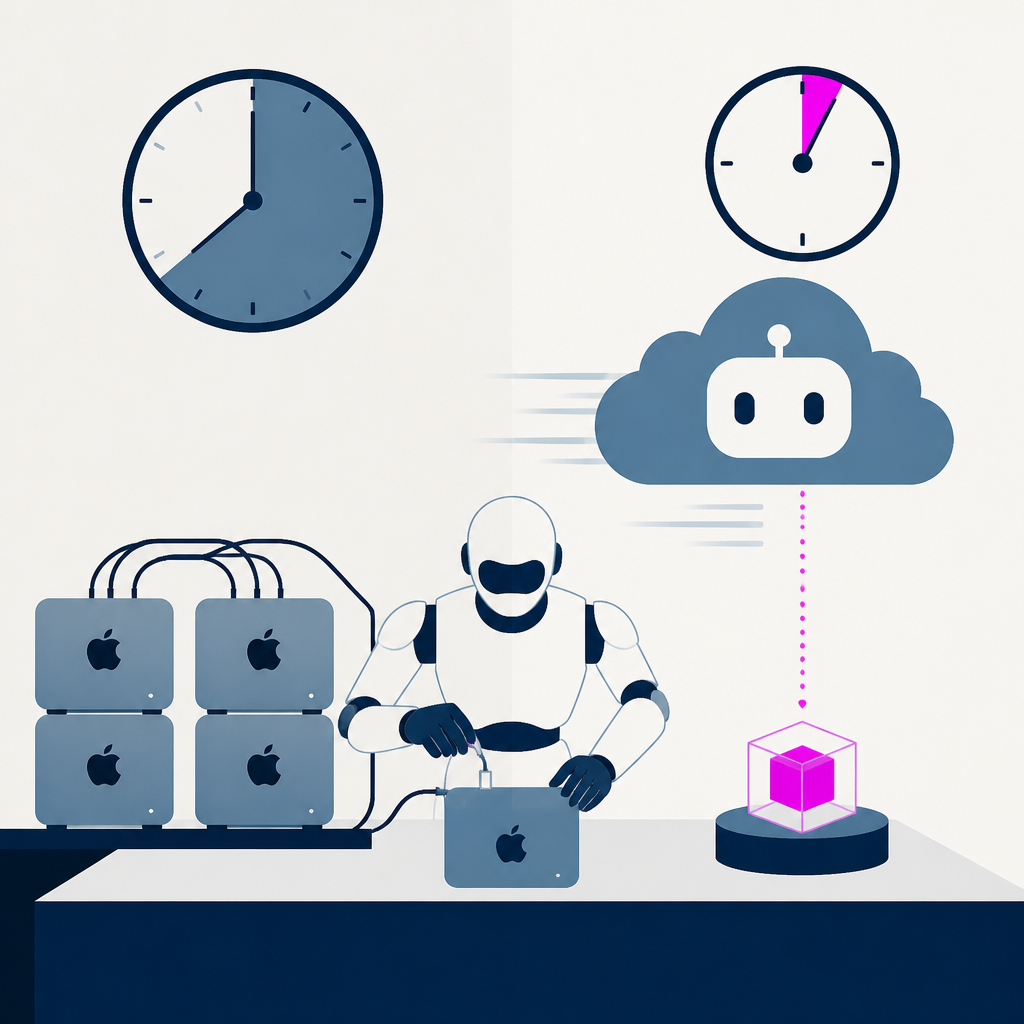
A hands-on test wired four Mac Studios into a local Kimi K3 cluster to run a coding job similar to a cloud agent run. The local setup took about four hours, while the cloud agent finished in about 15 minutes. The results suggest the cloud agent can complete the same kind of task much faster than the local cluster.
Nscale signed a multi-year AI cloud agreement with humanoid robotics company Figure and also took an undisclosed equity stake. The deal commits at least $3.5 billion in AI cloud compute, with capacity to scale past $6 billion, and targets initial systems for the second half of 2027. Figure gains priority compute and orchestration support from Nscale for its robotics training and models, while the partnership expands Figure’s ability to run large-scale training needed for robot shifts.
Nvidia introduced Personal AI Router (PAIR), a local distributed clustering tool that lets people use idle home PCs and Macs to run agentic AI subtasks across multiple machines. Nvidia said the client is available in beta for macOS, Windows, and Linux. PAIR sets up automatic proxy connections to tools like LM Studio and Ollama, discovers devices via mDNS/IP, dynamically redistributes subtasks when nodes become unavailable, and returns results to the main node for faster task completion.
Every AI story that matters,
in your inbox by 8am.
TLDRocket reads all relevant sources, removes duplicate coverage, and summarises the
day in two minutes. Follow companies and topics for alerts, or get the
briefing in Slack. Free, no spam, unsubscribe anytime.
Reading TLDRocket needs no cookies, and the readership counts we rely on come from
our own cookieless analytics. Google Analytics is the exception: it sets cookies and
reports to Google, so it stays switched off until you allow it. You can change your
mind any time from “Cookie settings” in the footer.
Strictly necessary
Session security and form protection (tldrocket-session,
XSRF-TOKEN, 2 hours). The site cannot work without them,
so they need no consent.
Always on
Google Analytics 4 (_ga,
_ga_<id>, up to 2 years). Measures which
stories and sections readers use. Google acts as a third-party processor and may
store the data outside the EU. No advertising, no profiling, no data sold.