ParakeetAI launched its second version, ParakeetAI 2.0, to help job seekers practice interviews with an AI interviewer and interview transcription features. The first mock interview is free. The platform adds a question bank and real-time listening to the actual interview to draft answers.
Thieves stole two trailers from autonomous trucking company PlusAI, including one with Nvidia branding, and left behind 40,000 pounds of sand instead of valuable cargo. Police recovered the trailers later the same day after an associate spotted them near a Newark office, and each truck held about 20,000 pounds of sand. AI cargo theft targeting hardware supply chains is rising and prompting freight firms to deploy tracking and AI-based verification to counter organized smuggling.
NetApp framed its storage business around “Intelligent Data Infrastructure” to target AI-driven data buyers and described how it is preparing architecture for AI data activation. NetApp reported that website traffic from net-new names rose about 50% year over year after its keynotes. The company is pushing new “AI factory” storage design with NetApp Novus and aiming to help customers access data wherever it already resides rather than lock them into one stack.
Ken Griffin announced a $3 billion gift to Carnegie Mellon University to create a new CMU Miami campus in Wynwood. $2 billion will fund the Miami campus, with plans to enroll its first students in 2028. Florida says the funding shifts competition from attracting companies to generating innovation by building research labs and venture partnerships tied to industry priorities, supported by the university’s AI foundations.
Midstream pipeline dealmaking picked up as the Senate introduced a bipartisan infrastructure permitting reform bill that could move before the end of the year. ONEOK agreed to buy West Texas’s Brazos Midstream Permian Basin assets for $4.42 billion. If the bill advances, permitting for oil and gas pipelines and related power projects would be expedited, which would likely speed up future deals.
Hewlett Packard Enterprise received a $1.2 billion order from cloud provider Vultr, marking its first commercial win for the AMD Helios AI networking platform. The deal was announced on Wednesday and HPE also raised its fiscal 2027 networking revenue-growth outlook to the high-teens to low-20% range. HPE says the next step is converting orders into shipments, revenue, and cash flow, with AI networking expected to become a larger growth engine and support margin expansion into 2027.
Good Tape, an AI transcription company, received investment from Nordic Makers and launched Explore, a feature that links each new recording to prior transcriptions to help users trace changes and contradictions. Explore launched this week, and Good Tape reports completing more than 15 million transcriptions across over 100 languages. Users can now navigate an interview “organizational memory” with safer access controls, shifting the product from plain transcription toward searchable contextual recall across months of audio.
A payments team replaced Confluence with a convention where each repo stores docs in the same Markdown folder and advertises them via a shared GitHub topic, then rebuilds a single Astro/Starlight site from those repos. The rebuild runs every 30 minutes using a GitHub Action that checks docs-folder git tree hashes and triggers a rebuild when the hash changes. Docs now update through the same pull requests as the code they describe, and both engineers and AI agents can discover and read them from one predictable, machine-consumable site.
Curiosity.ai rebuilt its entire website and design assets by using AI to restyle and redraw the site in multiple branded visual directions, then pick a winner via a live comparison game. The original rebuild covered all 67 pages, with the winning design rolled out on September 28 and additional style rounds used through September 29. The process replaced the prior brand with a monochrome scheme using one electric blue and generated design rules, and it removed the non-winning variants and their tooling.
Osavul raised a €8.5M Series A to expand its hybrid threat AI beyond governments into airports and banks. The funding was led by 33N Ventures and Osavul says total contract value grew fourfold in 2025. As a result, it plans to fund R&D and a sales push to sell early, evidence-traced threat assessments that can run on-premises.
The article argues that UK growth policy and investment are overfocused on high-profile, venture-backed companies while a profitable group of “invisible middle” SMEs is being overlooked. AI is cited as driving the shift, with AI companies making up 44% of UK smaller-business equity investment in 2025 while representing 26% of deals. The proposed change is to redefine which businesses qualify for support by prioritizing demonstrated profitability, job creation, and growth potential rather than glamour, sector, or unicorn prospects.
DIG Ventures closed Fund III to invest in early-stage AI-native enterprise and cloud infrastructure startups in Europe. The fund totals $120 million and aims to back about 30 companies at the pre-seed and seed stages. DIG plans to deploy capital immediately and focus on infrastructure areas like data, identity, compliance, and orchestration as AI makes enterprise software easier to build and distribute.
FRANK secured €2.9 million in seed financing from Armilar and Start Ventures for its AI Operator that automates insurance brokers’ portal and paperwork tasks. The product supports more than 350 brokerages and, on average, each broker saves about 10 administrative hours per week while the system runs 70,000 back-office tasks per month. The funding will be used to attract new clients, expand international operations (with plans for 2027), and continue R&D on the AI assistant.
Oogwai Beacon launched today to perform an Answer Engine Optimization audit by testing what search engines and AI assistants say about a site’s category using unbranded buyer questions. It reports results with inputs including ChatGPT and Gemini (and Claude for the full audit), with 20,000+ developers cited as using the company’s Context.dev API. The tool adds two checks—whether AI crawlers can read a site and whether engines recommend it—then lists specific gaps and fixes.
Nate Bargatze discussed skilled-trades shortages and how Ford is promoting hands-on careers while connecting his own move from door-to-door water-meter reading to major live events and a theme park. The Alliance for America’s Skilled Trades estimates the U.S. needs 1.7 million skilled-trades openings each year through 2035. The story frames AI as a way to make learning more accessible while reinforcing the idea that workers are still needed for physically installing, maintaining, repairing, and building things, with more demand shifting toward live experiences.
Verizon CEO Dan Schulman forecast rapid AI progress, saying AI model capability will step up every two months and that AGI could arrive within 6 to 18 months. He also predicted the “era of quantum” would begin about two years after that. Verizon plans to shift its workforce from fixed roles toward a more fluid structure and to expand training, including a $70 million initiative for American workers.
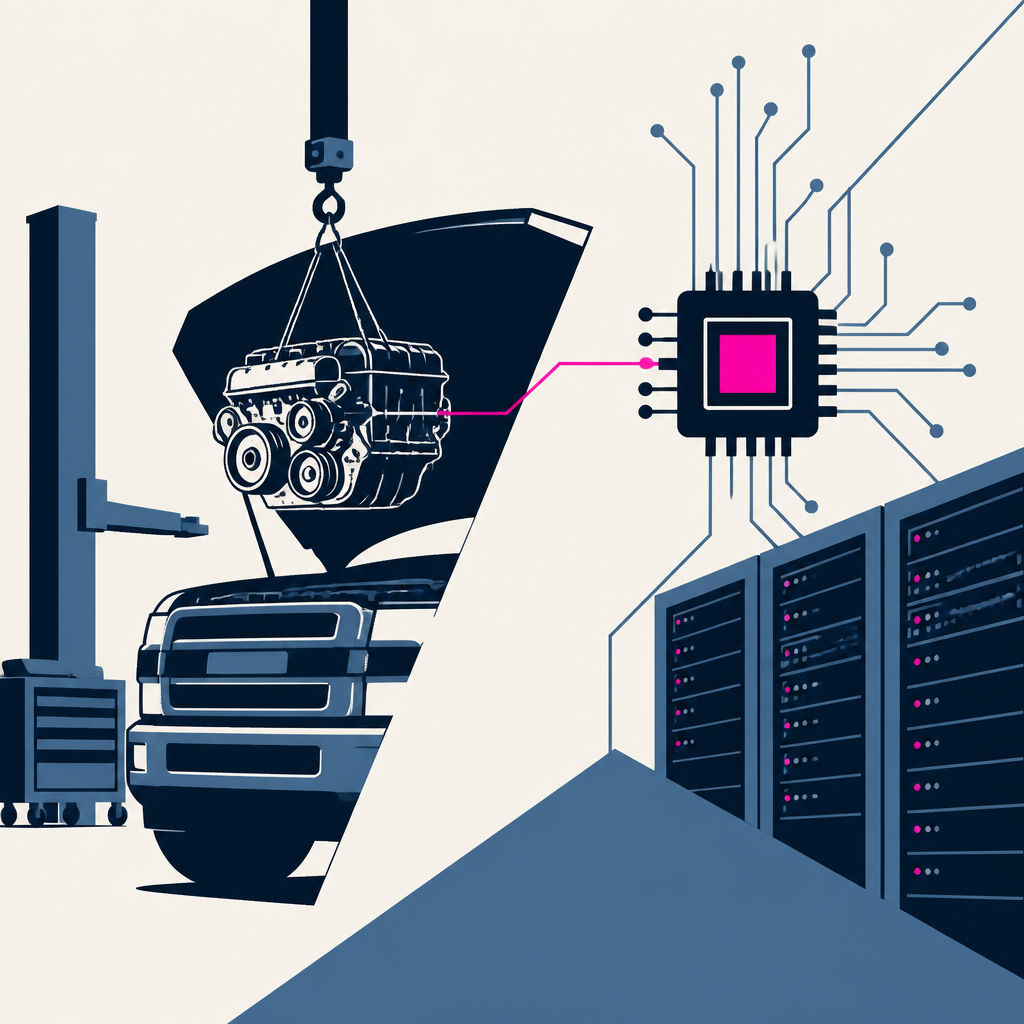
Ford CEO Jim Farley said AI is headed for factories and skilled-trades work as a “companion” that helps workers handle more complex tasks, while he warned routine white-collar roles will face disruption. He cited that engine removal on a Ford Super Duty can take two days and involve extensive disassembly, and Ford Pro uses AI guidance to help dealers do it faster. The company’s maintenance and repair work is shifting toward AI-enabled troubleshooting and advanced automated equipment, while other job types like spreadsheet and call-center work are expected to be changed or eliminated.
Metaview Labs raised $60 million in a Series C to automate recruiting tasks with AI agents that conduct interview workflows and turn responses into notes for human reviewers. The funding round brought Metaview’s total raised to $110 million and its agents have conducted more than 6 million interviews. The company is expanding its agentic recruiting platform, hiring to grow its team from about 80 people toward 250 by the end of next year, and launching additional autonomous features like a Slack-based recruiting agent called fillmore.
The Den opened a new location and used ChatGPT Work to speed up its grant applications and liquor-license paperwork. It reduced grant-application prep from 3 days to 2 hours. The club’s turnaround times for these tasks drop, freeing 10–15 hours a week for other growth work.
Every AI story that matters,
in your inbox by 8am.
TLDRocket reads all relevant sources, removes duplicate coverage, and summarises the
day in two minutes. Follow companies and topics for alerts, or get the
briefing in Slack. Free, no spam, unsubscribe anytime.
Reading TLDRocket needs no cookies, and the readership counts we rely on come from
our own cookieless analytics. Google Analytics is the exception: it sets cookies and
reports to Google, so it stays switched off until you allow it. You can change your
mind any time from “Cookie settings” in the footer.
Strictly necessary
Session security and form protection (tldrocket-session,
XSRF-TOKEN, 2 hours). The site cannot work without them,
so they need no consent.
Always on
Google Analytics 4 (_ga,
_ga_<id>, up to 2 years). Measures which
stories and sections readers use. Google acts as a third-party processor and may
store the data outside the EU. No advertising, no profiling, no data sold.