
TechCrunch AI
·
1 week ago
Lorde publicly criticized Meta's AI glasses during a performance at Madrid's Mad Cool Festival, calling them unattractive and urging people not to buy them due to privacy concerns. Ray-Ban Meta glasses sold more than 7 million units in 2025, more than triple the combined sales from 2023 and 2024. Despite widespread privacy worries and ongoing lawsuits against Meta, the product's strong sales have prompted the company to expand its smart glasses lineup.

TechCrunch AI
·
1 week ago
● 3 sources
OpenAI is developing a mobile smart speaker without a screen that integrates with ChatGPT and includes mechanical parts that can move independently. The device was created with help from former Apple engineers and is designed to function as a "humanlike AI companion" with access to users' emails and digital information to provide personalized service. The project advances OpenAI's hardware ambitions while the company faces a lawsuit from Apple alleging theft of trade secrets.

TechCrunch AI
·
1 week ago
● 3 sources
Apple released iOS 27 public beta with an upgraded Siri that uses on-device AI to access user information like emails and photos while grounding answers in web knowledge. The new Siri is available across Apple's 2.5 billion active devices worldwide and integrates with the device's search tool, photos, calendar, and other built-in apps. Users can now access Siri through voice command, side button, Dynamic Island swipe, a standalone app, or via Spotlight search, expanding when and how they interact with the assistant compared to the previous version.

TechCrunch AI
·
1 week ago
Anthropic released an advertisement featuring disturbing imagery including burning houses, surveillance, homelessness, cemeteries, and mining operations paired with questions about AI trustworthiness, which drew widespread backlash on social media. The ad includes what appears to be footage from Arlington National Cemetery with the voiceover asking "Who's gonna hit the brakes if we need to?" — a choice that critics found particularly offensive and sinister. The campaign backfired despite following a familiar marketing strategy where companies position themselves as ethical alternatives by highlighting industry harms.

The New Stack
·
1 week ago
AWS expanded its Security Hub service to monitor Microsoft Azure resources natively alongside AWS resources, marking the first time the service supports non-AWS infrastructure, while also launching GuardDuty AI Protection to detect threats in Amazon Bedrock and SageMaker workloads. Monitoring Azure resources costs the same as AWS equivalents with pricing starting from a 30-day free trial, and AI-powered investigations can complete threat analysis in minutes instead of hours. AWS aims to position Security Hub as a unified security console for multicloud environments, competing with similar offerings from Microsoft Defender, Google Cloud, and third-party vendors like Wiz and Palo Alto Networks.
NVIDIA
·
1 week ago
● 3 sources
NVIDIA Nemotron Labs promotes open AI models that enterprises can customize and control for domain-specific tasks, contrasting with closed proprietary models. Companies like Harvey achieved legal task accuracy matching frontier models at 10x lower cost, while Arcee AI reached inference costs of approximately 90 cents per million tokens, roughly 20x cheaper than comparable closed models. This shift enables organizations to build specialized AI applications tailored to their specific workflows and data rather than adapting their needs to existing general-purpose models.
Ars Technica
·
1 week ago
Google is refreshing its image search product, which launched 25 years ago, with expanded AI capabilities and a redesigned interface. The original image search launched in July 2001, prompted by demand to visually search for Jennifer Lopez's green Versace dress from the 2000 Grammy Awards. The updated version will replace the current minimalist search bar interface with additional AI-powered features.
Ben's Bites
·
1 week ago
● 5 sources
OpenAI released GPT-5.6 with three models (Luna, Terra, Sol) featuring five thinking levels plus a new Ultra mode, and merged the ChatGPT and Codex apps into a single application with a new ChatGPT Work mode. The three models have different strengths with Luna suited for simple tasks, Terra offering minor improvements over GPT-5.5, and Sol excelling at UI and writing, while usage limits are consumed significantly faster at higher thinking levels. Users should adjust their model and thinking level selections based on task complexity to avoid rapidly depleting their weekly usage allowances.

TLDR Dev
·
1 week ago
● 3 sources
Anthropic's new tokenizer for Claude models (Sonnet 5, Opus 4.8, Fable 5) produces approximately 30% more tokens from the same code than the previous tokenizer while maintaining the same list price. On identical TypeScript files, Claude's new tokenizer generates 1.73 times more tokens than GPT's o200k tokenizer, making Opus 4.8's effective price approximately $7.50/$37.50 rather than the listed $5.00/$25.00. Users comparing model prices must account for tokenizer differences rather than relying on published per-token rates, as the same work costs 32% more on Claude's newer models despite identical list pricing.
TLDR
·
1 week ago
● 3 sources
Apple released the first public beta of iOS 27, which is compatible with all iPhones running iOS 26. The update requires iPhone 15 Pro or newer to access Apple Intelligence features, particularly the new Siri AI capabilities. Users can now test performance and stability improvements ahead of the official release.

TLDR
·
1 week ago
● 3 sources
Apple released the iOS 27 public beta with a rebuilt Siri AI system that can hold conversations, search personal information, and understand onscreen content. Apps can launch up to 30% faster and AirDrop transfers up to 80% faster on devices including iPhone 11 and newer. iPhone users now have access to AI-powered features across Photos, Safari, Mail, and parental controls, with full iOS 27 releasing in the fall.

The New Stack
·
1 week ago
Thira, a startup founded by Apptio's Sunny Gupta and Kurt Shintaffer, is building AI agents to automate IT back-office processes that CIOs currently handle manually across multiple systems. The company raised $21 million in seed funding led by Madrona and has signed ten design partners ahead of a fall launch, initially targeting two repetitive IT processes out of six or seven identified. Thira differentiates itself through trust features like audit trails and rollbacks, offering semi-autonomous and fully autonomous modes, and plans to integrate with existing enterprise platforms rather than replace them.
The Neuron
·
1 week ago
● 2 sources
Anthropic has introduced localized pricing for Claude in India, its largest market outside the United States. The company adjusted its pricing structure to reflect local purchasing power in the Indian market. This enables broader adoption of Claude's AI services among Indian developers and businesses with pricing more aligned to regional economics.
The Neuron
·
1 week ago
● 2 sources
Anthropic localized Claude pricing in India, its largest market outside the U.S. The company adjusted pricing to reflect local purchasing power in the Indian market. This move makes Claude more accessible to Indian developers and businesses by aligning costs with regional economic conditions.

The Neuron
·
1 week ago
● 3 sources
Anthropic extended free access to Claude Fable 5 for paid subscribers through July 19, 2026, instead of switching to pay-per-use billing today. Subscribers can allocate up to 50 percent of their weekly usage limit to Fable 5 at no additional cost during this period. The extension reflects competitive pressure from OpenAI's GPT-5.6 Sol and lower-cost alternatives, as Fable 5 consumes usage quota faster than other Claude models.
The Neuron
·
1 week ago
Waze is adding Gemini-powered features including conversational road reports, personalized route suggestions based on driving history, and a new Motorcycle mode optimized for two-wheeler navigation. The personalized navigation feature, Gemini search capabilities, conversational map reporting, and Motorcycle mode are rolling out now globally on Android and iOS, with Motorcycle mode initially available in seven countries. Users can now report road updates and find destinations through natural speech, receive customized routes matching their preferences, and access a "less chatty" mode that reduces voice interruptions during drives.

Sifted
·
1 week ago
NestAI, founded by Peter Sarlin, released its first AI models designed specifically for military use, aiming to reduce Europe's dependence on foreign defence technology providers. The company raised €100 million in November, has grown to 200 people, and is running pilot programs with Estonian and Finnish armed forces that enable autonomous drone operations and battlefield mission orchestration. The launch addresses European security concerns highlighted by recent US export restrictions on Anthropic's models, with NestAI focusing on domain-specific military applications rather than competing with general-purpose frontier AI models.
Latent Space
·
1 week ago
● 3 sources
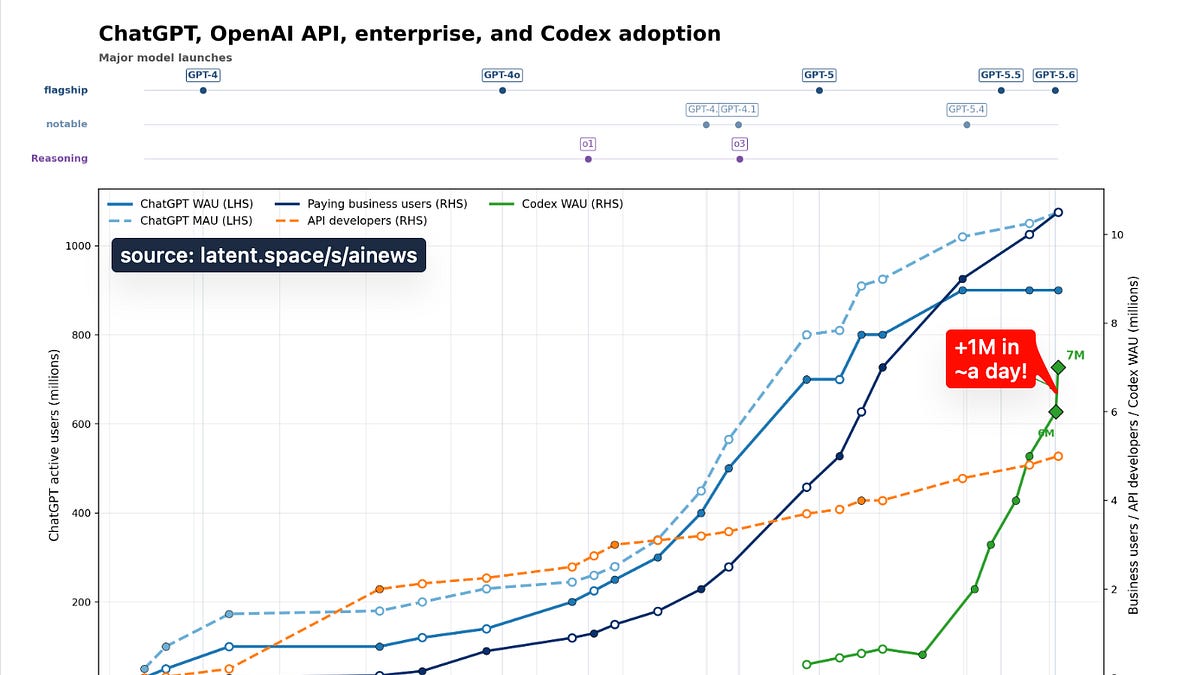
Codex usage grew from 2 million users in March to 7 million users by mid-July, representing approximately 10x growth over six months. The service added 1 million new users in roughly a single day following the July 9 launch of GPT 5.6 Sol, reaching 6 million users within 48 hours. Codex's growth trajectory now appears to match or exceed Claude Code's expansion, shifting competitive focus toward which coding platform maintains momentum in user adoption.
OpenAI Blog
·
1 week ago
● 2 sources
Data science teams can use ChatGPT Work to automatically generate documentation including root-cause analyses, impact summaries, KPI reports, scoped analyses, and dashboard specifications. The system processes actual work inputs and outputs to produce these documents without manual rewriting. Teams reduce time spent on documentation tasks and can focus more effort on analysis and decision-making work.
