Snapset was listed on Product Hunt as a Mac menu bar app that remembers a workspace and rearranges it when you change displays. It offers a free test with 20,000 credits. As a result, Mac users can switch setups automatically across monitors without manually reconfiguring windows and tabs.
CloudBees CEO Mo Plassnig outlined a plan to pivot the company into an AI-first organization rather than continuing its current CI/CD focus. The pivot was discussed at the WeAreDevelopers Conference in San Jose, California last week. CloudBees says generative AI’s order-of-magnitude increase in code output will require changes in process, governance, and security to manage AI-generated software in enterprise DevOps.
Consumer AI products such as Meta’s Muse, OpenAI’s Dots, and Instinct are getting renewed attention even as analysts warn the business economics are not improving fast. As of May, 2.2% of consumers were paying for AI services at an average of $31 per month, which still falls far below break-even levels. The industry response is shifting toward enterprise and vertical-by-vertical deals, which limits how much consumer-focused companies can grow without selling to businesses.
Amazon Bedrock Knowledge Bases was used to build a conversational claims assistant that retrieves evidence from claim documents so it can answer natural-language questions with citations. The example limits planning and retrieval to maxAgentIteration=5 rounds per question. As a result, claims status and work-queue queries can be answered from PDF/Word/text records via RAG-backed search scoped by metadata filters instead of manually scanning scattered documents.
Microsoft is expanding Fabric so enterprise agents learn a company’s business context from Fabric IQ, then use that context in Microsoft 365 Copilot and through MCP and ontologies. The update starts with Fabric IQ feeding Microsoft 365 Copilot by default and begins from Power BI semantic models that Microsoft says number 22 million. As a result, agents can query and act on unified, secured, and real-time business data, with Power BI and Fabric adding app creation, shared governed context, and preview support for agent tooling and ontology-based context.
Restate, the Berlin startup building durable workflow infrastructure, raised a Series A to expand its execution engine for AI agent workflows and compete in durable infrastructure.
Companies report that AI adoption is widespread but only a small share sees measurable financial impact, with little improvement year over year. Only 6 percent of companies are “high performers” that attribute at least 5 percent of EBIT to AI. The article argues firms need clearer outcome ownership and better data/workflow integration to move beyond pilots and scale AI into day-to-day operations, alongside adapting product data for new AI-assisted discovery paths.
Ascerta collected $18 million in early-stage funding to help enterprises measure which AI projects create business value rather than relying on usage counts. The Series A was led by Dell Technologies Capital and included participation from Hitachi Ventures, BGV, and Wipro Ventures. Ascerta will use its platform to track AI economics down to users, teams, and applications and to provide ROI, productivity, and compute cost insights.
Meta announced a new Meta Enterprise Platform intended to sell its agent and API stack to businesses and developers, hiring CJ Desai to run the effort. The plan is tied to committing “tens of gigawatts” against expected demand for first-party products like Muse. The company is positioning Muse to be delivered through enterprise marketplaces and a direct platform so Meta can secure compute and reduce risk from relying only on consumer agents.
Apple CEO John Ternus is overhauling the company to accelerate product development and shift toward a leaner, more engineering-focused organization. The article cites an initial target of speeding up product introduction. This direction also adds an experimental approach to help Apple compete in the AI era.
OpenClaw launched OpenClaw Enterprise to manage self-hosted AI agents in the enterprise, with Nvidia and Red Hat backing the project. OpenClaw says the software is being developed in the open for a 1.0 release later this year and is suitable only for internal pilots right now. The new control plane centralizes agent deployment, namespaces, credentials, permissions, and change auditing while agent execution happens separately, with security-focused work still unfinished.
OpenAI partnered with America’s SBDC to expand hands-on AI training and local support for small businesses, alongside a report on how small teams use AI. The collaboration focuses on small-business enablement through expanded training and local assistance, rather than providing a specific new model or product. Small businesses gain more local AI support and training, and the new report adds guidance on current AI usage by small teams.
StreamTV cut its staff after an investor pulled out at the signing date of a funding round, then later acquired TikFinity and rebuilt it while it stayed running. TikFinity 2.0 started rolling out gradually in August, and StreamTV reports 2.9 million creators have signed up. The pivot to TikTok LIVE makes StreamTV’s focus shift toward a livestream-interaction tool and leads to new products like automatic livestream recording and planned AI-based clips.
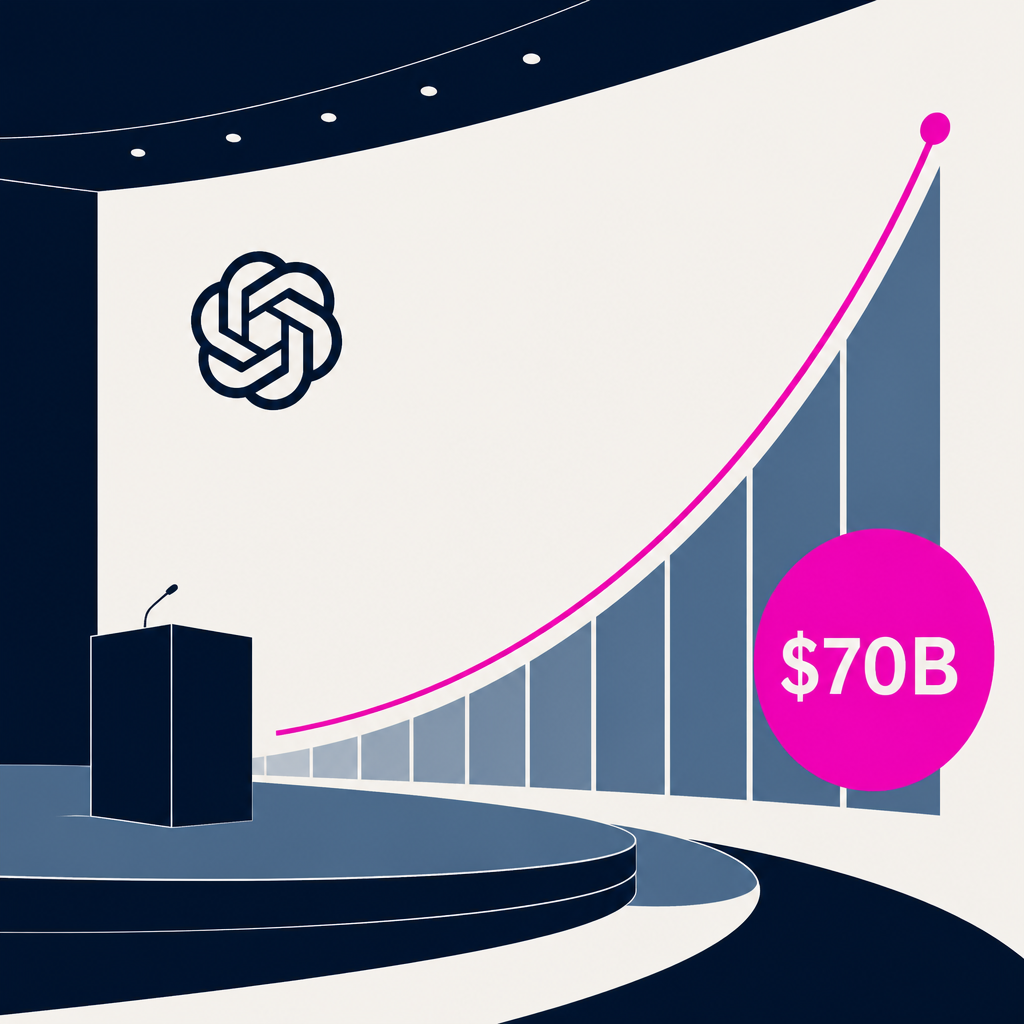
OpenAI’s annual recurring revenue/run rate is reported by Axios to be approaching $70B. The single most concrete detail is that figure, nearing $70B. This indicates OpenAI’s AI business is generating at that scale, though the article provides no specific change in product or policy beyond the reported run rate.
WONE argues that workplace stress is being poorly measured with annual employee surveys and says it replaces this with a continuous Stress Intelligence approach combining psychometrics, wearable data, and AI coaching. In a study of 1,000 employees across the US and UK, it found highly stressed workers took eight times as many sick days and were nearly four times more likely to consider leaving. This changes how companies detect and respond to stress by shifting from yearly, aggregated snapshots to earlier, more team-level and privacy-preserving interventions.
McDonald’s franchisees are being pushed to use a machine-learning pricing system that sets item prices by analyzing millions of daily transactions and competitor menu pricing for each location. The system calculates “the optimal price” for every item at nearly 14,000 restaurants. Since January, franchisees have faced added requirements to engage with the pricing consultant and tools, widening some price gaps according to operators, which McDonald’s disputes as a non-mandate tool.
Ahron, a Munich HR tech startup, raised a €2.2 million funding round led by Cusp Capital to build an AI agent-based platform that automates HR workflows across companies’ existing systems. The round totals €2.2 million. The company will use the money to develop a central control layer for its AI agents’ policies and expand internationally.
Blackwall, an Estonian cybersecurity company, jumped to a €1.03 billion valuation and moved up to 5th in TopTech 2026. Its valuation rose from around €221 million to €1.03 billion in a year, up 368%. The TopTech ranking changes as Blackwall climbs from 9th to 5th and Estonia’s top-30 total value edges down year over year.
Juicebox, a Sequoia and Lux Capital-backed AI recruiting startup, is opening its first office outside San Francisco in London. The company says it raised $18m in funding. That move expands its hiring and operations footprint to London as it targets Jack & Jill competition.
EliseAI raised $350M at a $4B valuation, led by a16z and Bessemer, citing growth in AI agents for housing and healthcare automation. The company says its agents cover one in six US apartments and handle about 5M calls per month. The new funding will go to product development and expanding engineering, deployment, and sales teams, plus adding San Francisco as a second engineering hub.
RSA announced RSA Agent ID, a platform aimed at discovering, governing, and securing enterprise AI agents that can hold credentials and permissions but often lack accountable ownership. RSA said one bank with a policy that prohibited agents still had more than 4,000 agents running in its enterprise. The approach changes incident response by enforcing policy at tool-call time, mapping actions to audit logs, and requiring out-of-band approvals only for risk-scored high-impact actions.
Every AI story that matters,
in your inbox by 8am.
TLDRocket reads all relevant sources, removes duplicate coverage, and summarises the
day in two minutes. Follow companies and topics for alerts, or get the
briefing in Slack. Free, no spam, unsubscribe anytime.
Reading TLDRocket needs no cookies, and the readership counts we rely on come from
our own cookieless analytics. Google Analytics is the exception: it sets cookies and
reports to Google, so it stays switched off until you allow it. You can change your
mind any time from “Cookie settings” in the footer.
Strictly necessary
Session security and form protection (tldrocket-session,
XSRF-TOKEN, 2 hours). The site cannot work without them,
so they need no consent.
Always on
Google Analytics 4 (_ga,
_ga_<id>, up to 2 years). Measures which
stories and sections readers use. Google acts as a third-party processor and may
store the data outside the EU. No advertising, no profiling, no data sold.