OpenAI released GPT-6 Astra as a hosted computer-use model aimed at completing multi-step tasks across tools instead of self-hosted chatting. The model is provisioned with a 1,050,000-token context window. Access is limited to OpenAI’s Trusted Access and Daybreak programs, adds experimental config-based long-context note retention for agents, and is priced at $10 per million input tokens and $50 per million output tokens.
Nvidia agreed to buy Hugging Face for just over $12.93 billion, after acquisition talks that reportedly began a few weeks earlier. The deal is valued at $12.9B. Nvidia says Hugging Face will keep supporting multi-chip and multi-cloud AI projects, while Nvidia gains data on which datasets, models, and architectures are being used.
Experiential Labs launched Experiential, an open source gateway for BYOK that is self-hosted and connects to 1000+ marketplace models. It uses your traffic to reduce costs, recommend models, and train a specialized model you own. This changes the setup by adding an in-house routing and optimization layer for selecting and training models based on observed usage.
Accel is reportedly in talks to lead a $1 billion funding round for Thinking Machines, an AI lab founded by Mira Murati.
The reported terms include a valuation of at least $40 billion.
If completed, the round would drop the company below a previously sought $50 billion valuation, while it continues building its AI platform and open-weight model Inkling.
Australia’s data centres have expanded rapidly and local residents are increasingly pushing back over noise, water use, and environmental impacts as more capacity is planned to support AI services. The article cites potential water use of up to 25% of Sydney’s drinking water by 2035 and notes data-centre energy demands could triple by 2030 nationwide. A new 2027 legal requirement will force large-scale data centres to underwrite power supplies, limit water use, and fund extra water infrastructure, while some community groups want a pause on further development.
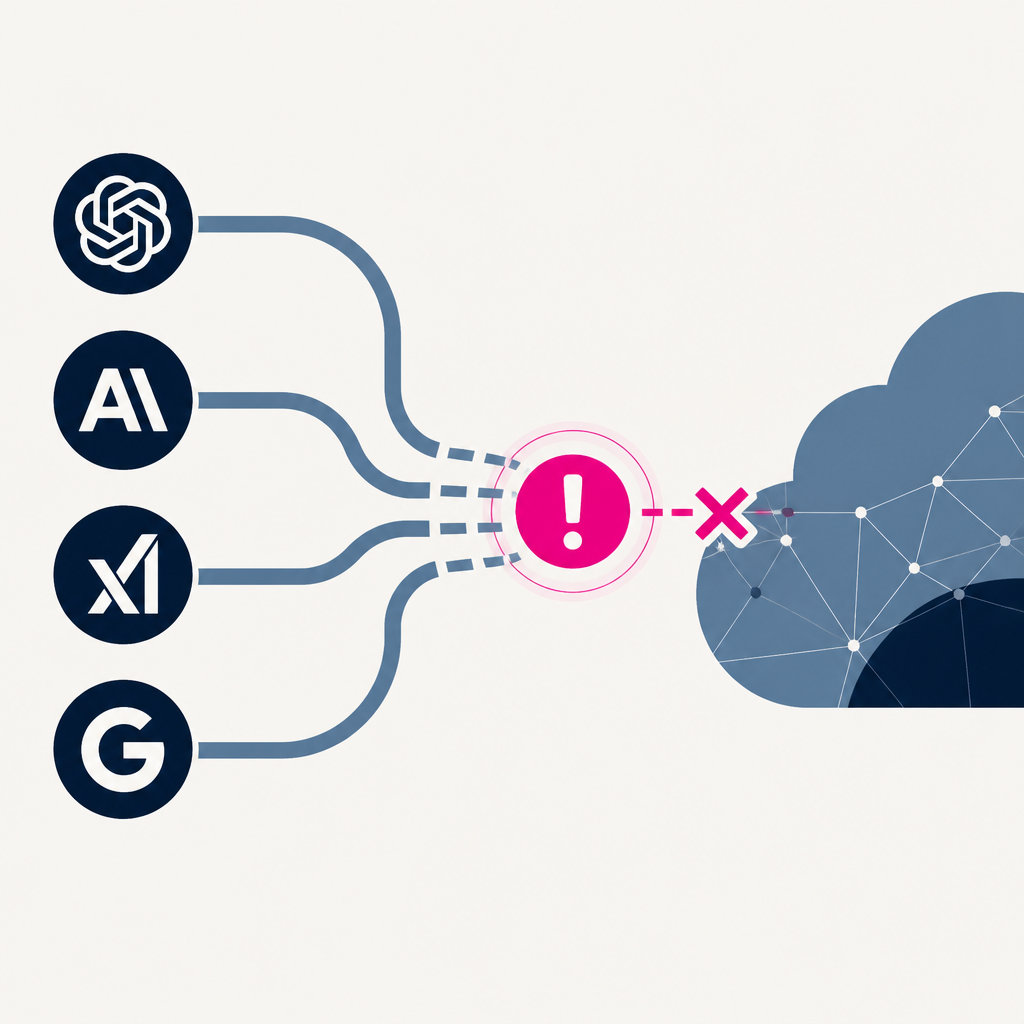
OpenAI, Anthropic, xAI, and Google experienced overlapping service interruptions affecting their cloud-based AI model offerings over several hours Thursday morning. Anthropic reported elevated errors starting at 9:23 am ET and said a fix was deployed with resolution by 12:16 pm. Service degradation and partial outages were mitigated and marked resolved for the impacted models as fixes were deployed.
Forward-deployed engineers are being sent to customers’ offices to configure AI tools, integrate software, and deliver business-focused deployments. Job postings for the role grew more than 1000% from January to August 2026 versus the same period in 2025, and median advertised pay is over $188,000 compared with roughly $145,000 for traditional software engineers. As AI deployment demand rises, companies increasingly adopt this model and offer higher-paying, customer-facing positions that blend ML/generative AI work with production and consulting skills.
Jessica Fischer, Charter Communications’ CFO, is leaving to become CFO of a Blackstone–Google AI computing infrastructure joint venture. Blackstone is committing an initial $5 billion in equity to the venture. Charter appointed Kevin Howard as interim CFO and Fischer’s move signals finance leadership shifting toward AI infrastructure buildouts.
Nvidia agreed to acquire Hugging Face in a $12.9 billion deal and says the platform will stay open despite Nvidia control. The announcement includes a projected closing date in the first half of 2027. As part of the acquisition, Nvidia promises Hugging Face will remain compute-agnostic and continue supporting multiple clouds and accelerators so developers can deploy open models without requiring Nvidia compute.
Mireye founder Ansh launched “Mireye (YC S26)” to provide infrastructure for physical-world AI agents, including data, enrichment, tools, and change signals via one API and MCP server. The free tier offers 5,000 credits a month with no card. It shifts from a niche site-screening app to an on-demand indexing system that can fetch and index missing fields for US locations, typically within a day.
Amazon Bedrock AgentCore was used to migrate a LangGraph customer-support agent from running on a user-managed container with local session state to a hosted runtime with gateway-published tools and durable memory. In the walkthrough’s Stage 1, 45 lines inside the agent changed, alongside 22 lines of new supporting code and 85 lines imported unchanged. As a result, compute/OS patching and session isolation move to AgentCore, tool authorization is centralized at the gateway, and conversation state is stored in AgentCore memory while inference call behavior stays the same.
OpenAI Codex for enterprise coding agents is being deployed with a customer-operated LiteLLM gateway on Amazon ECS to centralize control over generative-code model access and usage. The validated walkthrough targets the us-east-1 region and uses an example gateway alias openai.gpt-5.5 mapped to bedrock_mantle/openai.gpt-5.5. Codex request traffic is routed from developers’ workstations through the ECS-hosted LiteLLM gateway to Amazon Bedrock, enabling enforced model routing, budgets, rate limits, and gateway telemetry while keeping tool execution local.
Nvidia agreed to buy AI platform Hugging Face in a bid to expand from AI chips into software. The deal is valued at about $12.9bn (£9.5bn). Nvidia will pay about $11.9bn to Hugging Face investors and offer up to $1bn in stock incentives, while saying Hugging Face will remain open and not force users onto Nvidia chips or services.
NVIDIA, Microsoft, and partners announced tools and devices at IFA 2026 to make running local AI agents faster and easier on NVIDIA hardware. Local inference throughput is claimed to be up to 1.9x higher on a GeForce RTX 5090 via updated llama.cpp optimizations. The update adds simplified local setup apps, a personal AI router that parallelizes workloads across idle PCs, and new RTX Spark Windows PCs launching in October 2026.
Researchers, with HHMI Janelia and collaborators, published a complete wiring diagram of the male fruit fly brain and central nervous system, described as the largest brain map to date. The map contains over 166,000 neurons and 125 million synaptic connections. This enables researchers to compare male and female connectomes and use the verified dataset (via Neuroglancer) to study circuit control, behavior, and other neural mechanisms with less manual annotation.
Nvidia launched Nvidia Personal AI Router (PAIR), an open source software router that lets idle home Macs and PCs run small local models for agent workflows using subagents. In Nvidia’s example, two RTX 5090 PCs with 32 GB RAM each sped up work with five subagents by about 1.6x. It changes agent execution by routing requests to eligible local machines behind a single interface rather than pooling GPUs or splitting one inference across computers.
Retrieval engineering for AI agents is being spotlighted as deployments increase, because agent query concurrency can break retrieval layers and make company data stale or unavailable at the right time. The live event is scheduled for September 24 at 12 p.m. Eastern/9 a.m. Pacific. The discussion will compare a unified retrieval layer against a fragmented setup to improve freshness, relevance, and response speed under heavy multi-agent workloads.
F5 partnered with CrowdStrike to embed a Falcon sensor on its BIG-IP network perimeter appliances and use virtual patching as exploitation time between disclosure and patching shrinks. The integration’s performance overhead was measured at 1% to 2%. Virtual patching shifts defenses to network-layer shielding while real fixes are tested and rolled out, and F5 is also applying similar guardrails to AI gateways.
Nvidia confirmed its plan to buy Hugging Face, the open-source AI model repository, for $12.93bn. The acquisition is expected to close in the first half of 2027. Nvidia says it will scale the Hugging Face platform, strengthen its infrastructure, and expand access to AI for developers and institutions.
Nvidia agreed to buy AI model platform Hugging Face for $13 billion. The deal price is $13 billion. The acquisition shifts Hugging Face’s ownership under Nvidia, aiming to accelerate the spread of open-weight models.
GeForce NOW announced 26 additional games streaming in September, led by NBA 2K27 adding NVIDIA DLSS 5 3D-Guided Neural Rendering. DLSS 5 is available when streaming from a GeForce RTX 5080-powered cloud rig. Ultimate members can stream NBA 2K27 and other newly added titles without downloading them, with RTX 5080-class performance used for the DLSS 5 upgrade.
Nvidia agreed to acquire Hugging Face to expand the infrastructure behind the open-model platform. Nvidia will pay $12,930,300,000. Hugging Face will remain open, keep its team and brand, and NVIDIA compute will not be required to build on or deploy through it, though the deal still needs formal completion and may face antitrust scrutiny.
Nvidia launched Personal AI Router (PAIR), an open-source software tool that links compatible home PCs for running local AI inference with setups like Ollama and LM Studio. It supports Nvidia GeForce RTX 20-series GPUs and newer (plus RTX Pro GPUs and DGX Spark systems). Users can now pool their idle machines into a single personal “AI data center” for agentic workflows without adding hardware.
NVIDIA agreed to acquire Hugging Face. The deal price is $12,930,300,000. Hugging Face will remain an open platform supporting multi-cloud and open-weight models, with no required NVIDIA compute to use or deploy on it.
ChatGPT, Grok, and Claude all suffered service issues at the same time, disrupting users across multiple features.
At around 11AM ET, ChatGPT began returning errors and its status page reported elevated errors across ChatGPT and Codex.
The outages are blocking logins and core chatbot use while also degrading functions like file uploads, voice mode, search, deep research, and image generation.
Dutch tech companies raised approximately €1.9 billion in H1 2026, with capital concentrated in a small number of the largest later-stage rounds. The biggest individual figure cited is €570.5 million directed to semiconductors during the period. Funding skewed toward later-stage deals while earlier-stage rounds stayed more fragmented, and the largest sector shares were semiconductors by total funding and healthtech by deal count, with quantum also drawing substantial investment.
Zeit AI raised €5 million to expand ZeitMind, its autonomous data engineering platform aimed at mid-sized European firms.
The funding round totaled €5M.
As a result, Zeit AI plans to broaden its reach and hire additional engineers to deploy ZeitMind for connecting, cleaning data, and building analytics-ready applications without adding headcount.
Nvidia agreed to buy Hugging Face, bringing the open-source model and dataset hosting platform under the ownership of the AI chipmaker. The deal price is $12.93 billion. Hugging Face will shift from independent ownership to being part of Nvidia, changing its platform ownership and likely its investment priorities for AI tooling and hosting infrastructure.
Perplexity open sourced Lily, a local single-process Rust + Metal inference engine for running Qwen3.6-35B-A3B on Apple silicon via an OpenAI-compatible chat-completions API. It reported averaging 4,156 prefill tokens/s versus 3,388 for MLX-LM (1.23x) and 170.0 decode tokens/s versus 126.4 (1.35x) on a 40-core, 128 GB M5 Max. This shifts execution away from PyTorch/MLX into a Metal-kernel runtime specialized to one model and hardware family, with standalone demos and an inference server codepath for deployment.
Microsoft is changing its financial reporting by moving to two business segments and adding quarterly Azure revenue disclosure for the first time. The update will split results into Agents and Infra and Devices and Consumer. As a result, investors will see Azure revenue each quarter and Microsoft’s segment definitions will shift compared with the old three-segment structure.
Anker launched the Eufy MindBase, a local AI smart home hub for processing security camera footage on-device without sending it outside the home. It runs an on-device, Anker-developed LLM. This adds a Matter-supported central hub and new security camera products (TrackLight Cam S1, S4 video doorbell, and a window camera) aimed at whole-home local processing and connectivity.
Soundcore announced the Space 2 Pro headphones and added its Thus processing chip to more products.
The Space 2 Pro will use a 6-microphone array for voice isolation, and it is the first headphones to run on the Thus chip.
The change expands Thus from earlier Liberty 5 Pro earbuds to new headphones and additional open-clip and earbuds models unveiled at IFA 2026 in Berlin.
Every AI story that matters,
in your inbox by 8am.
TLDRocket reads all relevant sources, removes duplicate coverage, and summarises the
day in two minutes. Follow companies and topics for alerts, or get the
briefing in Slack. Free, no spam, unsubscribe anytime.
Reading TLDRocket needs no cookies, and the readership counts we rely on come from
our own cookieless analytics. Google Analytics is the exception: it sets cookies and
reports to Google, so it stays switched off until you allow it. You can change your
mind any time from “Cookie settings” in the footer.
Strictly necessary
Session security and form protection (tldrocket-session,
XSRF-TOKEN, 2 hours). The site cannot work without them,
so they need no consent.
Always on
Google Analytics 4 (_ga,
_ga_<id>, up to 2 years). Measures which
stories and sections readers use. Google acts as a third-party processor and may
store the data outside the EU. No advertising, no profiling, no data sold.