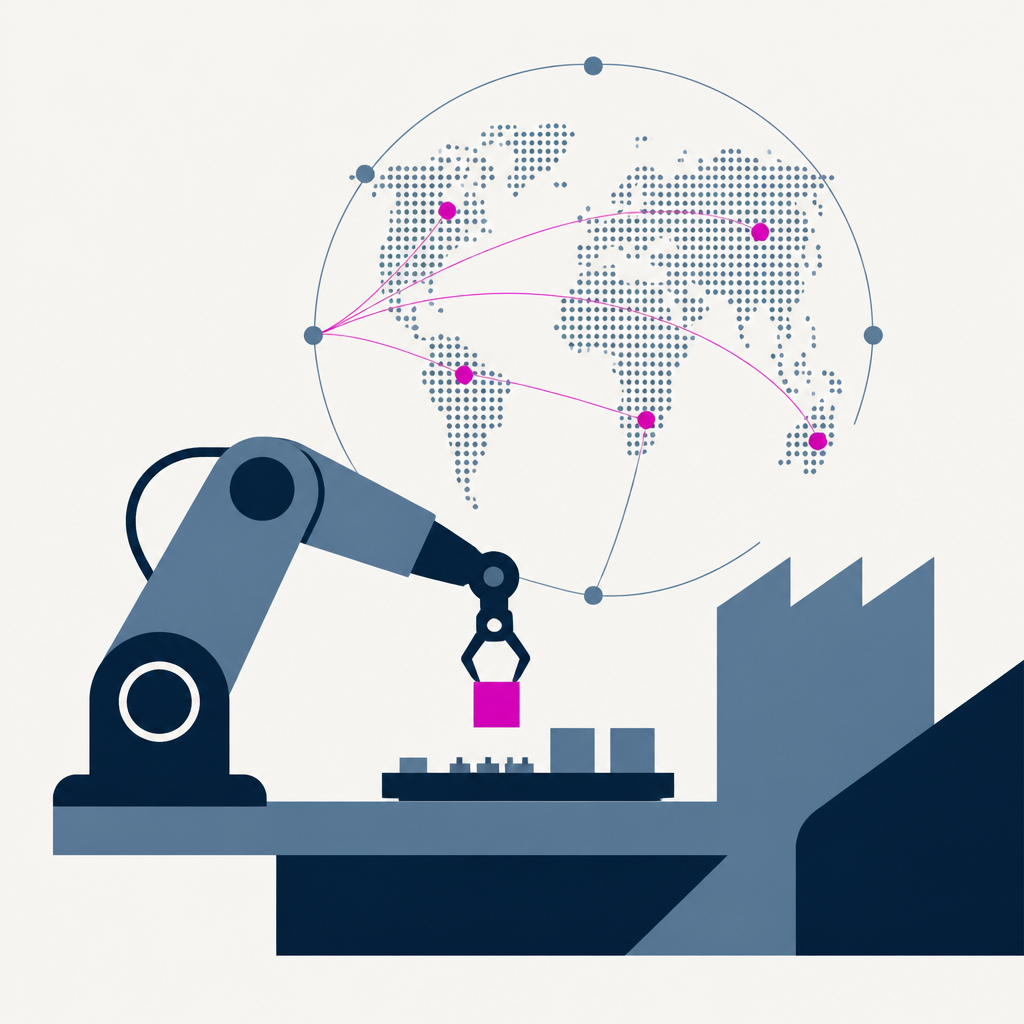
TechCrunch Disrupt 2026 will add a new “Real World AI Stage” focused on the digital-to-physical intersection. The stage runs October 13–15 at Moscone West in San Francisco. It expands Disrupt’s AI programming into two stages and brings speakers from Nvidia and robotics and de-extinction companies to cover autonomous hardware, edge deployment, and scaling prototypes into production.
Australian teams can now access OpenAI GPT-5.6 Sol, Terra, and Luna through Amazon Bedrock by calling the Bedrock Runtime endpoint in Sydney (ap-southeast-2) or Melbourne (ap-southeast-4), with Bedrock routing requests to supported AWS destination regions automatically. The setup supports context windows up to 1 million tokens. This changes deployment by letting apps avoid manual cross-region routing while enabling use via the Responses API, Chat Completions API, and the Bedrock Converse API, plus features like prompt caching and Codex integration.
Wonderful AI BV announced a $550 million Series C funding round for its enterprise AI agent automation platform. The round values the company at $5 billion. The additional capital is intended to accelerate product development and expand its international forward deployed engineering teams.
Multiverse Computing launched Quasar 438B, its first large-scale reasoning model for coding and enterprise AI agents, and reported benchmark and speed results to support its agent-readiness claims. It said Artificial Analysis measures Quasar’s output at about 183 tokens per second. The company is relying on its CompactifAI compression approach to try to make repeated agent reasoning and tool-calling faster and cheaper, though key details like the compression savings and required hardware were not disclosed.
llm released version 0.34, adding response-duration logging to Markdown output and the llm logs --short output. The update reports duration in milliseconds via a new duration_ms field. This changes the logs by including both a human-readable duration and duration_ms, alongside bug fixes and a performance improvement to llm logs.
An AWS team built an automated content validation system to catch dashboard failures that infrastructure monitoring misses, by visually and numerically checking hundreds of dashboards and alerting owners. The setup cut mean time to detection from up to 72 hours to less than 1 hour. As a result, content issues that previously required user reports became detectable in under 1 percent of cases with real-time Slack notifications and faster owner fixes.
Google released Gemini 3.8 Flash and a tuned variant, Gemini 3.8 Flash Cyber, as its third Flash model in six weeks. It priced API access at $0.75 per million input tokens and $3.75 per million output tokens through the end of the year. The rollout adds a dedicated vulnerability-focused model and temporarily reduces token costs for developers using the API.
NVIDIA released Switchyard, a Rust proxy and library that decodes inbound LLM requests, routes them to a selected upstream backend, and translates requests and streaming responses between OpenAI and Anthropic formats. The server exposes routing-overhead timing via switchyard_routing_overhead_ms in Prometheus buckets starting at 0.1 ms. Switchyard is provided as pre-alpha/experimental and explicitly not for production, changing deployments by enabling provider-neutral agent APIs while delaying production adoption until v1.0.
Storage companies are building products and integrations to make enterprise unstructured data usable for AI workflows, including governance, orchestration, and faster access for inference. More than 80% of enterprise data is unstructured, according to estimates cited in the article. As a result, organizations are shifting toward preparing data for AI training and audits and designing infrastructure (including key-value cache tiers and unified namespaces) to move and serve that data at scale.
Stripe acquired Privy, Bridge, Ourum, Metronome, and OpenRouter after making an aborted attempt to buy PayPal. The OpenRouter deal closed this month for around $7.5 billion. As a result, Stripe is expanding into stablecoins, account verification/bank transfers, usage-based billing, and AI distribution while the PayPal acquisition falls through after Stripe’s offer was judged too low as PayPal shares rose.
Walmart Global Tech engineer Saurabh Kumar redesigned a high-volume scoring system to remove a monolithic bottleneck. The update cut P99 latency by over 50%. It decoupled scoring into its own microservice and used Java fine-grained parallelism to score multiple items at once, plus it later enabled faster ML deployments and a rebuilt A/B testing platform.
Wonderful raised $550 million in a Series C round, lifting its valuation to $5 billion and more than doubling its prior $2 billion valuation from the previous funding nearly six months earlier. The round values the company at $5B. The company will use the money to develop products faster, expand its forward-deployed engineering teams, and meet rising demand for its AI platform after shifting from its customer-service agent origins toward “Wonderful AI OS.”
Reliance Jio expanded its JioPC cloud PC subscription beyond its own broadband customers to any internet user in India so existing computers can run AI-ready workloads without hardware upgrades. The standalone plans start at ₹1,000 for two months, with a ₹4,000 12-month option for 8GB RAM and 500GB storage. The move shifts PC usage from owning local hardware toward paying for streamed computing capacity and tests whether users accept recurring internet-dependent service instead of buying new PCs.
British Business Bank agreed to commit up to £46 million to Zinc Capital Management’s second institutional fund, the Science-for-Impact Fund. The funding is intended to grow Zinc’s portfolio toward 80 new UK deep tech companies, targeting a £70m fund size. The commitment expands early-stage finance and venture support for UK deep tech startups developing health and environmental technologies, including AI-related applications.
Jabil pursued enterprise integration to reduce disconnected site tools, data silos, and manual workarounds across its global manufacturing network. The effort targets more than 100 sites across 30-plus countries using SAP’s Integration Suite as a foundation. With a standardized, end-to-end data backbone in place, Jabil expects better real-time supply-chain visibility and a stronger platform for predictive insights, exception handling, and AI-driven planning.
iPronics, a Valencia-based photonics startup, announced a $125 million Series B round led by Maverick Silicon and Light Street Capital with Nvidia participating.
The company says it will use the funding to shrink its optical circuit switch hardware by roughly a factor of 20, after shipping its ONE-32 32-port unit for about a year.
This should let iPronics pack more switches into a rack to scale the size of optical AI cluster interconnects while continuing commercialization and scaling operations.
IBM and Confluent are adding IBM Granite time series foundation models to Confluent Cloud so they can run stream-native via Flink SQL where business data already moves. The models are in Early Access on Confluent Cloud, with “44M+ downloads” behind them. Teams can replace bespoke per-series model builds with function calls that run forecasting and anomaly detection on live streams and write inference results back to Kafka.
Fal.ai launched H3 Max, a post-trained version of its MiniMax H3 for quality video production. It generates a 5s video in about 3 seconds, claimed as 35x the throughput of the official H3. The model is post-trained on new data for prompt adherence and visual quality and is co-optimized with fal’s inference stack on NVIDIA GB200 NVL72.
LEAP kicked off in Saudi Arabia with announced technology investments and AI data-center plans tied to HUMAIN, including Together AI’s agreement and AWS and xAI expansion signals. The conference disclosed $15 billion in planned technology investments, and Together AI expects over $5 billion in gross annualized revenue in its first year. These deals expand AI cloud and data-center capacity across Saudi Arabia while reinforcing Saudi Arabia’s push to become a regional AI hub.
Federal Reserve Bank of Chicago CEO Austan Goolsbee warned that AI-driven data center expansion could soon contribute to “aggregate overheating” by crowding out spending and inputs from other parts of the economy. He said he’s “not far” from that outcome turning into aggregate overheating, with AI-related capex growth expected to peak in Q4 2026. As a result, AI is becoming a larger political and economic wedge issue around resource costs and hiring, even as AI-linked investment continues to boost GDP and certain stock sectors.
Taiwanese authorities raided and shut down Blue Ocean Smart System in August 2021 after investigating alleged Chinese-linked control hidden behind a Taiwan-registered shell. The broader crackdown has involved 166 technology cases over the past six years into concealed ties to China. As a result, Taiwan has kept enforcement active with continued raids and tighter scrutiny under cross-strait and national security rules affecting chip and other tech operations.
Speakeasy launched Kit, its coding agent runtime and the company’s 7th launch. Kit is delivered as a one-file static binary that includes a terminal client, an ACP server, an A2A endpoint, and a subagent orchestrator. By using ACP to separate agent clients from runtimes, Kit can run with compatible editors and coordinate other harnesses without custom integrations.
OnZero Finland Oy signed an agreement with Helsinki utility Helen Ltd to deliver AI computing waste heat into Helsinki’s district heating network. The facility is expected to supply up to 525,000 MWh of heat per year, enough for roughly 70,000 apartments, with commissioning scheduled for next year. OnZero will use liquid cooling designed to recover up to 99% of generated heat and Helen will reduce combustion-based heat by replacing gas with recovered heat.
Loudoun County, Virginia, built its economic recovery strategy around attracting data centers after earlier tech booms left behind vacant infrastructure, and it has since become highly visible as “Data Center Alley.” In 2024, data center tax revenue exceeded the county’s operational budget by $35 million. As generative-AI demand expands the US buildout from existing 3,000 operating centers and 1,500 under development, Loudoun and other communities are seeing louder opposition and more political pushback against further expansion.
Every AI story that matters,
in your inbox by 8am.
TLDRocket reads all relevant sources, removes duplicate coverage, and summarises the
day in two minutes. Follow companies and topics for alerts, or get the
briefing in Slack. Free, no spam, unsubscribe anytime.
Reading TLDRocket needs no cookies, and the readership counts we rely on come from
our own cookieless analytics. Google Analytics is the exception: it sets cookies and
reports to Google, so it stays switched off until you allow it. You can change your
mind any time from “Cookie settings” in the footer.
Strictly necessary
Session security and form protection (tldrocket-session,
XSRF-TOKEN, 2 hours). The site cannot work without them,
so they need no consent.
Always on
Google Analytics 4 (_ga,
_ga_<id>, up to 2 years). Measures which
stories and sections readers use. Google acts as a third-party processor and may
store the data outside the EU. No advertising, no profiling, no data sold.