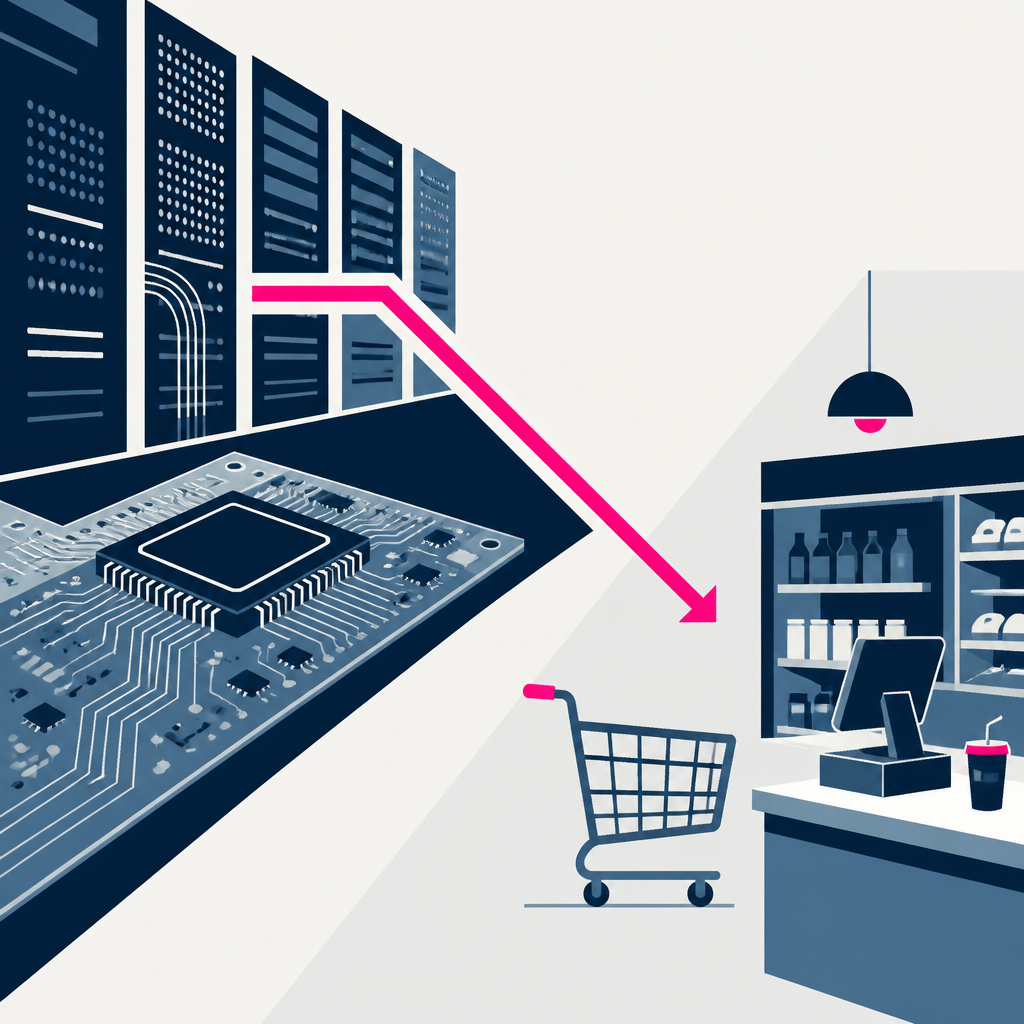
College graduates with computer science and other AI-exposed majors faced fewer hiring opportunities after ChatGPT’s release and increasingly moved into lower-paying service and retail roles. Employment for ages 22–24 in the most AI-exposed fifth of industries fell 12% over ten quarters following ChatGPT’s release. Their initial employment odds and earnings dropped, and the gaps shrank only partially over time as hiring volumes recovered on a smaller base.
Peter Oppenheimer updated his earnings-bubble warning for technology stocks with a new Goldman note arguing that AI infrastructure spending and government borrowing are competing for capital and raising the cost of capital. He cites U.S. convertible bond issuance at $135 billion year-to-date, with AI-related borrowers making up 44% of the total. The update strengthens his case with capex-to-cash-flow data, record credit issuance, and a worsened near-term outlook for stocks.
Shopify CEO Tobias Lütke said employees are using AI to produce unreviewed “slop grenades” that shift extra review work onto others. The survey cited estimates workslop revision costs 3.4 hours per month on average. The focus is shifting from AI as default to tighter review and more careful use to prevent low-quality outputs from reaching coworkers.
The FAA is set to launch SMART, an AI software program intended to help manage air traffic controller workflows and reduce route conflicts. SMART will cost $875 million over a 12-year period and will first roll out in the Washington, D.C., metropolitan area. Controllers’ planning should shift toward predictions of traffic flows using inputs like airline schedules and weather, as the FAA expands the system to other regions.
NATO-backed startup Scaleout Systems is deploying small, on-drone AI models for autonomous battlefield target detection and selection, supporting surveillance and attack missions. The company was founded in 2018 and pivoted toward defense after Russia’s full-scale invasion of Ukraine in 2022. As a result, AI inference can run on small drones using edge/sensor data instead of relying only on larger systems elsewhere, aiming to give NATO allies an operational advantage.
Verity Score launches to track what six AI assistants say about a Shopify store and lets you approve factual corrections and edits before they go live. It covers answers from ChatGPT, Perplexity, Gemini, Claude, AI Overviews, and Grok. As a result, store owners can fix AI-provided inaccuracies, generate or rewrite blog content, and measure the visits and orders those AI answers drive.
Amazon launched Amazon Connect Talent, an AI hiring solution that runs AI-led interviews and assessments at scale while recruiters review scored results. The example provided is ramping up 500 warehouse roles for peak season. Recruiters get dashboards with transcripts and competency-based scores, candidates can interview without scheduling delays, and hiring teams can apply consistent evaluations across larger applicant volumes.
Unvendor launched a shared UI with the AI that turns user wishes into an interactive canvas. It’s launching today with 20 followers. The experience shifts from chatting to an interface that updates as follow-ups arrive and keeps plans in view alongside tools and saved canvases.
Zhang Yiming, the founder of ByteDance (TikTok/Douyin parent), overtook Gautam Adani to become the richest person in all of Asia as his wealth climbed amid AI investment. His net worth reached $105.5 billion. New AI valuations and ByteDance’s ability to train AI models on its social-media data helped drive the rapid increase in his fortune.
Christie Kozlik, chief accounting officer at Accel Entertainment, said AI adoption in corporate finance depends on governance and trust rather than budget because AI outputs must be checked before they feed audited reporting. She cited a target of cutting the financial close from seven days to five. As a result, teams must define inputs and expected outputs, document review steps, and involve internal and external auditors early to ensure AI-produced numbers are filing-ready.
AI coding tools are keeping many developers working longer and self-reporting dependence-like behavior, and managers are reinforcing it by rewarding the heaviest users. The report surveyed over 300 developers who use AI at least once a week, and 43% stayed until home time but couldn’t stop using AI. As a result, breaks, meals, and bedtime get delayed, code is shipped that developers don’t fully understand, and other developers feel pressure to mimic the rewarded “hustle” pattern.
TechCrunch announced the deadline to book an exhibit table for TechCrunch Disrupt 2026, with the option to exhibit or buy a conference ticket instead. The exhibit table deadline is Friday, September 18 at 11:59 p.m. PT. After that cutoff, exhibit table bookings close and startups can only participate via the event with a ticket and matchmaking/networking.
Magentic, a London startup, raised $18 million in Series A funding to build AI agents that diagnose, plan, and act on procurement and supply-chain workflows for manufacturers. Felicis led the round, part of $23.5 million in total funding over 14 months. The company says it will expand coverage to more procurement workflows and fund longer-term AI research into complex optimization problems.
Cooley built GO Public with ChatGPT Work to bring intelligence to the IPO process. The article says Cooley uses ChatGPT Work to help lawyers surface issues earlier. As a result, lawyers can identify IPO issues sooner and spend more time applying judgment rather than routine review.
The author shared an email arguing that increasing reliance on AI for thinking risks turning cognitive offloading into cognitive surrender. They reference an earlier message from March to distinguish the two and to warn that attention and reading habits had already been declining before AI adoption. The article urges a change in how people use AI—favoring more critical reasoning rather than uncritical delegation.
Apple is working on an AI server powered by its M-series Ultra chips. The server is expected to be released in 2029 with two or four M8 Ultra chips. As a result, Apple would be moving deeper into enterprise AI compute with a dedicated, chip-packed server offering.
Veltrix AI launched a new e-commerce product aimed at analyzing sales, costs, customers, and marketing to suggest what to promote and where to cut spending. The first Business Health Check is free. As a result, businesses can run an initial automated assessment without a payment method and then use the tool to plan improvements based on the findings.
Kuva Space completed a pilot showing that combining its Hyperfield-1 hyperspectral satellite imagery with Sentinel-2 and AI can improve large-area monitoring of illicit opium poppy cultivation in Afghanistan. It flagged 8,835 of 248,889 agricultural fields in Helmand Province as likely poppy fields. The approach reduced false positives versus using Sentinel-2 alone and the company plans to raise accuracy toward at least 90% while moving from first-generation classification to field-by-field verification using more ground truth and future Hyperfield-2 data.
Morsa Signals launched GTM and AI visibility workflows for developer-tool founders and GTM teams. The launch page shows 24 followers. It gives founders workflows that start from their product to help with developer outreach, first-user identification, AI search audit, and competitor tracking instead of generic reports.
FaceHeart introduced the CardioMirror smart mirror at the Taiwan Innotech Expo to compute vital signs from a ~40-second camera scan of a person’s face. It says heart-failure screening using that scan reached an AUC of 0.90 (accuracy 89.71%) in a study of 68 participants. The product expands FaceHeart’s rPPG offering (including an SDK and smartphone app) while its FDA clearances currently cover only pulse rate and respiratory rate, leaving heart-failure and NT-proBNP estimates awaiting regulatory approval.
Apple Watch Series 12 adds truly continuous heart-rate monitoring while keeping the same overall look and hardware approach as prior models. The update specifically makes heart-rate tracking continuous. As a result, Apple positions the watch for future AI-focused health features that use more of a full day’s data.
Logibot, a Belgian software platform for logistics robots, raised €1.4M to add an AI layer that helps warehouses pick, train, steer, and monitor robots. The funding round was led by BeamBerlin and includes RDY Ventures, PMV, and BAN Business Angels. The company plans to use the money to roll out its first robots at client sites and assemble a second robot with sensors mounted in Zellik.
Health Force secured €4.2 million in seed financing to expand its AI agents that automate hospital insurance claims across Europe. Three out of four insurance claims can be handled without human intervention in Italy’s largest private hospital groups, and the team plans to grow from eight to sixteen employees. It will deploy the platform to Germany, France, and Spain while adding new agents and local teams to scale its operations.
TechCrunch Disrupt 2026 plans a Builders Stage session on how startups should hire when AI agents handle engineering, customer support, research, and operations alongside people. The event is scheduled for October 13–15 in San Francisco. It shifts early hiring from filling roles to deciding which work people should own versus delegate to AI, with new questions about ownership, checks, and accountability.
Every AI story that matters,
in your inbox by 8am.
TLDRocket reads all relevant sources, removes duplicate coverage, and summarises the
day in two minutes. Follow companies and topics for alerts, or get the
briefing in Slack. Free, no spam, unsubscribe anytime.
Reading TLDRocket needs no cookies, and the readership counts we rely on come from
our own cookieless analytics. Google Analytics is the exception: it sets cookies and
reports to Google, so it stays switched off until you allow it. You can change your
mind any time from “Cookie settings” in the footer.
Strictly necessary
Session security and form protection (tldrocket-session,
XSRF-TOKEN, 2 hours). The site cannot work without them,
so they need no consent.
Always on
Google Analytics 4 (_ga,
_ga_<id>, up to 2 years). Measures which
stories and sections readers use. Google acts as a third-party processor and may
store the data outside the EU. No advertising, no profiling, no data sold.