
Goldman's top strategist just added hard numbers to his earnings-bubble warning
Fortune Nick Lichtenberg

Goldman’s Peter Oppenheimer says AI stocks may have an earnings problem, not a valuation one. He now backs it with debt, capex and bond-market numbers.
Based on reporting by Fortune, Nick Lichtenberg — read the original for the full story.
Summary, retelling and take written by AI under human oversight; images are AI-generated illustrations. How we work · Report an error
Peter Oppenheimer is pressing the AI-bubble case harder than he did in August. Back then, Goldman Sachs’ chief global equity strategist said tech stocks did not look like a valuation bubble, but they might be building an earnings bubble. This week’s note, “Competition for Capital,” keeps that idea intact and gives it a clearer mechanism: AI spending and government borrowing are both fighting for capital at the same time, just as higher energy costs and inflation are pushing borrowing costs up too.
The numbers are the point. Oppenheimer says capital spending among AA-rated technology issuers rose 65% from a year earlier in the second quarter, the tenth straight quarter in which aggregate AA capex growth topped 35%. U.S. convertible bond issuance has hit $135 billion this year, and AI-related borrowers make up 44% of that total. Goldman’s credit team also lifted its full-year forecast for U.S. investment-grade issuance by $200 billion, to a record $2.3 trillion, with AI-related issuers accounting for a quarter of the supply.
He is not alone in reading the credit markets this way. Five days before Goldman’s note, Apollo Global Management’s Torsten Slok argued that the old “savings glut” regime has flipped into a “savings shortage,” with more projects than capital. In his telling, that means capital now wins by demanding a higher return. He pointed to wider spreads on hyperscalers’ longest-dated bonds and said much of the paper issued in 2026 already trades wider than where it priced.
Oppenheimer also used the new note to sharpen his historical frame. He compared today’s setup with banks before 2008, saying the danger then was not an obvious stock-market valuation excess but earnings inflated by leverage tied to U.S. real estate. He still thinks technology looks different in some important ways: profits are “very robust,” balance sheets are “strong overall,” and demand for AI compute is still running ahead of supply. But he also warned that if profit growth slows while the cost of capital stays high, equity prices could come under pressure across the whole AI ecosystem.
Markets got a taste of that split just days before the note. Nvidia fell more than 3% and other chip names dropped 5% to 6% after Anthropic’s Dario Amodei called for a slowdown in frontier AI development, with Sam Altman echoing him. Alphabet, Microsoft and Meta rose anyway. That’s the awkward truth here: the companies paying for the boom can pause it, but the suppliers are the ones left staring at the bill.
My take — AI-written commentary, not fact-checked reporting
This is the part of AI mania that deserves more attention: the hyperscalers can brake, but the chip and infrastructure crowd can’t. That asymmetry is why so many “AI is fine” takes feel suspiciously like a sales pitch with nicer formatting. When capital gets scarce, the people selling picks and shovels don’t get to redefine the weather.
Read more about this at: Fortune
Related stories
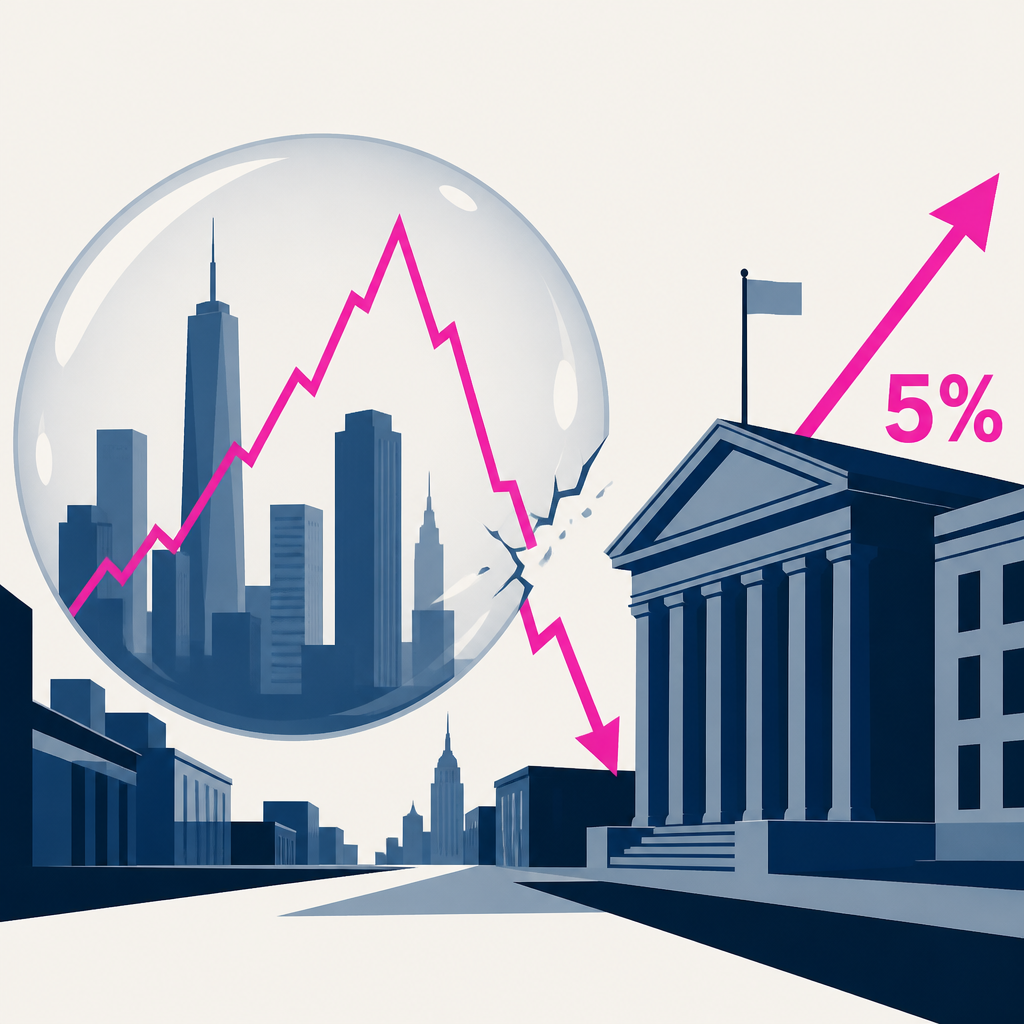 Stocks are in a late-stage bubble and poised to crash 21% next year, while Treasury yields above 5% will signal a new era of tight money, analysts say
Fortune ·
41
Stocks are in a late-stage bubble and poised to crash 21% next year, while Treasury yields above 5% will signal a new era of tight money, analysts say
Fortune ·
41
 Exclusive: Goolsbee says AI is 'not far' from overheating the economy
Fortune ·
2
Exclusive: Goolsbee says AI is 'not far' from overheating the economy
Fortune ·
2