Every AI story that matters — and the intelligence behind it.
TLDRocket reads all relevant sources, removes duplicate coverage, and publishes a short neutral
summary of every story, linking back to the original. Free, no spam, unsubscribe anytime.
OpenAI announced ChatGPT Work and the author of this piece documents how it works after iterating since July 9.
ChatGPT Work is available only to subscribers paying at least $20/month (free and $8/month tiers do not have access).
The article claims Work adds cloud execution with internet-capable code, a headless Chrome browser, persistent shared filesystem access across sessions, and capabilities like publishing ChatGPT Sites and running sub-agent sessions.
A Massachusetts Senate primary debate centered on whether incumbent Ed Markey, 80, is too old for another term, after he gave an unclear answer about using AI platforms like Claude or ChatGPT. Markey would be 86 at the end of another term if he wins Tuesday’s party primary. The campaign narrative pivots on AI regulation and generational change, with some younger supporters urging a focus on Markey’s long record while Moulton’s team frames Markey’s AI misstep as evidence he can’t regulate technologies he doesn’t understand.
Voice-agent latency benchmarks based on time-to-first-token (TTFT) and related measures are published across the full voice stack, including LLMs, speech-to-text, text-to-speech, and speech-to-speech. The practical voice-to-voice target is about 700ms of TTFT budget within a 700ms to 1.2s end-to-end turn. Providers and teams are encouraged to separate generation-start latency (TTFT) from first-sentence completion (TTFS) and treat vendor timing definitions, workload settings, and warm-start behavior as the deciding factors instead of a single TTFT figure.
HappyShrimp is Alibaba’s new AI music generator that produces complete songs (lyrics, melody, arrangement, and vocals) from simple prompts or ideas. It launches today. Users can generate full tracks and also supply their own lyrics while controlling instrument, vocal style, tempo, and progression without production experience.
Google AI researchers released EnvHarness, a programmable wrapper that converts static agent benchmarks into adaptive training environments without changing the underlying simulator or human-built verifiers. It reports up to a 9.0-point gain on held-out tasks and 9.8% fewer execution steps across five benchmarks. Skills mined this way improve when the same reset/step-based interfaces are used, and the release provides Apache-2.0 Python plus drivers for six environments while requiring resettable environments.
OpenAI notified SpaceX that it plans to wind down its contract supplying OpenAI models to Cursor after citing concerns that SpaceX may not use the models under OpenAI’s terms of service.
SpaceX confirmed that a secret foundry it is building in Bastrop, Texas will cast gas-turbine blades and vanes to speed up AI data-center power delivery. It aims to accelerate turbine production by up to 18 months. As a result, faster rollout of gas turbines comes alongside renewed pollution and health lawsuits and studies tied to turbine emissions.
Amy Webb says corporate AI spending is hitting “pilot purgatory” as companies launch endless generative AI pilots without budgeting for integration, scaling, or measurable workflow change. A Bain & Company survey of 951 global companies found nearly 40% of firms that tracked AI savings landed below 10% versus targets of 11% to 20%, with 90% still increasing AI budgets. The result is more “abundance” that feels productive short term but compounds hidden costs, leading to missed targets and a reckoning that she expects as early as next year.
Anthropic and HHMI Janelia opened a research preview of a Model Hardware Standard (MHS) to let AI agents use programmable lab and factory equipment via a shared read/write interface with safety tags. One early partner demo using MHS recovered a quantum laser’s lock in 695 of 700 trials. If adopted, it should cut the time to integrate agent software with physical hardware from weeks or months down to hours or minutes, enabling more automated experiments.
AI agents are shifting retrieval needs so that evidence delivery must be correct and timely for systems that investigate, reason, and act on users’ behalf. The article highlights that when retrieval is commoditized, competitive advantage shifts to decisioning, i.e., deciding what an agent should see and in what order before it acts. Engineers will therefore focus on end-to-end retrieval engineering workflows (hybrid retrieval, real-time signals, ranking, inference, and experimentation) rather than only embeddings or vector search.
Caterpillar is using its experience automating mining and connected equipment to deploy AI across construction and technician workflows, including a voice-driven Cat AI Assistant. Caterpillar has about 1.6 million connected assets and more than 16 petabytes of structured data, and it plans to spend $100 million over the next five years to train its workforce in AI, autonomy, and robotics. The shift requires changing jobsite workflows and employee roles, including moving some operators to remote oversight and expanding AI-related training for 118,000 employees.
Agent demos can look reliable until real inputs trigger missing records, tool errors, policy changes, or capability limits that reveal the system is not production-ready. The article’s example billing trace includes a 13.4s run that used 2,180 tokens and cost $0.04, illustrating how a harness logs and gates work around the model. Production deployments change by treating the model as only one component and adding tool contracts, permissions, deliberate context, traces, and failure-focused tests so wrong calls are contained and diagnosable.
The article argues that most AI startups prioritize speed to ship and learn, building on existing tools rather than optimizing infrastructure until later growth pressures appear. It says infrastructure constraints often become unavoidable by Series A. It recommends preserving architectural optionality—avoiding deep proprietary vendor lock-in and planning for portability—so later cost, latency, and edge/edge-like deployment demands can be met without starting over.
AI agents have caused multiple production incidents by deleting data, exposing user information, enabling account takeovers, and leaking private repositories despite performing their intended tasks. The article points to an Instagram support chatbot being used to hijack thousands of accounts. Organizations should add four safeguards—Sense, Decide, Act, and Secure—to keep agents’ inputs current, ground actions in decision history, orchestrate multi-step workflows, and restrict/monitor permissions with an emergency kill switch.
Proofrr launched a single workspace for creative feedback, reviews, approvals, and version control to replace email-based approvals. It shows 4 followers and positions feedback in WhatsApp while moving versions to Google Drive. The workflow shifts to side-by-side draft comparisons with annotations, shareable review links without client logins, and AI-assisted reviews to speed up feedback.
Texas Governor Greg Abbott froze state spending on Flock AI surveillance cameras amid backlash and a Texas Tribune investigation. The investigation said Texas spent over $30 million on Flock cameras, with much of the funding coming from a $1 fee added to insurance policies. As a result, the state will pause additional payments for the cameras while privacy and misuse concerns continue to drive scrutiny.
The Sequence Radar summarized recent AI developments as an industrial shift, focusing on ownership, power, and capital rather than only model benchmarks. NVIDIA reportedly agreed to acquire Hugging Face for $12.9 billion, about 3x its 2023 valuation. The emphasis moves toward control of distribution, compute infrastructure, and physical hardware finance, with model progress becoming one component in a larger system.
The five-day World Humanoid Robot Games in Beijing showcased humanoid robots in events that included visible failures. Honor’s robot lost a leg mid-sprint during the August 26, 2026 competitions. The coverage shifts attention to how far robots have come while also underscoring how often they still stumble under real running and contact routines.
Anthropic opened a research preview of the Model Hardware Standard (MHS), a shared specification that lets AI agents discover and operate physical devices via a standardized driver instead of bespoke translators. MHS reduced a Carnegie Mellon liquid-handling dose-response workflow from several weeks to about eight hours to produce a completed curve. As a result, device integration time drops to hours or minutes and safety limits can be enforced through the driver across model-agnostic, MCP-compatible setups.
AppGacha turns a plain-language wish into a real desktop app with utilities, widgets, games, and personal tools that run locally. The launch page lists 53 followers. As a result, users can generate portable apps and organize them in their own desktop workspace.
AI hyperscalers are issuing large amounts of corporate debt while buying chips and building data centers, and that demand has diverted capital away from Treasuries. Investment-grade corporate bond issuance reached about $1.7 trillion year-to-date through July, keeping corporate yield spreads compressed. Instead of higher corporate borrowing costs relative to Treasuries, Treasury yields have risen to clear the market, with feedback-loop concerns and signs of market fatigue emerging.
The article argues that unbounded recursive self-improvement is mathematically possible but practically constrained by factors like generation time and physical limits affecting iteration speed and compute. It cites an OpenAI chip called Jalapeño that was built in about 16 months and reported to deliver 1.5–1.9x higher tokens-per-megawatt peak throughput than comparable Nvidia silicon. As a result, the piece shifts focus from endless RSI to faster, segmented progress across open models and more specialized AI hardware rather than expecting infinite acceleration in AI capabilities.
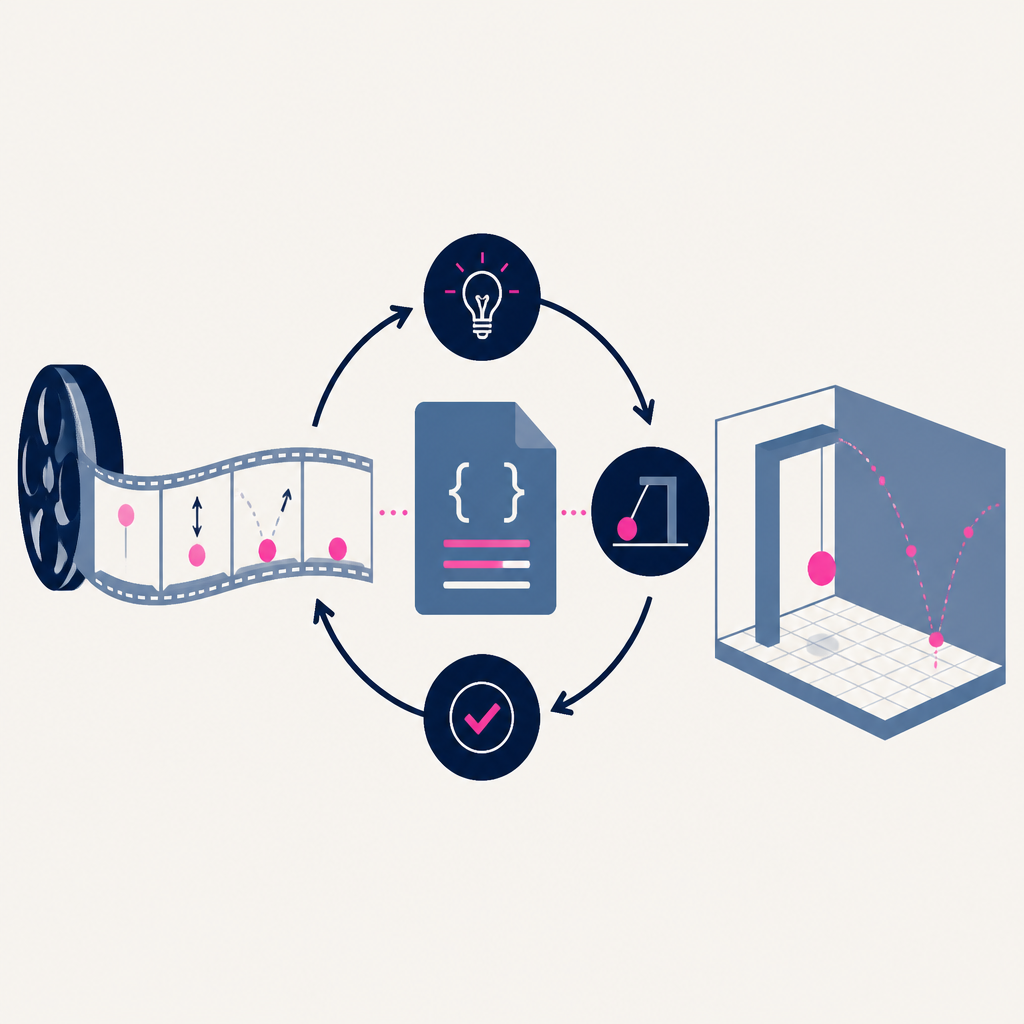
MirroS released Code-as-World, a method that converts real videos into executable MuJoCo physics programs by fitting an editable scene.json rather than predicting pixels, latents, or captions. The agentic propose→execute→verify loop recovers those programs in up to 5 rounds and Code-as-World-VL-9B scores 55.4 MRA on QuantiPhy-validation (above Gemini-3.1 Flash at 54.8). Verified worlds produced by this loop become training supervision with exact physical labels, and MirroS shipped Apache 2.0 code plus 4B and 9B checkpoints with an OpenAI-compatible /v1 vLLM endpoint for internal research use.
Every AI story that matters,
in your inbox by 8am.
TLDRocket reads all relevant sources, removes duplicate coverage, and summarises the
day in two minutes. Follow companies and topics for alerts, or get the
briefing in Slack. Free, no spam, unsubscribe anytime.
Reading TLDRocket needs no cookies, and the readership counts we rely on come from
our own cookieless analytics. Google Analytics is the exception: it sets cookies and
reports to Google, so it stays switched off until you allow it. You can change your
mind any time from “Cookie settings” in the footer.
Strictly necessary
Session security and form protection (tldrocket-session,
XSRF-TOKEN, 2 hours). The site cannot work without them,
so they need no consent.
Always on
Google Analytics 4 (_ga,
_ga_<id>, up to 2 years). Measures which
stories and sections readers use. Google acts as a third-party processor and may
store the data outside the EU. No advertising, no profiling, no data sold.