
Wall Street used to worry that too much U.S. debt would crowd out the private sector. But AI hyperscalers are 'reverse crowding' the Treasury
Fortune Jason Ma
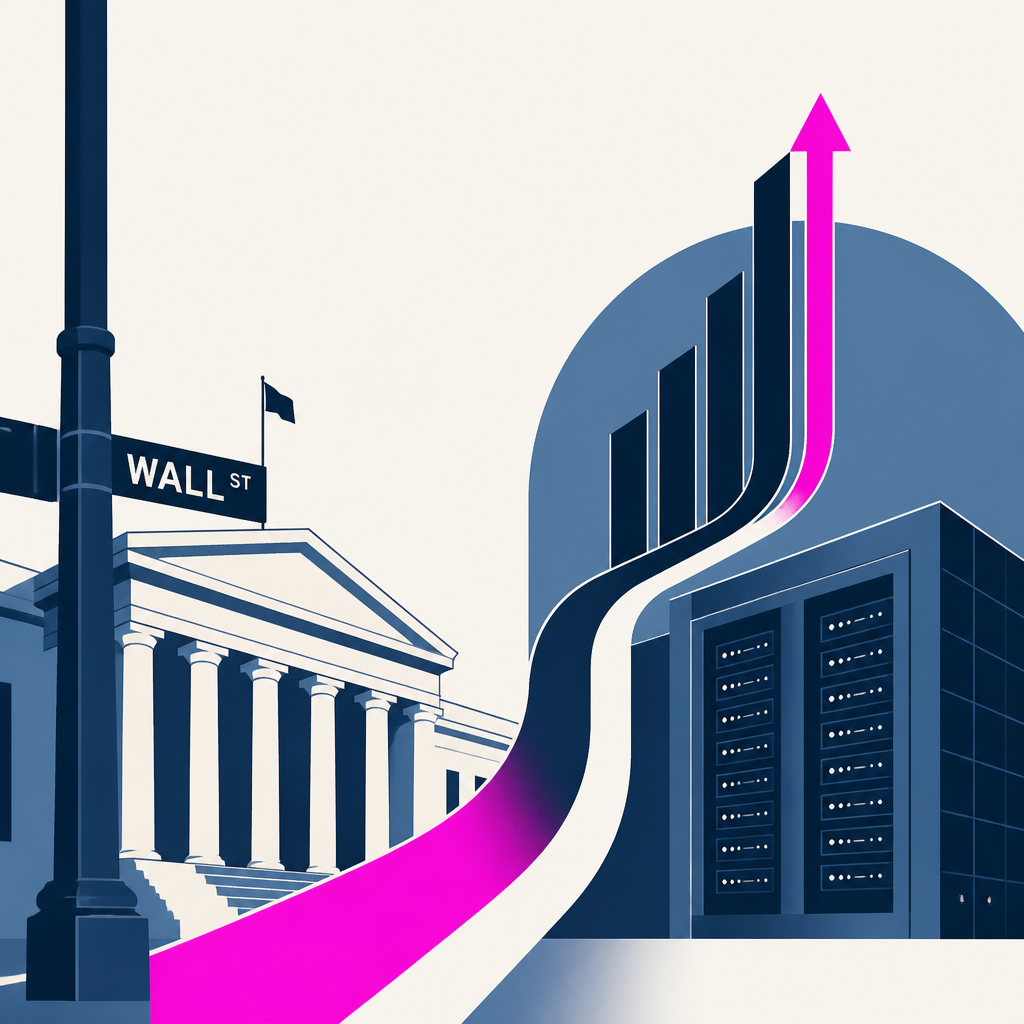
AI giants are borrowing like crazy to build data centers and buy chips. That debt is helping push Treasury yields up instead of crowding out companies.
Based on reporting by Fortune, Jason Ma — read the original for the full story.
Summary, retelling and take written by AI under human oversight; images are AI-generated illustrations. How we work · Report an error
The old fear was simple: if Washington borrowed too much, everyone else would get squeezed out. But the current twist is stranger. U.S. debt is already at $40 trillion, the deficit is headed toward $2 trillion this fiscal year, and debt service alone is running at $1 trillion a year. Even so, the biggest AI firms are still finding buyers for their own debt as they race to buy chips, build data centers, and wire up the rest of the machinery they need.
Treasury Secretary Scott Bessent has noticed. He said recently that a lot of the corporate issuance tied to AI is “almost yield-agnostic,” because companies think the returns from the build-out will be so high that borrowing costs barely matter. That attitude has helped corporate bond sales keep humming. U.S. investment-grade issuance reached about $1.7 trillion through July, according to Ed Yardeni, up about 27% from last year’s pace and on track to top $2 trillion for the first time.
Normally, a flood that big would force companies to pay up to attract buyers. Not here. Yardeni says demand for AI-related bonds has been so strong that the spread over risk-free bonds has barely widened. Instead of corporate borrowing costs jumping much higher, Treasury yields have risen to make room. Capital going into corporate bonds is capital not going into Treasuries. That is the “reverse crowding out” he’s talking about.
The effect has started to get attention beyond the bond market. Jurrien Timmer of Fidelity said on X that the reverse crowding-out in corporate bonds had even reached the Treasury Secretary. Kevin Warsh, speaking at Jackson Hole on Friday, also nodded to the AI debt boom, saying that “ever-expanding pools of capital” are flowing into AI infrastructure. Add private credit financing, Nvidia using its balance sheet to support AI deals, and a hidden-borrowing tally that has hit $1.65 trillion, and the pile gets bigger fast.
There are limits, though. S&P Global warned last month that markets are starting to tire after absorbing so much debt so quickly, even if the hyperscalers still enjoy strong cash flow reputations. The report said issuers once seen as safe are now being asked for a higher premium. That is the part worth watching: the AI boom may not be starving corporate borrowers, but it is making the Treasury pay up.
My take — AI-written commentary, not fact-checked reporting
This is what happens when the biggest hype cycle in finance meets the safest borrower in the world: the “safe” asset gets shoved around by the risky one. AI still has real demand behind it, but Wall Street has a habit of funding every glowing story until the bill arrives. The boring Treasury market is now being dragged into the same circus, which is a very 2026 sentence to write.
Read more about this at: Fortune
Related stories
 The U.S. economy is running hot and stuck on a hamster wheel as GDP growth must outpace borrowing costs—or risk getting sucked into a debt spiral
Fortune ·
31
I.M.F. Warns of a Debt Spiral in the A.I. Build-Out
Trending Topics · 3 days ago ·
4
The U.S. economy is running hot and stuck on a hamster wheel as GDP growth must outpace borrowing costs—or risk getting sucked into a debt spiral
Fortune ·
31
I.M.F. Warns of a Debt Spiral in the A.I. Build-Out
Trending Topics · 3 days ago ·
4