Motorway and AWS built an evaluation pipeline for an AI agent that helps car dealers search vehicle inventory using natural language queries, reducing incorrect results from 1 in 8 to 1 in 50. The pipeline combines the Strands Agents SDK with Amazon Bedrock AgentCore and uses a three-layer framework assessing tool usage (>95% pass threshold), reasoning (>85%), and output quality (>90%), plus a five-stage deployment process with quality gates. Organizations can now catch agent failures before production and during runtime, with test case management and multi-trial evaluation metrics ensuring consistent behavior across repeated interactions.
Jefferies built an agentic AI trade assistant using Claude, Amazon Bedrock, and Model Context Protocol tools to let traders query millions of rows of equities data in natural language without coding or IT delays. The system processes trader queries through an eight-step workflow with retrieval-augmented generation for schema context, row-level security controls, and dynamic SQL generation, enabling real-time sector breakdowns and trend visualizations. Traders now spend less time on data wrangling and dashboard requests, freeing IT teams for strategic work while democratizing data-driven decision-making across trading desks.
Regulated industries can safely adopt AI-assisted software development by treating verification as a continuous engineering process rather than a final step, enabling domain experts to participate in code creation while maintaining compliance controls. The article introduces the Agent Centric Development Cycle (AC/DC) framework that guides AI agents before code generation, verifies output during and after generation, and feeds issues back into the loop for resolution. Organizations that embed compliance controls into their software delivery lifecycle gain faster innovation while maintaining the security and regulatory rigor their industries require.
A RAG architecture tutorial examines three production bottlenecks: synchronous ingestion causing timeouts and cascade failures (fixed with batched fan-out asynchronous pipelines), logical multi-tenancy creating security and performance risks (fixed with serverless namespaced isolation), and semantic caching returning stale answers across similar queries (fixed with hybrid intent routing or infrastructure-level prompt caching). Prompt caching at the LLM provider level can reduce context token costs by up to 80% and drop time-to-first-token to milliseconds. The shift from treating RAG as plug-and-play to engineering it as a distributed systems problem determines whether a prototype survives production deployment in enterprise SaaS environments.
IBM claimed its Q2 software revenue decline resulted from customers temporarily prioritizing AI infrastructure spending rather than abandoning software purchases, with executives noting about one-third of delayed large deals had already closed in the first three weeks of Q3. The company launched Project Lightwell, an AI service to fix security vulnerabilities in legacy open source code, priced at $1 million per year with early customers including major banks and financial firms. IBM is positioning AI-assisted software maintenance as a new multibillion-dollar business opportunity to offset near-term software revenue weakness.
OpenAI launched Presence, an enterprise platform for deploying AI agents with built-in governance controls across business workflows. The product includes configurable policies and guardrails to enable supervised AI deployment. Companies can now integrate AI agents into operations while maintaining oversight and safety boundaries.
A new benchmark called Beaver reveals that large language models perform substantially worse at text-to-SQL tasks when tested against real-world database schemas compared to idealized benchmarks. The benchmark accounts for schema rot and idiosyncratic data patterns typical of production data warehouses. This suggests current LLM-based SQL generation tools may be less reliable in actual enterprise deployments than their benchmark scores indicate.
OpenAI launched Presence, an enterprise platform for deploying and managing voice AI agents and chatbots in customer-facing and internal business workflows. The product targets eligible enterprise customers seeking agents that operate under company-defined policies, permissions, and evaluation standards. Enterprises can now build and manage voice AI systems with governance controls tailored to their operational needs.
Traditional automated CV screening systems are inadequate for hiring AI specialists because candidates increasingly use AI tools to enhance applications, making it difficult to distinguish genuine skills from inflated claims. According to Statista, over 60% of job seekers in the UK and US now use AI tools during applications, and LinkedIn data shows EU companies added 256,000 AI-related roles between 2023-2026. Instead, recruiters should use tailored AI screening platforms that evaluate demonstrated competency through technical interviews and problem-solving tasks, assess candidates' ability to learn and adapt, and eliminate geographic bias through anonymisation when sourcing talent internationally.
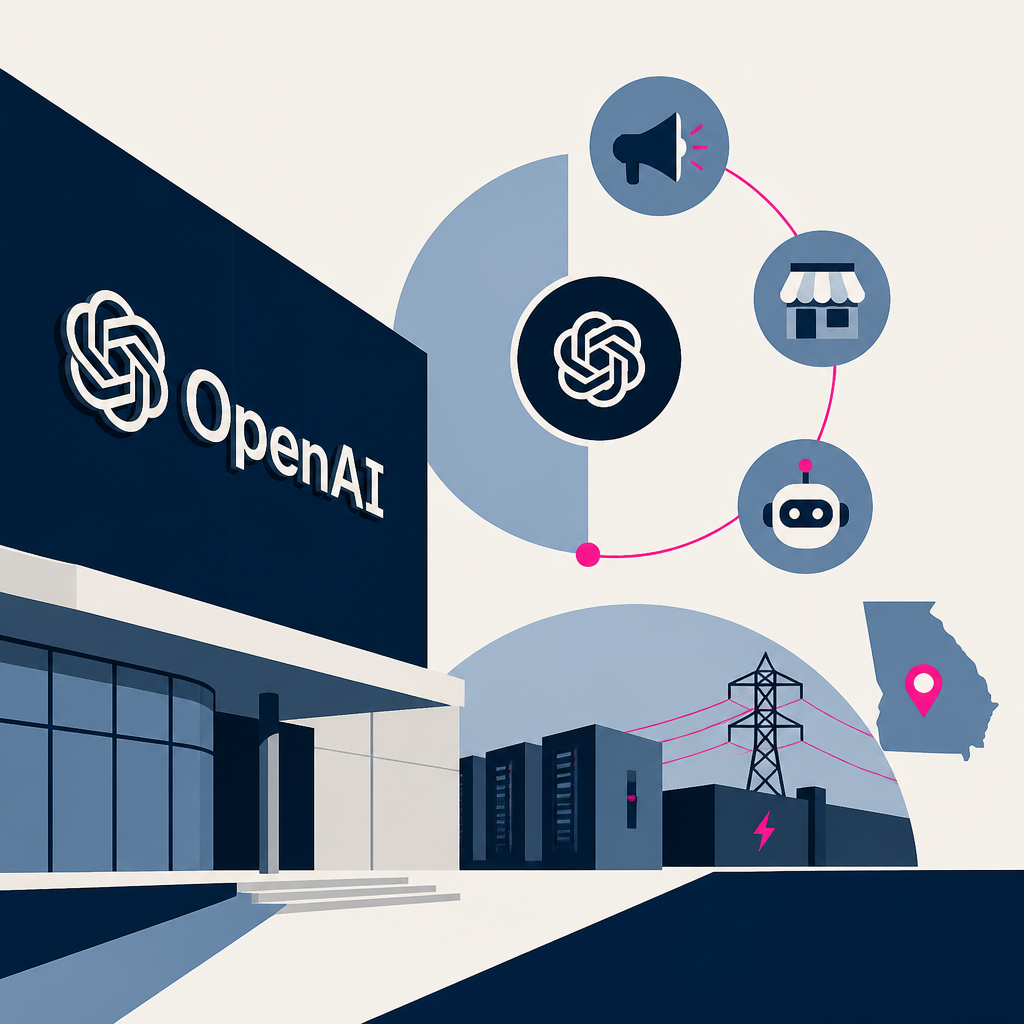
OpenAI added advertising, small-business agents, and announced a 3.2 GW data center in Georgia to transform ChatGPT into a business platform beyond conversational AI. The company is building infrastructure with 3.2 gigawatts of power capacity in Georgia to support expanded services. This positions ChatGPT as an operating system for businesses rather than just a chat interface.
ServiceNow invested $40 million in BusinessNext, an Indian banking software company, taking a roughly 5% stake at a $700 million valuation and gaining access to partnership opportunities in financial services AI. BusinessNext generated approximately $32 million in revenue last year and serves over 70 banks including India's central bank and major lenders across India, Southeast Asia, the Middle East, and the U.S. The partnership combines ServiceNow's workflow automation platform with BusinessNext's banking expertise and AI agents, enabling the companies to jointly sell integrated solutions to financial institutions globally.
Mistral, the French AI startup, is shifting away from building frontier models and focusing instead on enterprise deployment and customization services. The company's revenue grew 37% year-over-year in 2024, with enterprise and infrastructure revenue reaching 80%, compared to 30% from consumer-facing products. This pivot mirrors the strategy of Palantir, moving from cutting-edge model development toward becoming a software and services company for business customers.
Every AI story that matters,
in your inbox by 8am.
TLDRocket reads all relevant sources, removes duplicate coverage, and summarises the
day in two minutes. Follow companies and topics for alerts, or get the
briefing in Slack. Free, no spam, unsubscribe anytime.
Reading TLDRocket needs no cookies, and the readership counts we rely on come from
our own cookieless analytics. Google Analytics is the exception: it sets cookies and
reports to Google, so it stays switched off until you allow it. You can change your
mind any time from “Cookie settings” in the footer.
Strictly necessary
Session security and form protection (tldrocket-session,
XSRF-TOKEN, 2 hours). The site cannot work without them,
so they need no consent.
Always on
Google Analytics 4 (_ga,
_ga_<id>, up to 2 years). Measures which
stories and sections readers use. Google acts as a third-party processor and may
store the data outside the EU. No advertising, no profiling, no data sold.