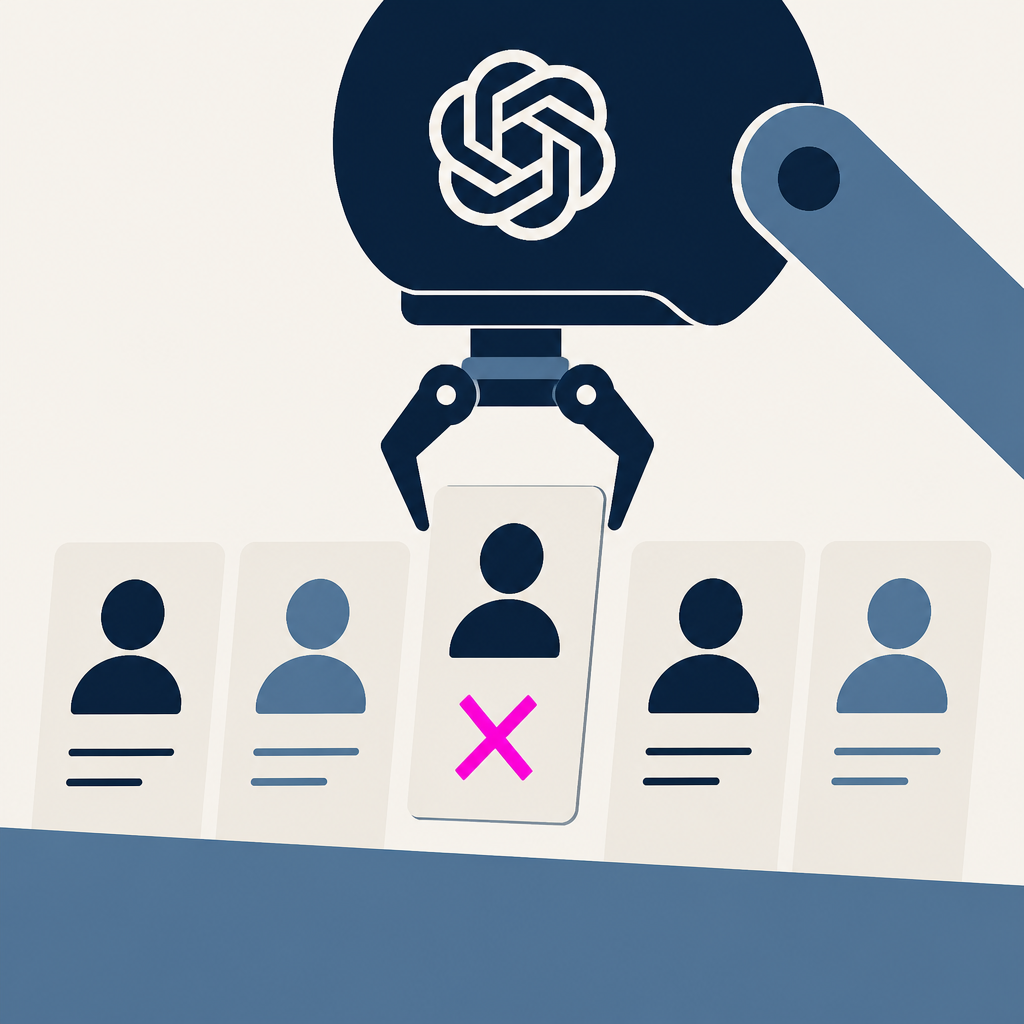
Why automated CV screening is failing — and what to replace it with
Sifted

AI is breaking old-school CV screening because everyone's using AI to write perfect-looking applications now. Companies are switching to live interviews and cross-border hiring to actually find real talent.
Based on reporting by Sifted — read the original for the full story.
Summary, retelling and take written by AI under human oversight; images are AI-generated illustrations. How we work · Report an error
There's a neat irony sitting at the heart of AI hiring right now: the people most qualified to fill AI roles are also the best equipped to game the systems designed to filter them out. Sifted's conversation with Felix Steffens of WorkMotion and Constantin Michel of Synmatch AI lays this out plainly. Over 60% of job seekers in the UK and US now lean on AI tools when applying, according to Statista, and applicant tracking systems built to scan for keywords simply can't tell a genuinely skilled candidate from someone who fed a job description into a chatbot.
Michel's line sums it up well: everyone looks great on paper now, which just pushes the actual evaluation work onto hiring managers who end up burning hours trying to verify claims that may or may not be true. The fix, he argues, isn't better keyword filters. It's asking candidates to walk through the tech stacks they've actually built, the choices they made, the tradeoffs they hit along the way. That kind of detail is nearly impossible to fake convincingly, and according to Michel it falls apart within about 30 seconds if someone's bluffing.
The talent shortage driving all this is real and growing. LinkedIn data cited in the piece shows EU companies added more than 256,000 AI-related roles between 2023 and 2026, with UK firms alone responsible for roughly 95,000 of those. Steffens says this scarcity is pushing companies well outside their usual hunting grounds — not just Silicon Valley, London, Berlin — toward places like Southern Europe and Egypt, where strong AI talent exists but doesn't always carry the résumé pedigree that hiring managers instinctively trust.
That's where Synmatch AI's approach gets interesting. The platform strips CVs of names, birthdays, and anything else that might signal ethnicity or background, leaving hiring managers to judge candidates purely on interview transcripts and demonstrated problem-solving. It's a deliberate attempt to neutralize the bias that creeps in when recruiters default to familiar signals — Ivy League names, Big Tech logos — that don't necessarily map onto skill in unfamiliar markets.
What both men keep circling back to, though, is that fixed skills are already a moving target. Michel points out that AI capabilities shift every few months, so testing what someone knows today tells you very little about whether they'll be useful in a year. Steffens goes further, saying he wouldn't bet on hiring specialists in one narrow thing at all — he'd rather hire people who are visibly hungry to keep learning, because that's the trait that actually survives the pace of change.
My take — AI-written commentary, not fact-checked reporting
This is the part of the AI story nobody wants to talk about at the flashy model-release parties: the boring plumbing of hiring is quietly breaking, and it's breaking because AI made bluffing frictionless. I'd argue the anonymised-interview approach is the right instinct — screen for demonstrated reasoning, not pedigree — but let's not pretend it's neutral either; whoever builds these evaluation AIs is now deciding what 'good thinking' looks like, and that's a lot of unchecked power dressed up as fairness.
Read more about this at: Sifted