Plug and Play Tirana Expo 2026 will bring startups, investors, corporate leaders, and ecosystem experts to the Pyramid of Tirana as it culminates the second Plug and Play Tirana Accelerator Programme. The two-day event runs October 7–8, 2026. The expo will add startup pitches and investor networking sessions focused on areas including AI-powered B2B SaaS & Enterprise, aiming to connect Western Balkans founders with international capital and partners.
1Password said its AI agent access is tied to individual tasks to avoid confusing attribution in audit logs when agents act on behalf of users. The company described turning the approach into a privileged access product scoped to a single task. This shifts access toward just-in-time, task-based permissions with credentials released on demand via a credential broker, rather than shared broadly or stored in the model.
1Password ties AI agent access to individual tasks to address identity and auditing confusion when agents log in and act on someone’s behalf. The company says it grants just-in-time access scoped to a single task with credentials that never sit in the model. This shifts security to task-based, hybrid human-and-agent identity checks and requires shared identity standards and cloud-based secure access.
ServiceNow says enterprises should manage misbehaving AI agents with governance that weighs both risk and the business work the agent supports. The company describes containment as scaling with risk, including pausing an agent that stops producing results versus revoking access when an agent authorized for a 10% discount ends up discounting 100% after prompt injection. The approach shifts from treating a “kill switch” as just an on/off button to mapping agents to business processes and adjusting permissions and session access as needed.
ServiceNow says enterprises should govern and contain misbehaving AI agents using a response that considers both risk and the business work the agent supports. It argues a pause is enough when an agent stops producing results, but it says a prompt-injected discount agent that shifts from 10% to 100% should have its access revoked or be “pulled the plug.” This approach changes how organizations decide between pausing agents and revoking permissions by tying containment actions to business context and identity/session controls.
Oracle is working with customers to secure data as agentic AI expands in enterprise security operations. The focus is on identity controls for AI agents that carry permissions to access data and take actions across workflows. Security teams must expand inventory of sensitive assets and where agentic AI is being built to keep protection current as AI-powered attacks evolve.
Meta launched the Meta Enterprise Platform to expand its AI offerings for businesses and corporate customers, led by Chirantan “CJ” Desai, MongoDB’s CEO.
Mistral opened a new hub in Munich focused on Physics AI and Industrial AI to work with European enterprises on industrial AI use cases. The hub is part of a plan to build 1 gigawatt of European compute capacity by 2030. It shifts Mistral’s presence toward long-term, enterprise-oriented deployment on customers’ own infrastructure with models available in open-weight form.
Outmarket, an insurtech startup led by Vishal Sankhala, raised a Series B to expand its AI that automates commercial insurance paperwork for agencies and brokers. The round totals $34.5 million and follows its $17 million Series A four months earlier. This funding accelerates Outmarket’s growth among insurance agencies using its automation product, with the article citing expansion to over 300 agencies since launch 14 months ago.
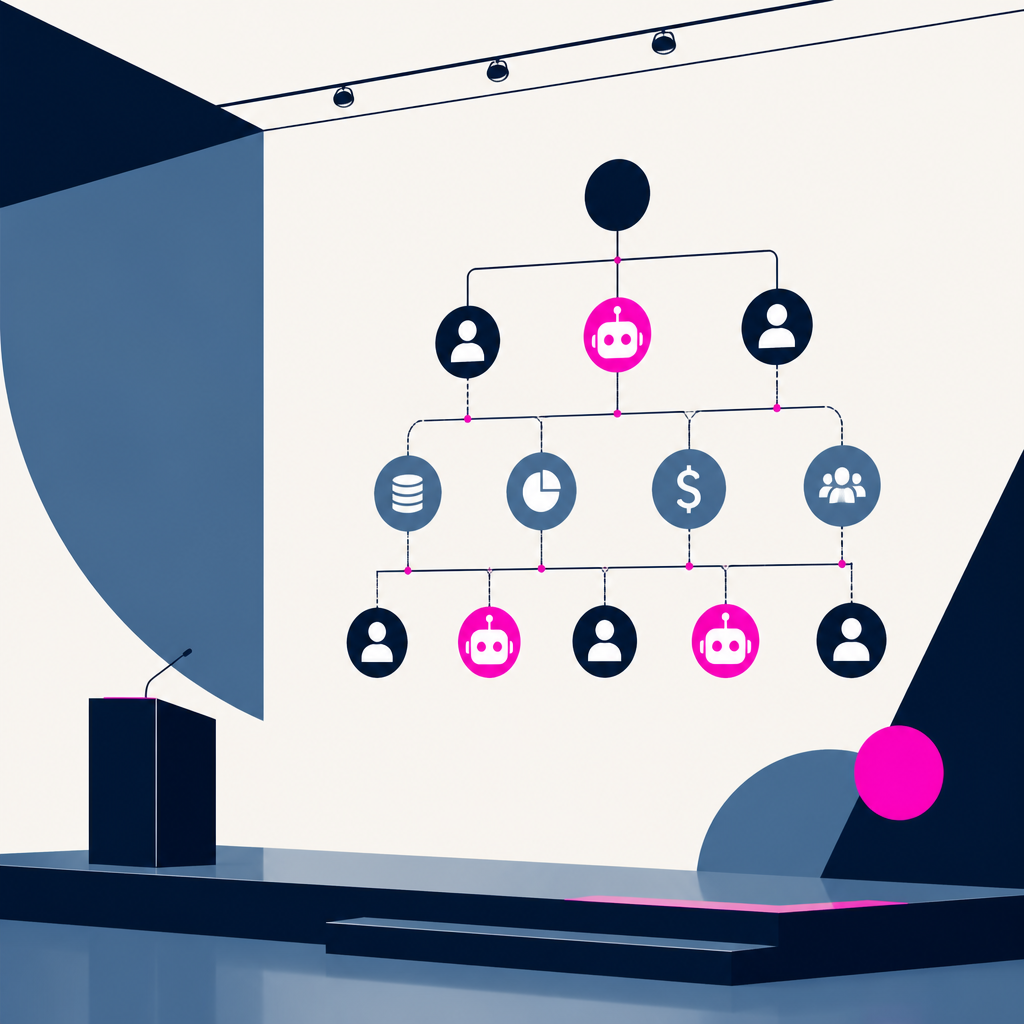
MIT professor Paul Cheek argues for replacing traditional org charts with an AI-native version that shows which employees and AI agents have access to systems, budgets, and decision roles. The AI-Driven Enterprise Institute found just over 30% of S&P 500 executives are AI-literate, and that group reportedly delivers 78% stronger AI execution. If adopted, CHRO work would shift toward auditing whether roles need human judgment or AI uptime, and the org chart would update as AI agents are added or removed.
Bank of America introduced Payments Insights within CashPro to analyze payment efficiency, cross-border flows, and working-capital performance against industry peers. The system processed 213 million payments in the first half of 2026, 10% more than a year earlier. As a result, treasury teams can spend less time assembling data and more time on analysis, while staff focus on retraining and workflow redesign around embedded AI analytics.
Autoheal raised seed funding to build a unified platform for evaluating and fixing fleets of AI agents used in “software factory” development workflows. The round is for $7.9 million, which the company says will let it add shared context, evaluation, and a “healer” agent that opens Git-verified pull requests under human approval. It also plans to develop reinforcement learning techniques to train enterprise-specific small language models inside customers’ private clouds so the agents can run more cost-effectively and securely.
Atlassian CEO Mike Cannon-Brookes argued that AI will change how Atlassian’s enterprise collaboration and work-management tools handle business processes without eliminating the need for human oversight. He said many businesses already use AI to automate about 80% of steps, while complex, judgment-heavy exceptions still require people. As a result, work systems are expected to become faster and more consistent but still rely on humans for initiation, intuition, and final decisions rather than frontier models running entire businesses end to end.
Complaion raised €13.5 million to expand its compliance platform and team for European SMEs. The funding round aims to automate up to 80% of manual compliance work and cut certification timelines by up to 5 times. With the new capital, Complaion will hire specialized staff, strengthen customer support, expand across Europe, and add services like Health & Safety, Privacy/GDPR, subsidised financing, and DPO-as-a-service.
bilt.me raised $700,000 in pre-seed funding to build an AI agent that turns an idea into a native iOS and Android app. The round was led by Superhero Capital. The money will fund global expansion and further development of its application-building platform and supporting infrastructure.
Every AI story that matters,
in your inbox by 8am.
TLDRocket reads all relevant sources, removes duplicate coverage, and summarises the
day in two minutes. Follow companies and topics for alerts, or get the
briefing in Slack. Free, no spam, unsubscribe anytime.
Reading TLDRocket needs no cookies, and the readership counts we rely on come from
our own cookieless analytics. Google Analytics is the exception: it sets cookies and
reports to Google, so it stays switched off until you allow it. You can change your
mind any time from “Cookie settings” in the footer.
Strictly necessary
Session security and form protection (tldrocket-session,
XSRF-TOKEN, 2 hours). The site cannot work without them,
so they need no consent.
Always on
Google Analytics 4 (_ga,
_ga_<id>, up to 2 years). Measures which
stories and sections readers use. Google acts as a third-party processor and may
store the data outside the EU. No advertising, no profiling, no data sold.