Every AI story that matters — and the intelligence behind it.
TLDRocket reads all relevant sources, removes duplicate coverage, and publishes a short neutral
summary of every story, linking back to the original. Free, no spam, unsubscribe anytime.
Prem Natarajan, a former Amazon Alexa AI leader, became Chief Scientist at Capital One to advance AI research tailored to banking's complex constraints rather than deploying off-the-shelf models. Capital One filed 38 percent of AI patents among the top 50 financial institutions and was recognized as the only bank among top U.S. patent leaders in agentic and generative AI in 2025. The bank is developing domain-specific AI systems like fully agentic customer service tools and fraud detection across billions of transactions, requiring original research that adapts general models to real-world financial problems serving over 100 million customers.
Microsoft Research and collaborators developed generative causal testing (GCT), a method that distills opaque language model predictions of brain activity into readable explanations by having LLMs generate targeted stories to confirm which concepts specific brain regions respond to. The approach was published in Nature Neuroscience and successfully identified known selectivity patterns, separated three place-processing regions previously thought similar, and discovered unmapped prefrontal micro-regions tuned to specific concepts like dialogue and clock times. GCT demonstrates that black-box predictive models can be converted into testable scientific hypotheses that can be verified through real experiments.
Anthropic introduced Claude Tag, enabling users to mention and delegate tasks to a shared instance of Claude Code within Slack while maintaining conversation context. The feature allows Claude Code to access Slack messages and manage workflows without losing context from previous discussions. This change enables team-based agent collaboration and task delegation through Slack's interface.
AI systems have progressed from basic mathematical computation to solving unsolved problems and producing publishable research, with Google DeepMind's Aletheia achieving Ph.D.-level results and OpenAI's system disproving a conjecture in combinatorial geometry. Large language models combined with proof assistants are automating the formalization of mathematical proofs, removing a bottleneck that previously required mathematicians to manually translate informal proofs into machine-readable code. As AI increasingly handles mathematical problem-solving, mathematicians must reconsider whether their value lies primarily in obtaining answers or in the deeper satisfaction found in the struggle to understand complex ideas.
Researchers released a report measuring the generative AI economy at $110 billion in revenue over the past 12 months with an annualized run rate of $175 billion, using a deduplicated model that tracks end-customer spending rather than double-counting supply chain flows. The analysis found that AI revenues are growing roughly three times faster than previous technology waves like mobile and internet, and that hyperscaler revenues are approximately covering depreciation expenses on AI infrastructure capital spending. As token prices fall, demand elasticity shows a 10% price cut generates 12-18% more token usage, suggesting the market will expand further as models improve and become cheaper.
OpenAI unveiled Jalapeño, its first custom inference processor developed with Broadcom, designed to reduce dependence on Nvidia GPUs. Early testing shows significantly better performance-per-watt than current alternatives, with the chip specifically optimized for low-cost inference on real-time coding models. The move allows OpenAI to control more of its infrastructure stack, potentially improving operating economics and enabling faster, more reliable, and cheaper service delivery.
Major AI labs are hiring philosophers to help address ethical and operational challenges in AI systems. Companies are now recruiting philosophy experts to apply ethical frameworks and critical reasoning to AI development and decision-making. This trend creates new career opportunities for philosophers while influencing how AI systems are designed and evaluated.
Researchers provided a mechanistic analysis of how prompt injection attacks work in large language models, showing that model behaviors shift when given role-playing instructions. The study identified that transformer attention mechanisms selectively follow instructions from role-based contexts rather than original system prompts. Understanding these mechanistic details helps defend against prompt injection by clarifying how models internally process conflicting instructions.
Peerd is a browser extension that runs AI agent loops locally in Chrome or Firefox, allowing agents to read and control your existing tabs, run sandboxed code, and optionally communicate peer-to-peer, with all keys encrypted locally and no backend or telemetry. The extension uses browser security primitives (V8 isolates, WebCrypto, iframes) to isolate the agent holding your API keys from the untrusted content it reads, delegating work to separate actors that hold no keys and operate individual environments. The project is in experimental 0.x status with breaking changes likely, available as developer preview, store packages, or research preview with decentralized web features.
Google integrated computer use capabilities directly into Gemini 3.5 Flash, enabling AI agents to see, reason, and act across browsers, mobile, and desktop environments. Developers can access this feature via the Gemini API and Gemini Enterprise Agent Platform, with safeguards including adversarial training and optional enterprise controls for sensitive actions. This allows builders to create agents for automation tasks like software testing and knowledge work across professional applications.
An article discusses best practices for naming variables, functions, and classes in software development from a cognitive psychology perspective. The author cites a study showing that improving identifier names yields the largest returns for LLM code understanding and that clearer names reduce debugging time by 19%. Better naming practices help both humans and AI tools understand code intent more quickly and reduce the cognitive load required to maintain and reason about software.
PostHog rewrote its SQL parser using Claude AI in parallel coding sessions, producing 16K lines of hand-rolled Rust code that achieves 454x faster performance than the previous ANTLR-based C++ parser on production queries. The developer used property-based testing with a custom SQL generator based on the grammar file, along with code-coverage-guided fuzzing and production corpus testing, to ensure the new parser matched the oracle parser's behavior on millions of queries. The rewrite—which would have taken months without AI assistance—demonstrates that LLM-assisted hand-written parsers can outperform generated parser frameworks.
Alibaba's Qwen team released three new robotics models—Qwen-RobotNav, Qwen-RobotManip, and Qwen-RobotWorld—designed to translate visual understanding into robotic actions. The models address the gap between perception and physical execution, with the main bottleneck identified as converting visual understanding into motor commands rather than general intelligence. This shift enables Qwen's language models to move beyond text and image tasks into controlling physical robotic systems.
The author argues that the software industry mischaracterized the importance of natural language AI by focusing on conversational interfaces when the real capability is language-native systems that accept user intent in plain language and execute deterministic operations. The distinction matters because conversation is just one mechanism for clarifying intent; most valuable interactions—like querying business intelligence, scheduling, or financial planning—require language understanding but not dialogue. Future software architecture should separate intent determination (where ambiguity is acceptable) from execution (where determinism is essential), treating natural language as a programming interface rather than a chat interface.
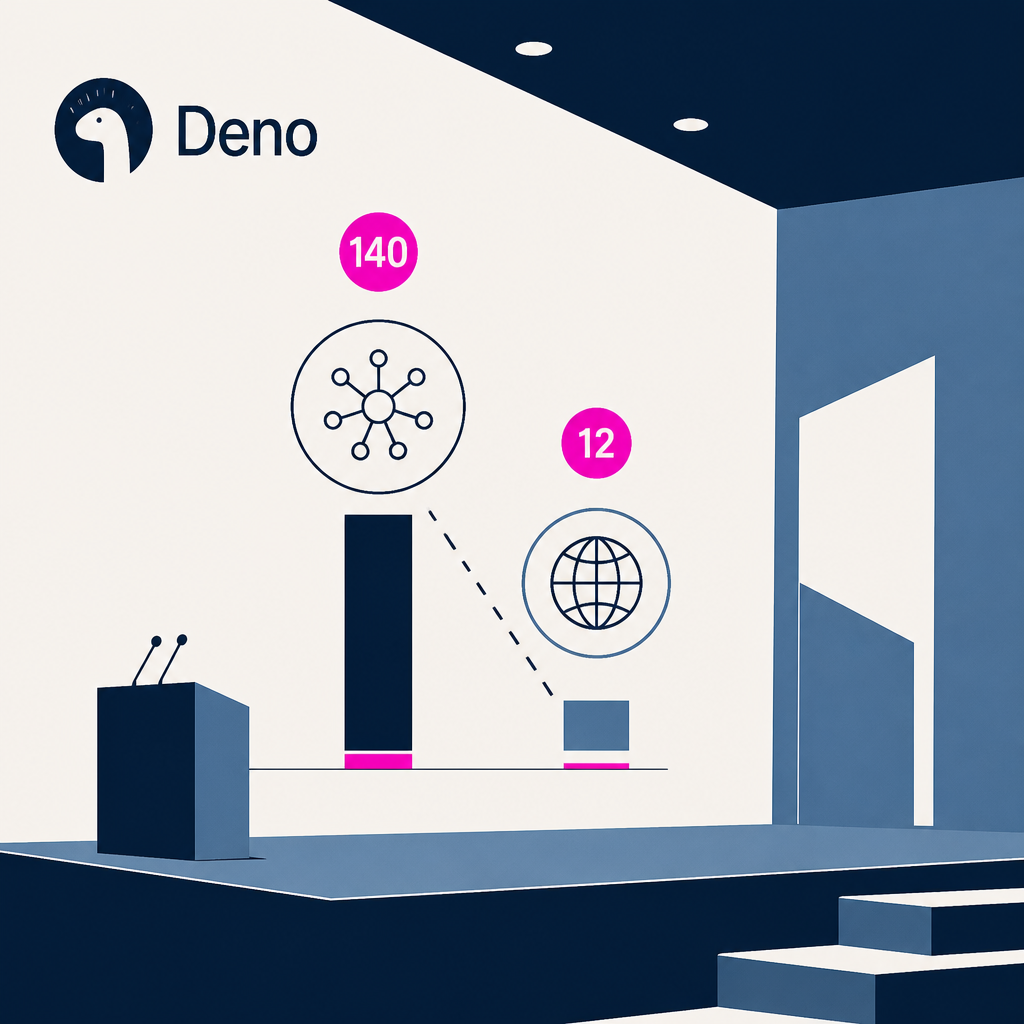
A developer documented how LLM-generated code patterns consume excessive output tokens by relying on outdated Node.js conventions instead of native Web APIs available in modern runtimes like Deno. Query string parsing costs 140 tokens versus 12 tokens using native URL APIs, form handling costs 200+ tokens versus 14 tokens using FormData, and a complete request handler costs 400–600 tokens in default style versus 60–90 tokens with native APIs. Developers can reduce API costs and improve security by specifying their runtime environment and teaching LLMs to use platform-native solutions already tested against edge cases.
Colin Angle, former iRobot CEO, founded Familiar Machines & Magic to sell a home robot that monitors loved ones and responds emotionally using on-device AI models. The Familiar is a furry creature that processes interactions locally without cloud data transmission. The product targets elderly care and family connection, shifting Angle's focus from autonomous vacuums to emotional AI companions.
OpenAI and Broadcom unveiled Jalapeño, a custom AI chip designed for inference workloads, marking OpenAI's first entry into silicon manufacturing. The chip was designed in nine months and will be deployed starting late 2026, with significant scaling expected in 2027 and early 2028. OpenAI aims to reduce dependence on Nvidia GPUs and build a complete technology stack to serve AI models more efficiently and affordably.
Google researchers developed linear elastic caching that dynamically adjusts cache size using lightweight machine learning to optimize the trade-off between memory costs and cache misses. In production testing on Spanner, the approach reduced memory usage by 15.5% and total cost of ownership by approximately 5% while increasing cache misses by only 5.5%. The system frames cache eviction as a ski rental problem where data can be kept in expensive RAM or evicted to slower storage, with a shallow decision tree predicting optimal retention times for each data page.
IBM announced 0.7 nanometer transistor chips, the smallest in the world, using a new three-dimensional nanostack architecture with innovations in wafer bonding and memory scaling. The chips are 70% more efficient than IBM's previous 2 nanometer chips from 2021, and could theoretically enable AI accelerators to deliver 9,000 TOPS compared to current accelerators' 1,500 TOPS, potentially reducing training time for large language models from three months to two weeks. The nanostack design could support a decade of further chip innovations by stacking transistors vertically rather than only shrinking them horizontally.
Researchers compared Olmo 3 (a transformer) and Olmo Hybrid (a hybrid architecture) by analyzing how well each predicted different token types, finding that hybrid models excel at predicting content words like nouns and verbs with a loss gap of 0.04 compared to 0.02 on function words, while transformers maintain their advantage on tokens that repeat verbatim from earlier in the passage. The study used regression analysis across passages of prose, code, and structured text to isolate architecture-specific strengths. This fine-grained token-level analysis suggests that hybrid architectures warrant further development and that single overall loss metrics are insufficient for comparing different model architectures.
OpenAI's research paper documents how AI agents are handling longer and more complex tasks, expanding their application across different work roles. The paper demonstrates agents completing multi-step processes that previously required sustained human attention and decision-making. Organizations can now delegate more intricate workflows to AI systems, reducing manual intervention in routine and complex work alike.
Every AI story that matters,
in your inbox by 8am.
TLDRocket reads all relevant sources, removes duplicate coverage, and summarises the
day in two minutes. Follow companies and topics for alerts, or get the
briefing in Slack. Free, no spam, unsubscribe anytime.
Reading TLDRocket needs no cookies, and the readership counts we rely on come from
our own cookieless analytics. Google Analytics is the exception: it sets cookies and
reports to Google, so it stays switched off until you allow it. You can change your
mind any time from “Cookie settings” in the footer.
Strictly necessary
Session security and form protection (tldrocket-session,
XSRF-TOKEN, 2 hours). The site cannot work without them,
so they need no consent.
Always on
Google Analytics 4 (_ga,
_ga_<id>, up to 2 years). Measures which
stories and sections readers use. Google acts as a third-party processor and may
store the data outside the EU. No advertising, no profiling, no data sold.