
Liquid AI Releases LFM2.5-VL-3B-DSpark: Speculative Decoding for Vision-Language Models With Up to 3.13x Faster Decoding
MarkTechPost Asif Razzaq ● Covered by 2 sources
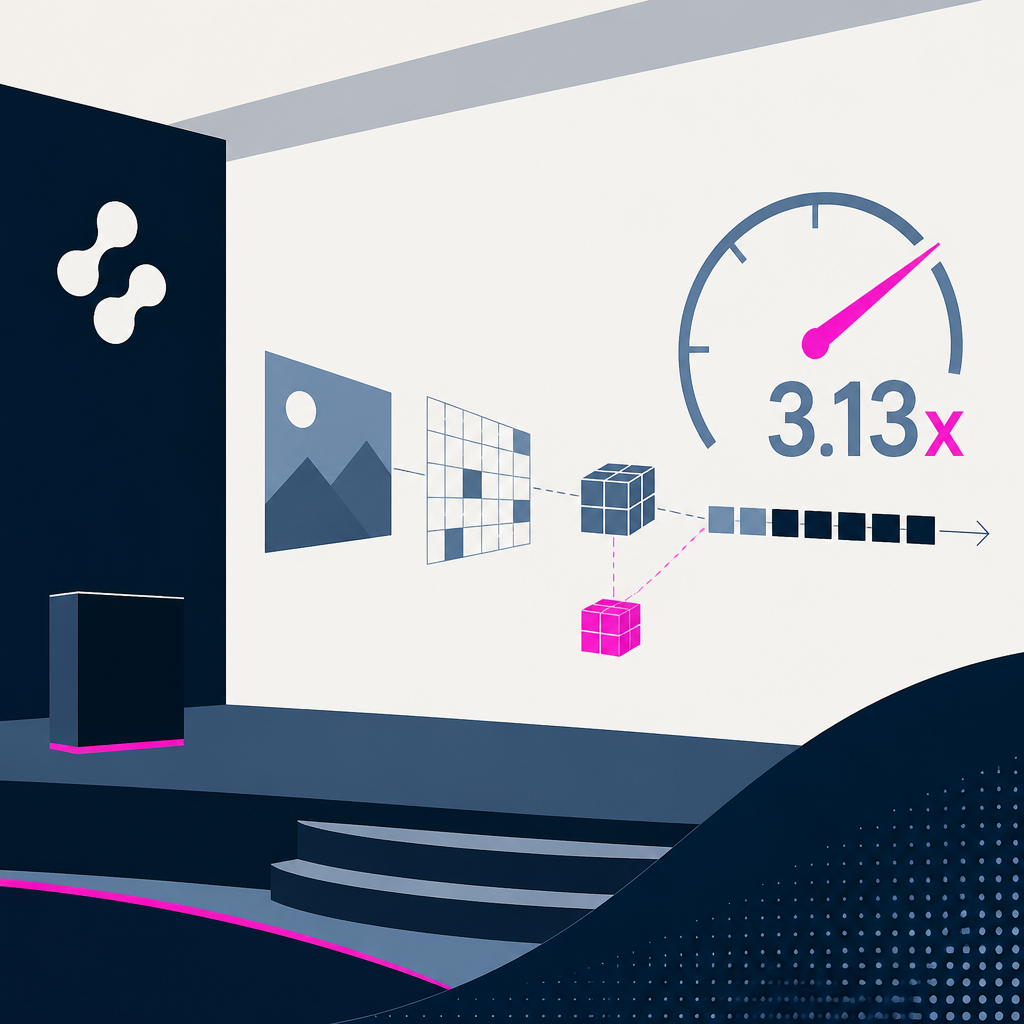
Liquid AI’s new vision-language draft model can make decoding up to 3.13x faster. It keeps the same output, but only under certain settings and still isn’t a full end-to-end cure.
Based on reporting by MarkTechPost, Asif Razzaq — read the original for the full story.
Summary, retelling and take written by AI under human oversight; images are AI-generated illustrations. How we work · Report an error
Liquid AI has put out LFM2.5-VL-3B-DSpark, an experimental draft model built for its LFM2.5-VL-3B vision-language system. The idea is simple enough: add a small helper that suggests tokens ahead of time, let the bigger model verify them, and save time without changing what comes out. Liquid AI says the drafter adds about 279.5M parameters, or 8.9% on top of the base model, and can push decoding as high as 3.13x faster on Apple silicon and 2.66x faster on an NVIDIA H100.
This is not a lab-only tease. The weights are already on Hugging Face in Safetensors and GGUF, and day-one support is there for SGLang, MLX-VLM, and llama.cpp. Liquid AI is also calling the release experimental, which is the right amount of caution for something that leans so hard on exact model pairing and runtime support. The license matters too: LFM Open License v1.0 allows free commercial use only for companies under $10M in annual revenue.
The draft model itself is stripped down. Liquid AI says it uses an attention-only design with 4 layers, a hidden-state projection, a Markov head, and tiny norm and confidence pieces. The embedding and LM head are tied to the target model, so they do not sit inside the drafter. Training used supervised fine-tuning data drawn from common vision-language tasks over 10 epochs, and all the ablations and training were done on AMD hardware.
The speed numbers come from MMSpec, which covers six task types: General VQA, Text VQA, Image Captioning, Chart VQA, Complex Reasoning, and Multi-turn Conversation. The best decoding gains do not always line up with the best end-to-end gains, because image encoding and prefill still take the same time. That is why Liquid AI can show 3.13x faster decoding on the M5 Max while the end-to-end figure there is 2.62x, and why TextVQA on the same machine lands at 1.56x end to end even when decoding moves much faster.
The company’s own testing says the pattern holds across Apple silicon, llama.cpp on an M3 Ultra, and SGLang on an H100 80GB: speculative decoding helps, but the rest of the pipeline still sets the ceiling. Under greedy decoding the output matches the base model exactly. At non-zero temperatures, the output distribution is preserved, but the acceptance rate drops when the model gets more uncertain. That is the tradeoff. Faster tokens, yes. Magic, no.
My take — AI-written commentary, not fact-checked reporting
This is the kind of release that makes more sense than the usual AI fireworks. A real speedup on real runtimes, a public weight dump, and an honest note that prefill still drags the whole thing down. The annoying part is the license gate, because open weights with a revenue ceiling is just corporate hospitality wearing a hoodie.
Read more about this at: MarkTechPost
Related stories
 Liquid AI Releases LFM2.5-DSpark Draft Models That Deliver Up to 3.18x Faster Decoding Without Changing Model Outputs
MarkTechPost · 1 month ago ·
37
Up to 3.2x Faster Inference with LFM2.5-DSpark
Hugging Face · 1 month ago ·
30
LFM2.5-VL-3B for Better and Faster Vision Capabilities for the Edge
Hugging Face · 1 month ago ·
22
Liquid AI Releases LFM2.5-DSpark Draft Models That Deliver Up to 3.18x Faster Decoding Without Changing Model Outputs
MarkTechPost · 1 month ago ·
37
Up to 3.2x Faster Inference with LFM2.5-DSpark
Hugging Face · 1 month ago ·
30
LFM2.5-VL-3B for Better and Faster Vision Capabilities for the Edge
Hugging Face · 1 month ago ·
22