Every AI story that matters — and the intelligence behind it.
TLDRocket reads all relevant sources, removes duplicate coverage, and publishes a short neutral
summary of every story, linking back to the original. Free, no spam, unsubscribe anytime.
Introspection, a startup founded by former xAI employees, is building infrastructure for "autoresearch" systems where agents maintain and improve themselves through feedback loops rather than requiring constant human intervention. The company proposes three patterns: treating the feedback loop itself as the product, using "agent recipes" to capture how systems evolve over time, and optimizing for systems that become both better and cheaper as they operate. Companies deploying these self-improving agents will need to establish reliable feedback signals, control costs, and gradually shift human involvement from direct decisions to providing training data and oversight.
Construct Computer says an AI coworker gets a computer to do the work. No specific number, price, or date is provided in the article. As a result, the pitch claims you get your day back by offloading tasks to that AI.
FLARE-AI, a crowdsourced platform for reporting harmful AI behavior and model flaws, has launched to improve transparency and accountability in AI systems. The platform provides a centralized system where users can report issues, addressing a gap in existing AI oversight mechanisms. The initiative aims to increase AI transparency and create better mechanisms for identifying and addressing problematic AI behavior before it causes harm.
The Godot game engine team announced a new contribution policy that prohibits almost all AI-generated code submissions, citing an overwhelming volume of low-quality pull requests from contributors who don't understand their code. New contributors will need explicit maintainer permission for significant changes, and any autonomous agent-authored code will result in automatic bans, with AI use limited only to menial tasks like code completion. The stricter policy aims to reduce wasted time reviewing poor-quality submissions and ensure contributors understand the codebase well enough to maintain it responsibly.
The Algorithmic Bridge·2 months ago·
42
● 4 sources
Anthropic redeployed its Fable 5 AI model on July 1 after an export control restriction, but with new constraints including usage limited to 50% of weekly tokens and stricter safety classifiers trained with government oversight. The model now flags benign coding requests more frequently due to a deliberately enlarged safety margin, potentially capping effective frontier AI capabilities at the level of Claude Opus 4.8 and GPT-5.5. The redeployment establishes a new framework where the US government gains pre-release access, veto authority, and dedicated resources from Anthropic for evaluating all future models, marking a structural shift toward government control of AI development.
Cursor is building a forward-deployed engineering team to help enterprises implement AI agents across their entire software development lifecycle, moving beyond individual coding assistants to what the company calls an "AI software factory." The team plans to grow tenfold by the end of December, hiring software engineers with at least five years of experience and proven track records deploying production systems at companies like Spotify, Rippling, and Palantir. This shift addresses the enterprise challenge of scaling AI adoption beyond early adopters to enable consistent automation across teams, processes, and organizational functions.
Melbourne is positioning itself as a global leader in addressing energy infrastructure challenges created by AI's growing computational demands, with data centers projected to account for 11 percent of Australia's electricity consumption by 2035. The city's strength lies in integrating research, renewable energy infrastructure, battery storage, and grid modernization capabilities through institutions like the University of Melbourne and facilities such as the Smart Grid Lab. Melbourne will host the IEEE PES Generation Transmission and Distribution Asia 2027 Conference to convene global engineers and policymakers to develop coordinated solutions for designing energy and digital infrastructure systems together.
Genesis Molecular AI has developed PEARL, a diffusion-based model that predicts how drug molecules bind to proteins by accounting for protein flexibility and induced-fit dynamics that traditional methods cannot handle. The model achieved superior performance on the OpenBind benchmark of 802 unseen protein-ligand complexes, consistently reaching 1 Ångstrom RMSD accuracy—a threshold necessary for correctly modeling interactions like hydrogen bonds, compared to the field's inadequate 2 Ångstrom standard. This accuracy enables autonomous drug discovery agents to iterate through molecular design cycles continuously, combining computational predictions with automated lab testing to accelerate the search through 10^60 possible drug-like molecules.
Australian startup Springboards built an LLM called Flint that generates more diverse responses to open-ended questions than mainstream models, addressing a widespread tendency for language models to converge on similar, predictable answers. A November NeurIPS paper titled "Artificial Hivemind" demonstrated that when 25 different LLMs were asked 50 times each to write a metaphor about time, most of the 1,250 responses were variations of "Time is a river" or "Time is a weaver." Springboards trained Flint to identify specific points in its output where variety is possible and inject less predictable words at those moments, allowing creative professionals in advertising and marketing to access more divergent ideas for brainstorming.
Warp, originally a command-line tool, is pivoting toward a software factory platform called Oz that automates the entire software development lifecycle through coordinated AI agents rather than individual interactive coding. CEO Zach Lloyd expects most significant software projects to operate some form of automated factory within the next year, with companies gradually increasing automation from lower-risk repositories toward 60% or more of pull requests merged without human review. As underlying AI improves, developers will shift from writing code directly to a new discipline of "meta-engineering" — configuring and optimizing the systems that build software.
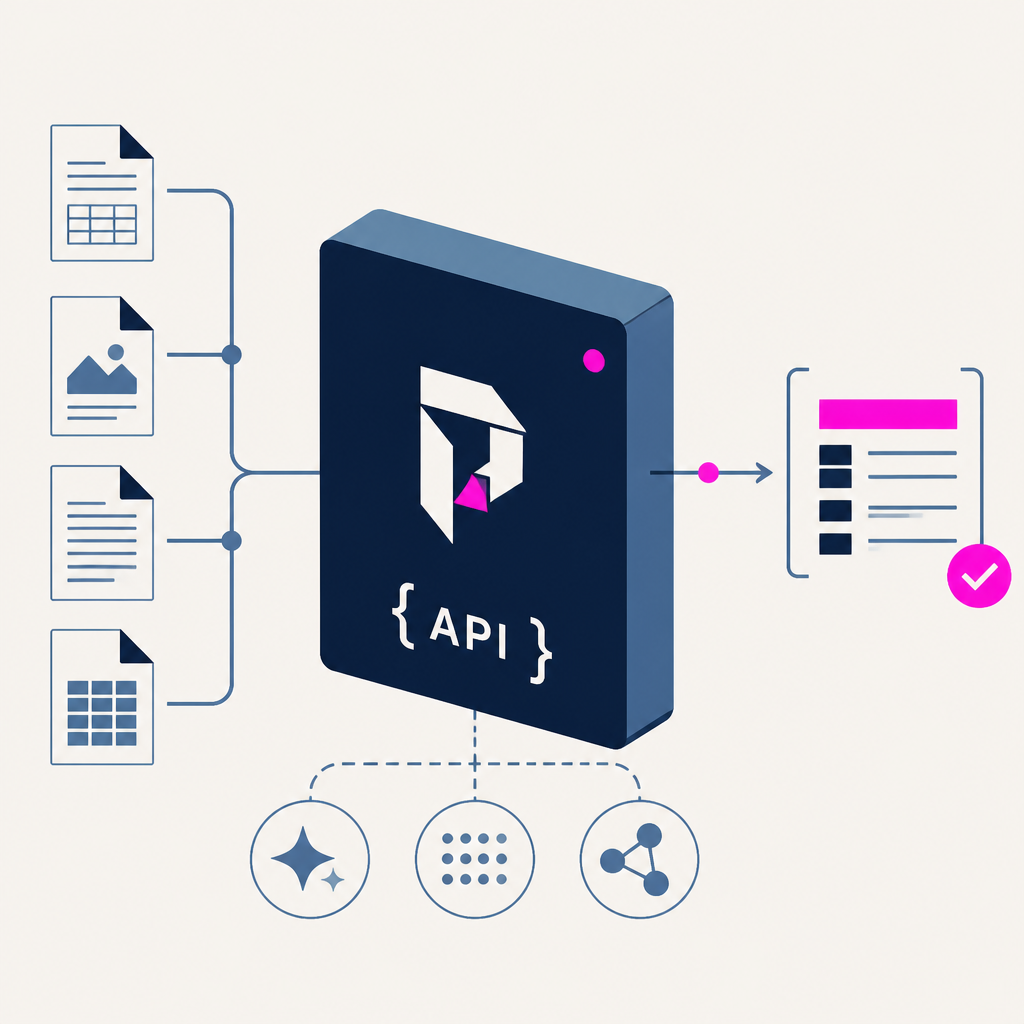
Parsewise, a Y Combinator company, launched an API that extracts and transforms unstructured data from multiple documents into schema-compliant structured output while maintaining full lineage tracing. The system uses Gemini models for visual reasoning, vLLMs for parsing, and smaller models for search, achieving state-of-the-art performance on the Databricks OfficeQA benchmark. The platform enables technical teams to validate extracted data quickly with business experts, solving limitations of direct LLM approaches like token limits, latency, and cost.
NVIDIA and its partners are investing in U.S.-based semiconductor manufacturing, electronics production, and AI infrastructure facilities across 43 states, including TSMC's Arizona fab for Blackwell chips and new facilities in Texas and North Carolina. NVIDIA plans to produce up to $500 billion in AI infrastructure in the U.S., with AI infrastructure powered by NVIDIA chips supporting over 100,000 jobs and projected to contribute $485 billion to U.S. GDP in 2026 alone. The buildout aims to enable American scientists, healthcare providers, and manufacturers to accelerate discovery and productivity while creating skilled manufacturing and technical jobs across the country.
SpaceX filed an FCC application to deploy up to 1 million orbital data center satellites in low Earth orbit, with Elon Musk claiming orbital data centers will be cheaper than terrestrial ones within two to three years. Deploying 1 million satellites at current SpaceX launch rates of 165 missions per year would require approximately 16,666 Starship launches, taking a decade even at 10 times current cadence, while building 1 million satellites at a tenfold increase from the current 4,000 per year production rate would take roughly 25 years. The economic case remains unproven due to technical challenges like cooling 700-watt GPUs requiring 1.4 square meters of radiator surface, environmental concerns about blocking starlight, and latency constraints that make the near-term application primarily viable for inference rather than training workloads.
Apple released security updates for iOS, iPadOS, macOS, and Safari, with four WebKit vulnerabilities discovered using AI tools like Claude and Codex. The company released these patches on an accelerated schedule outside its normal update cycle, compressing the time between disclosure and deployment to all users. Apple cited the faster pace at which AI can convert known flaws into working exploits as the reason for departing from its traditional practice of bundling fixes into major version releases.
Most companies report usage of AI tools but lack fundamental improvements in team capabilities, with only 39% of organizations seeing any profit impact despite 88% adopting AI in some form. The distinction lies in measuring outcomes—whether AI enables genuinely new work or merely accelerates existing tasks—rather than tracking adoption metrics like tool access and frequency of use. Effective measurement requires two KPIs scored monthly by team leads: whether AI unlocks new outcomes and whether it's embedded in daily workflows, with most honest teams starting at level 2 and progressing through demonstrable evidence of capability improvement over time.
Teams building AI agents typically fail in production because they over-index on model intelligence while neglecting data quality, API reliability, and execution governance. Agent performance in production depends primarily on three coupled systems—data quality, API quality, and execution quality—rather than model capability alone, with most failures stemming from interface issues rather than reasoning failures. Success requires treating agents as distributed systems embedded in execution workflows with full observability and governance, rather than conversational interfaces relying on strong models compensating for weak tools and incomplete data.
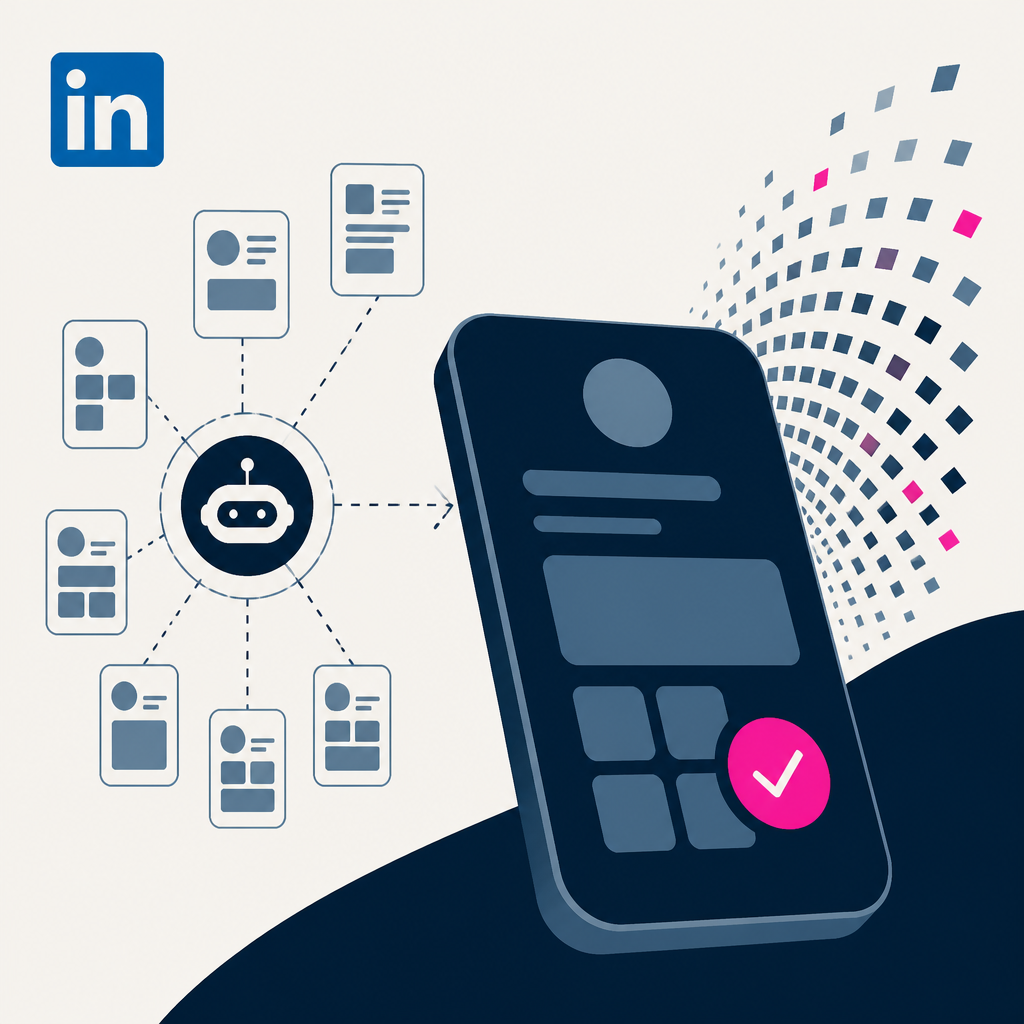
LinkedIn built an autonomous QA agent using AI and vision-language models to test applications across numerous UI variations that manual and scripted testing cannot cover. The agent uses visual understanding to evaluate software behavior across the massive number of possible interface states without predefined test scripts. This shifts quality assurance from reactive, manual testing to continuous autonomous validation that adapts to new UI changes automatically.
Meta published a paper describing Autodata, a system where AI agents dynamically generate training data by creating examples, testing them against models, analyzing failures, and iteratively refining their data generation approach rather than using static datasets. The method treats data creation as an agentic process with continuous feedback loops instead of pre-generating a fixed set of training examples. This shifts focus from scaling models and compute to optimizing the data generation process itself.
The Wall Street Journal·2 months ago·
25
● 3 sources
Anthropic reached an agreement with the Trump administration to restore access to its Fable AI model after researchers at Amazon circumvented its safeguards. The Center for AI Standards and Innovation, a government testing unit, is expected to be involved in the agreement to address the workaround issues. Access to the model began being restored today following the deal.
A programmer argues that AI systems currently generate high-quality local code but struggle with global program understanding, suggesting programming languages might again offer solutions—he illustrates this through Rust's approach to multi-threading, where local reasoning about ownership and Send/Sync traits enforces a global data-race-free property. Rust's compiler catches data races as static errors at compile time, which the author experienced when rewriting his website builder to use multi-threading in under 5 minutes with zero debugging required. This demonstrates that thoughtful language design can allow developers to reason locally about code while guaranteeing surprising global properties, a model potentially applicable to addressing AI's current limitations in generating globally coherent software.
Anthropic released Claude Sonnet 5, an AI model positioned between its cheaper and most expensive offerings, with introductory API pricing of $2 per million input tokens and $10 per million output tokens through August 31. After the promotional period ends, pricing increases to $3 and $15 per million tokens respectively. The lower price point aims to attract enterprise developers seeking cost-effective access to advanced AI capabilities for building agent systems.
The Berkeley Artificial Intelligence Research Lab celebrates its 2026 Ph.D. graduates, who conducted research across robotics, large language models, computer vision, AI safety, and human-AI interaction. The 25 profiled graduates are pursuing positions at major AI companies like OpenAI, Anthropic, and Mistral AI, as well as faculty roles and AI startups. Their departures represent the distribution of Berkeley-trained AI researchers to influence the broader AI research and development landscape.
At the AI Engineer World's Fair, attendees focused heavily on "loops"—repeating cycles where agents autonomously complete tasks and restart against the same specifications—as the foundation for building software factories that automate the entire development lifecycle. Microsoft's Foundry, OpenAI's Codex, and platforms like Warp are positioning agents to handle coding, code review, and deployment with minimal human intervention, with the shift expected to create a new discipline called "software factory engineering." A new role of Forward Deployed Engineer is emerging to help organizations orchestrate these agent-based systems, shifting integration work from model development to orchestration layers.
Together AI announced an $800 million Series C funding round from investors including Aramco Ventures and NVIDIA to expand its open-source AI platform. The company secured commitments for over 500 MW of compute capacity and operates endpoints for open-weights models, with customers reporting 6x to 20x lower inference costs compared to proprietary alternatives. Together AI aims to make open-source AI the standard for production deployments as companies seek to reduce the economic burden of running large language models at scale.
Hugging Face and Cerebras demonstrated a real-time speech-to-speech AI system using Google DeepMind's Gemma 4 language model paired with Cerebras inference acceleration to reduce response latency in voice conversations. The system achieves predictable performance at the P95 latency percentile by combining open-source components including Nvidia's Parakeet for speech recognition and Alibaba's Qwen3TTS for text-to-speech conversion. The modular architecture enables developers to deploy responsive voice AI for robots, assistants, and embodied AI applications where conversational naturalness depends on minimizing delays between user input and system response.
Every AI story that matters,
in your inbox by 8am.
TLDRocket reads all relevant sources, removes duplicate coverage, and summarises the
day in two minutes. Follow companies and topics for alerts, or get the
briefing in Slack. Free, no spam, unsubscribe anytime.
Reading TLDRocket needs no cookies, and the readership counts we rely on come from
our own cookieless analytics. Google Analytics is the exception: it sets cookies and
reports to Google, so it stays switched off until you allow it. You can change your
mind any time from “Cookie settings” in the footer.
Strictly necessary
Session security and form protection (tldrocket-session,
XSRF-TOKEN, 2 hours). The site cannot work without them,
so they need no consent.
Always on
Google Analytics 4 (_ga,
_ga_<id>, up to 2 years). Measures which
stories and sections readers use. Google acts as a third-party processor and may
store the data outside the EU. No advertising, no profiling, no data sold.