
Quality Assurance Agent: Reimagining Software Quality with AI-Driven Autonomous Testing
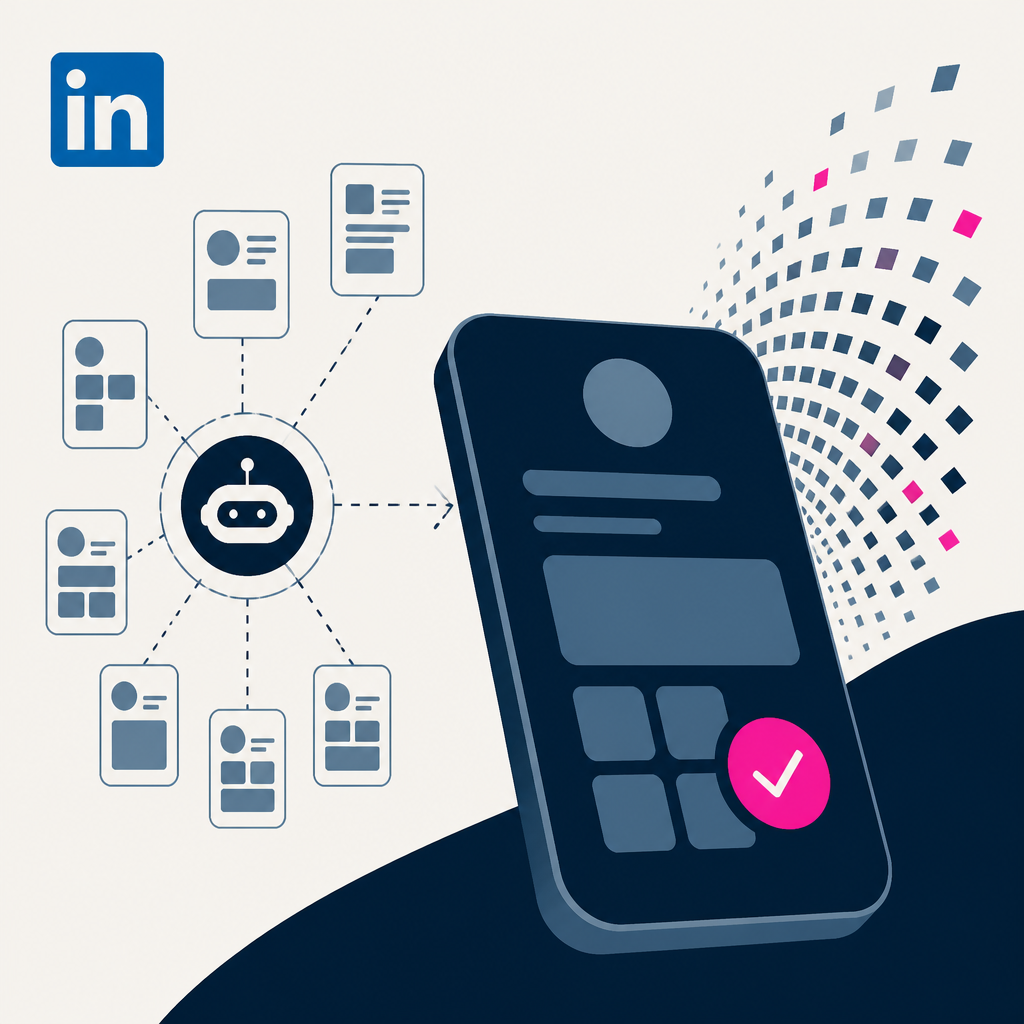
LinkedIn built an AI agent that tests its own apps by actually looking at the screen like a human would. It's meant to catch UI bugs across countless variations that manual testers just can't cover.
Based on reporting by LinkedIn — read the original for the full story.
Summary, retelling and take written by AI under human oversight; images are AI-generated illustrations. How we work · Report an error
LinkedIn's engineering team has a problem that will sound familiar to anyone who has shipped a consumer app at scale: the number of possible screen states, feature flags, languages, and device configurations has grown far past what a QA team, or even a pile of scripted tests, can realistically cover. Their answer is a new autonomous QA Agent that uses vision-language models to look at the app the way a person would, rather than poking at hidden DOM elements or relying on brittle test scripts written months earlier.
The core idea is simple to state and hard to build. Instead of engineers hand-writing test cases for every button and menu, the agent takes a goal, like completing a specific user flow, and figures out how to navigate the actual rendered interface using screenshots and visual reasoning. That means it can adapt when a layout shifts slightly, when an A/B test changes a label, or when a new UI permutation appears that nobody explicitly scripted for. Traditional automated testing breaks the moment something visual changes; this approach is built to tolerate that kind of drift.
What makes this notable isn't just the novelty of using a VLM for testing, it's the practical motivation. LinkedIn's apps ship constantly, across web, iOS, and Android, with a combinatorial explosion of experiment variants and localization states. Manual QA simply cannot scale linearly with that. So the agent is designed to run continuously, exploring flows and flagging regressions the way an actual tester might stumble onto a broken button, except it can do that at a scale and cadence no human team could sustain.
There's an obvious tradeoff here worth sitting with: vision-based, model-driven testing is inherently less deterministic than a scripted assertion checking for an exact pixel or DOM value. LinkedIn's framing suggests they're betting that broader coverage and resilience to change are worth more than the precision of old-school scripted tests, at least for catching the kind of visual and functional bugs that slip through gaps in existing suites. That's a meaningful bet on how QA engineering evolves as apps get more dynamic and personalized.
My take — AI-written commentary, not fact-checked reporting
This is the sane version of 'AI agent hype': not a chatbot that replaces your job, but a tool aimed squarely at a genuinely tedious, combinatorially impossible problem that engineers have hated forever. I'd rather see this kind of unglamorous, high-leverage AI application scale across the industry than another flashy demo, and I suspect QA is exactly where agentic AI proves its worth first, quietly, before anyone notices.
Read more about this at: LinkedIn
Related stories
 Superflow AI
Product Hunt · 1 month ago ·
38
Superflow AI
Product Hunt · 1 month ago ·
38
 The agent evaluation gap: Enterprise AI organizations have a reality-alignment problem, not a coverage problem — and most are shipping to production anyway
VentureBeat · 2 months ago ·
20
The agent evaluation gap: Enterprise AI organizations have a reality-alignment problem, not a coverage problem — and most are shipping to production anyway
VentureBeat · 2 months ago ·
20