Cognition released SWE-2, a post-trained coding model built from Moonshot AI’s 2.8T-parameter Kimi K3 and trained with reinforcement learning. It scored 50.0% on FrontierCode 1.1 Main, within 1 point of Fable 5.1, while claiming 64% lower cost. The update adds selectable reasoning-effort levels and changes deployment by keeping the model closed (no open weights or standalone API), running only inside Devin (with Devin Web and Fusion rolling out).
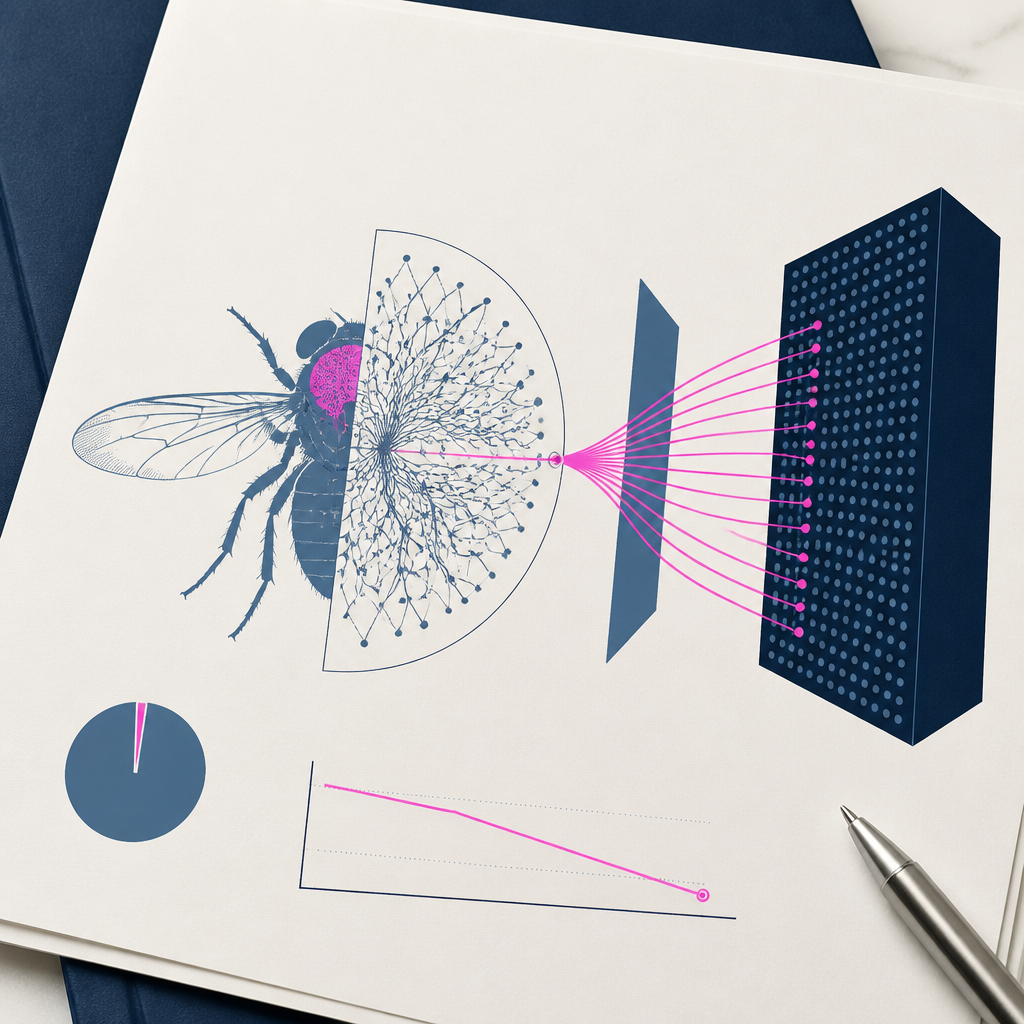
Fly Language Model (FLM) combines the full retained MaleCNS v1.0 fruit fly connectome with a frozen LiquidAI LFM2.5-1.2B-Instruct backbone by training only a 278,528-parameter reservoir readout. The fly readout reduced loss by 0.0222 nats per token (from 3.98 to 3.90) versus the frozen backbone, but a direct-input no-graph control did better in all 3 seeds, and the fly graph’s residual added no supported fly-specific gain. As a result, the study concludes the connectome wiring participates but does not improve outcomes beyond simpler controls, and context length still comes from the frozen backbone rather than long memory in the reservoir.
Zvi (Don't Worry About the Vase)·1 month ago·
14
● 2 sources
GPT-6 Astra is described as a major upgrade over prior OpenAI models, with large gains in 3D, computer-use, and multi-step agent work, while the author says it still isn’t best across the board versus Fable 5.1 for back-and-forth discussion. Its headline price is $10 per million input and $50 per million output tokens, and the release frames it as AGI-adjacent while also prompting a recommendation to use Astra and Fable 5.1 together on difficult tasks.
The Algorithmic Bridge·1 month ago·
36
● 21 sources
Millennium Pastimes argues that AI systems have started solving parts of the Millennium Prize-style math problems, which changes how mathematicians value proofs and the struggle behind them.
DeepSeek released the open-weight model DeepSeek v4.1-Flash with a causal encoder-decoder architecture and added vision inputs. It charges $0.30 per 1M input tokens and $1.20 per 1M output tokens (MIT license, 1M-token context), with active parameters listed as 8B for prefill and 16B for decode. The launch shifts attention toward inference efficiency—especially KV/cache cost reduction—along with faster, lower-RAM local deployment enabled by SSD offloading and day-0 support in tools like Ollama and Baseten.
Every AI story that matters,
in your inbox by 8am.
TLDRocket reads all relevant sources, removes duplicate coverage, and summarises the
day in two minutes. Follow companies and topics for alerts, or get the
briefing in Slack. Free, no spam, unsubscribe anytime.
Reading TLDRocket needs no cookies, and the readership counts we rely on come from
our own cookieless analytics. Google Analytics is the exception: it sets cookies and
reports to Google, so it stays switched off until you allow it. You can change your
mind any time from “Cookie settings” in the footer.
Strictly necessary
Session security and form protection (tldrocket-session,
XSRF-TOKEN, 2 hours). The site cannot work without them,
so they need no consent.
Always on
Google Analytics 4 (_ga,
_ga_<id>, up to 2 years). Measures which
stories and sections readers use. Google acts as a third-party processor and may
store the data outside the EU. No advertising, no profiling, no data sold.