
Fly Language Model (FLM) Wires the Full Fruit Fly Connectome Into a Frozen 1.2B LLM, and Its Own Controls Show the Wiring Does Not Help
MarkTechPost Asif Razzaq
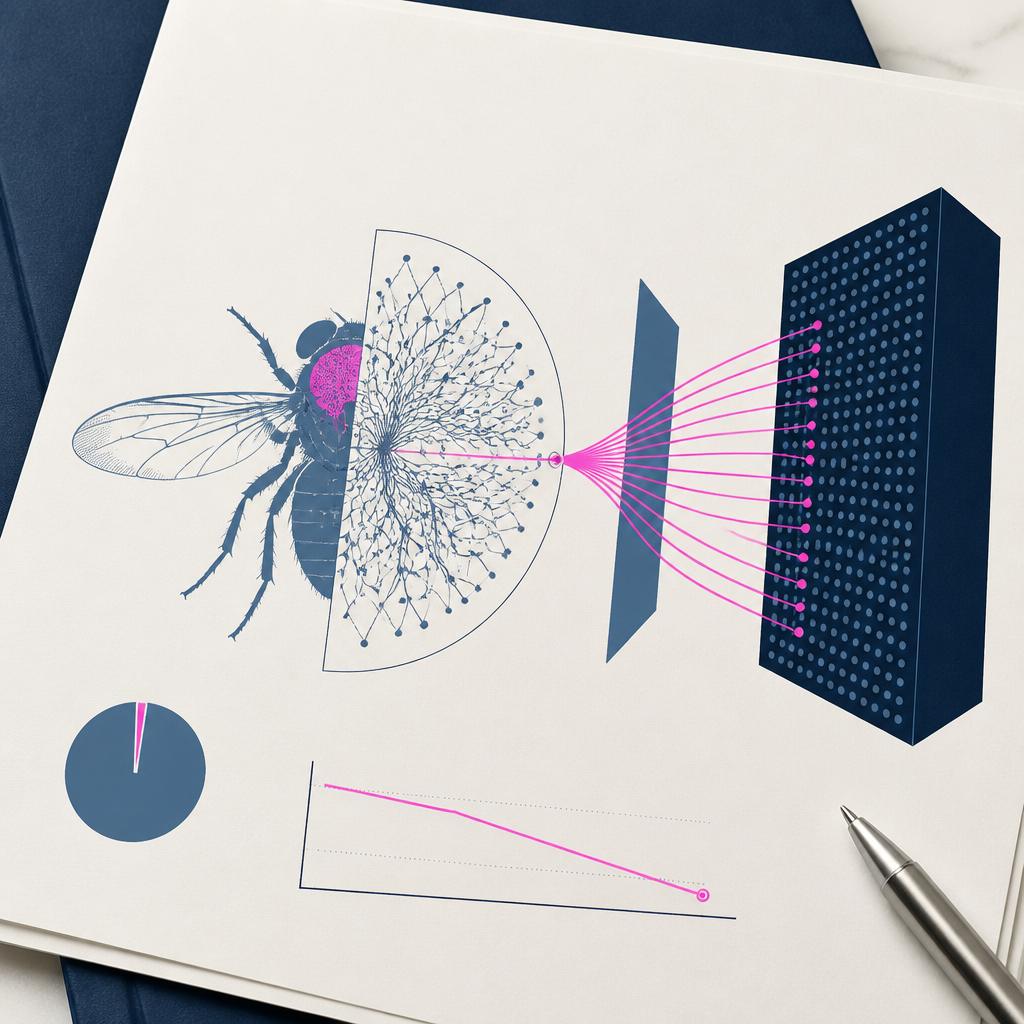
A new chatbot wires a full fruit-fly connectome into a frozen 1.2B model. But its own control test says the fly wiring doesn’t beat a plain direct input.
Based on reporting by MarkTechPost, Asif Razzaq — read the original for the full story.
Summary, retelling and take written by AI under human oversight; images are AI-generated illustrations. How we work · Report an error
The Fly Language Model, or FLM, is a public chatbot that bolts the full retained MaleCNS v1.0 fruit fly connectome onto a frozen LiquidAI LFM2.5-1.2B-Instruct backbone. Its creator calls it the world’s first Fly Language Model, built around something named GPF, but the report also says it is not using that label and does not claim to be the first connectome language model. That distinction matters, because the system is trying to show what the fly graph adds while keeping the language model itself fixed.
What got built is closer to a reservoir computer than a new language model. All 166,700 retained nodes and 25,582,938 directed edges in the MaleCNS graph are active, but the graph, the backbone, and the random input and output projections stay frozen. Only a 278,528-parameter readout is trained, which is about 0.0238% of the 1,170,340,608 backbone parameters. At each token, a 2,048-dimensional embedding is compressed to 128 channels, pushed through the fly graph, pooled, and turned into a bounded residual that gets added to the backbone logits.
On 32 SmolTalk dialogues with 1,236 target tokens, the fly readout does improve over the frozen backbone: negative log-likelihood falls from 1.381995 to 1.359816 nats per token, about a 0.0222 drop, and perplexity moves from 3.98 to 3.90. But the plain control that feeds the same 128-channel token projection straight into the same readout, with no graph at all, does better in all three seeds, at 1.359328 nats per token. The paired bootstrap interval does not support a fly-specific gain, which is the awkward little punchline here.
Two more controls sharpen that point. Zeroing the graph removes the residual exactly and returns the backbone losses, so the connectome is definitely in the loop. But relabeling node identities without retraining leaves performance near baseline, which says the learned interface matters more than the fly topology itself. The report also says the recurrence contracts differences by at most 0.6 per token, so the model forgets quickly; the fly wiring is not acting like a secret long-memory module. Context still comes from the frozen LFM2.5-1.2B.
My take — AI-written commentary, not fact-checked reporting
This is the kind of result the AI world needs more often: a flashy biological idea, then a control that quietly steps on its neck. The fly graph participates, sure, but it doesn’t win, and that’s exactly how science should ruin a good headline. A lot of connectome talk sounds like architecture cosplay until the no-graph baseline shows up with better numbers and fewer metaphors.
Read more about this at: MarkTechPost
Related stories
 Liquid AI Releases LFM2.5-2.6B: An On-Device Agentic Model With 128K Context, Tool Calling, And Open Weights
MarkTechPost · 1 month ago ·
44
Scaling Categorical Flow Maps
Apple Machine Learning Research · 1 month ago ·
9
Liquid AI Releases LFM2.5-2.6B: An On-Device Agentic Model With 128K Context, Tool Calling, And Open Weights
MarkTechPost · 1 month ago ·
44
Scaling Categorical Flow Maps
Apple Machine Learning Research · 1 month ago ·
9