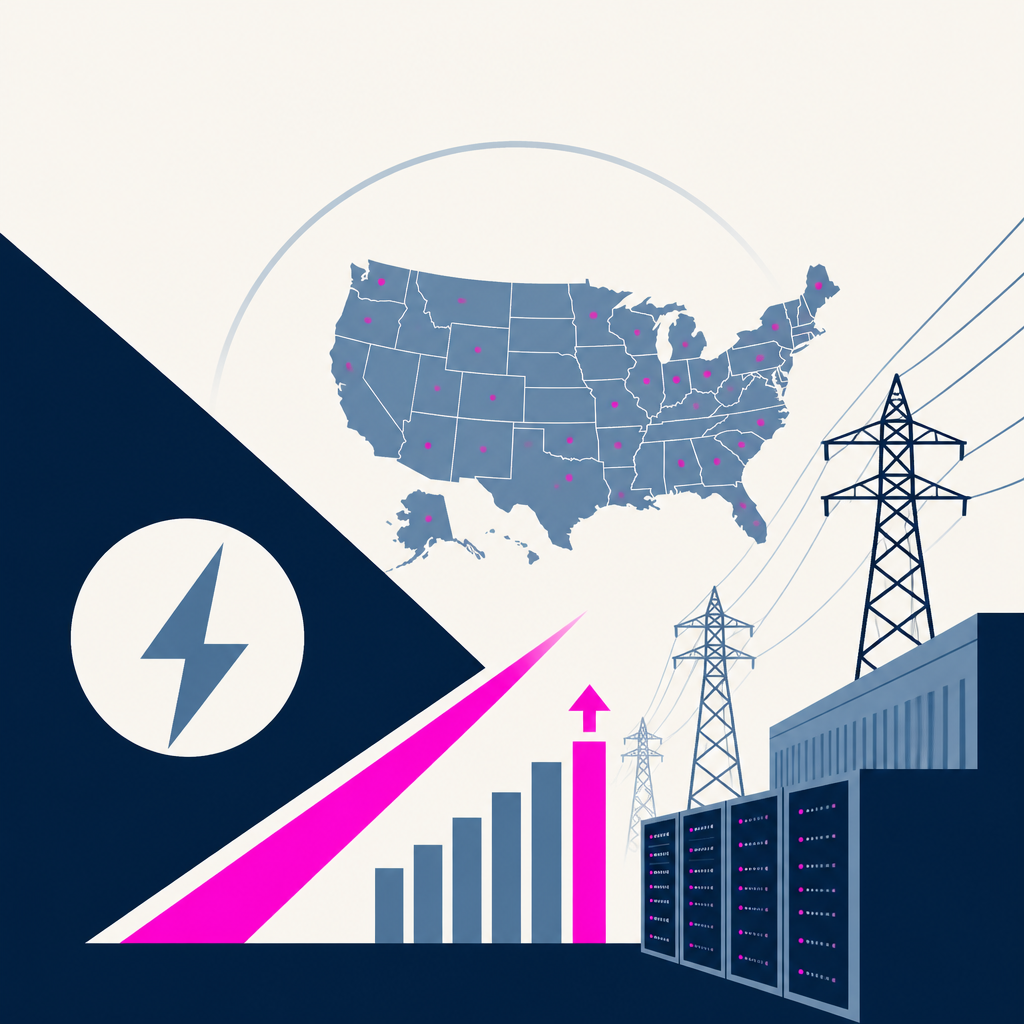
The U.S. Energy Department planned to award nearly $2 billion in grants to add capacity and reliability to the aging grid amid rising electricity demand tied to AI data centers. It will fund 31 projects across 26 states expected to deliver more than 23 gigawatts of additional capacity, enough for about 16 million homes. The effort will expand real-time monitoring and grid rerouting over thousands of miles of transmission lines, aiming to improve reliability and reduce costs for around 100 million Americans.
Nscale, a Nvidia-backed company building and renting AI-ready data center capacity, filed for a New York IPO with a target valuation of up to $35 billion while reporting a $1.02 billion net loss in the six months to June 30, 2026. Nvidia is backing the deal with a Sept. 15 $3.1 billion financing round that includes $1 billion in convertible notes or non-voting shares. The reliance on Nvidia funding and guarantees shifts the story from an IPO filing to a test of whether the AI infrastructure market’s demand is real or largely supported by circular financing arrangements.
Oracle sent a force majeure notice to the developer of its Project Jupiter Stargate data center campus in New Mexico. The notice would allow delayed payments if the facility misses its 2028 go-live target. Energy and permitting setbacks tied to the site’s fuel supply increase pressure on the project’s timeline and payment schedule despite Oracle saying it expects to stay on schedule.
CoreWeave EVP Chen Goldberg says long-running AI agents change infrastructure from scaling GPU count to making reliability, latency, security, orchestration, storage, networking, cooling, and power work together. The infrastructure must act “like one enormous computer.” As a result, teams need integrated management across those layers rather than treating GPUs as the only bottleneck.
Google is launching its first Project Suncatcher experimental satellite, called MVP, to validate its orbital AI data center concept. The satellite will launch on October 1 and carries four custom Google TPU AI accelerators. The test shifts from planning toward on-orbit validation using about 1 kilowatt of solar power, with future constellation plans accelerated beyond the original 2027 timeline.
Open science groups led by NVIDIA released predicted 3D structures for protein complexes from over 2,800 viruses in the AlphaFold Database. The dataset adds structures inferred by AlphaFold2 at scale, using NVIDIA BioNeMo Inference Runtime. Researchers can access the data and NVIDIA’s BioNeMo Structure Prediction Pipeline to predict and verify viral complex structures faster, improving pandemic readiness.
Every AI story that matters,
in your inbox by 8am.
TLDRocket reads all relevant sources, removes duplicate coverage, and summarises the
day in two minutes. Follow companies and topics for alerts, or get the
briefing in Slack. Free, no spam, unsubscribe anytime.
Reading TLDRocket needs no cookies, and the readership counts we rely on come from
our own cookieless analytics. Google Analytics is the exception: it sets cookies and
reports to Google, so it stays switched off until you allow it. You can change your
mind any time from “Cookie settings” in the footer.
Strictly necessary
Session security and form protection (tldrocket-session,
XSRF-TOKEN, 2 hours). The site cannot work without them,
so they need no consent.
Always on
Google Analytics 4 (_ga,
_ga_<id>, up to 2 years). Measures which
stories and sections readers use. Google acts as a third-party processor and may
store the data outside the EU. No advertising, no profiling, no data sold.