Runlayer, a startup offering a Model Context Protocol gateway for AI systems, sued Rippling alleging the HR software company built a clone of its product after a year-long product trial where Runlayer shared source code and roadmaps. Runlayer raised $42 million and is being represented by law firm Sullivan & Cromwell in claims of trade secret misappropriation and breach of contract. Rippling denied the allegations and confirmed it is launching its own MCP gateway, highlighting the challenge AI infrastructure startups face selling to well-resourced tech companies that can build competing products in-house.
Nvidia CEO Jensen Huang predicted the semiconductor industry must expand 5-10x over the next decade to support AI agents and robots that will consume compute continuously. Huang estimates there will be 100 billion AI agents and billions of robots all using computers, compared to today's 1 billion human users, requiring fundamental changes to backend infrastructure and data center architecture. This forecast is driving major supply commitments, including Nvidia's $500 billion partnership with SK Group to secure advanced memory and build out AI data center capacity in South Korea.
Google increased its 2025 capital expenditure estimate to as much as $205 billion, up from the previous forecast of $190 billion, signaling unpredictable costs that now exceed revenue. The company's lower-bound estimate of $195 billion already exceeds what it previously projected as its maximum spending, a $15 billion swing that reflects inability to forecast AI infrastructure costs. Investors are growing concerned about the sustainability of such spending levels, particularly when capital outlays are outpacing revenue growth.
Apple's market capitalisation surpassed $5 trillion for the first time, briefly overtaking Nvidia as the world's most valuable company. The stock gained 0.4% to close just below the $5 trillion mark on Tuesday, marking only the second company ever to reach this threshold. Investors are rotating capital away from AI infrastructure-heavy stocks like Nvidia and toward Apple's hardware-focused business model, which avoids the heavy capital expenditure burdens of large-scale AI infrastructure deployment.
Multiverse Computing, an AI model compression startup, raised $570 million in Series C funding at a $1.7 billion valuation, roughly five times its previous round valuation from June 2025. The company's CompactifAI technology uses tensor networks to reduce large language model sizes by 50–95%, enabling powerful models like Meta's Llama 3.3 70B to run on consumer hardware such as laptops and smartphones with minimal accuracy loss. The funding enables Multiverse to expand its model library, advance compression algorithms, invest in AI infrastructure, and establish regional operations across Asia, the Middle East, Canada, and the United States.
Recursive Superintelligence announced a $400 million compute deal with Amazon Web Services to support its research into self-improving AI systems. The multi-year agreement represents the bulk of the company's $650 million in funding raised since emerging from stealth in May, with CEO Richard Socher stating he expects it to be among the smallest compute deals the company will sign. The arrangement frees Recursive to allocate most capital directly to compute infrastructure rather than hiring, with plans to release tangible AI products by October 2024.
SpaceX's stock price collapsed 50 percent in six weeks after its June 2026 IPO, erasing $1.2 trillion in market value—equivalent to Tesla's entire market cap—due to thin trading float, repositioning as an AI company with unprofitable xAI operations, and skepticism about speculative orbital data center plans. The company's Q1 2026 showed Starlink generating $1.19 billion in operating profit while the AI segment lost $2.47 billion, valued at an 80+ price-to-sales ratio while traditional aerospace trades at 1.5 to 3. The August 6 lockup expiration will release 911.5 million shares to the market, and investors are divided between value skeptics calling it the craziest IPO ever and bullish analysts maintaining $237 price targets.
Amazon is winding down most of its in-house Nova AI models and closing its AGI Lab, concentrating engineering resources instead on a single frontier model effort expected in fall 2026. The company is shifting from building its own flagship models to hosting OpenAI (through a $38 billion partnership with GPU capacity) and Anthropic (through $13 billion invested and a $100 billion ten-year cloud commitment) on AWS infrastructure. This represents a strategic pivot toward positioning Amazon as the infrastructure and distribution layer for AI rather than as a primary model developer.
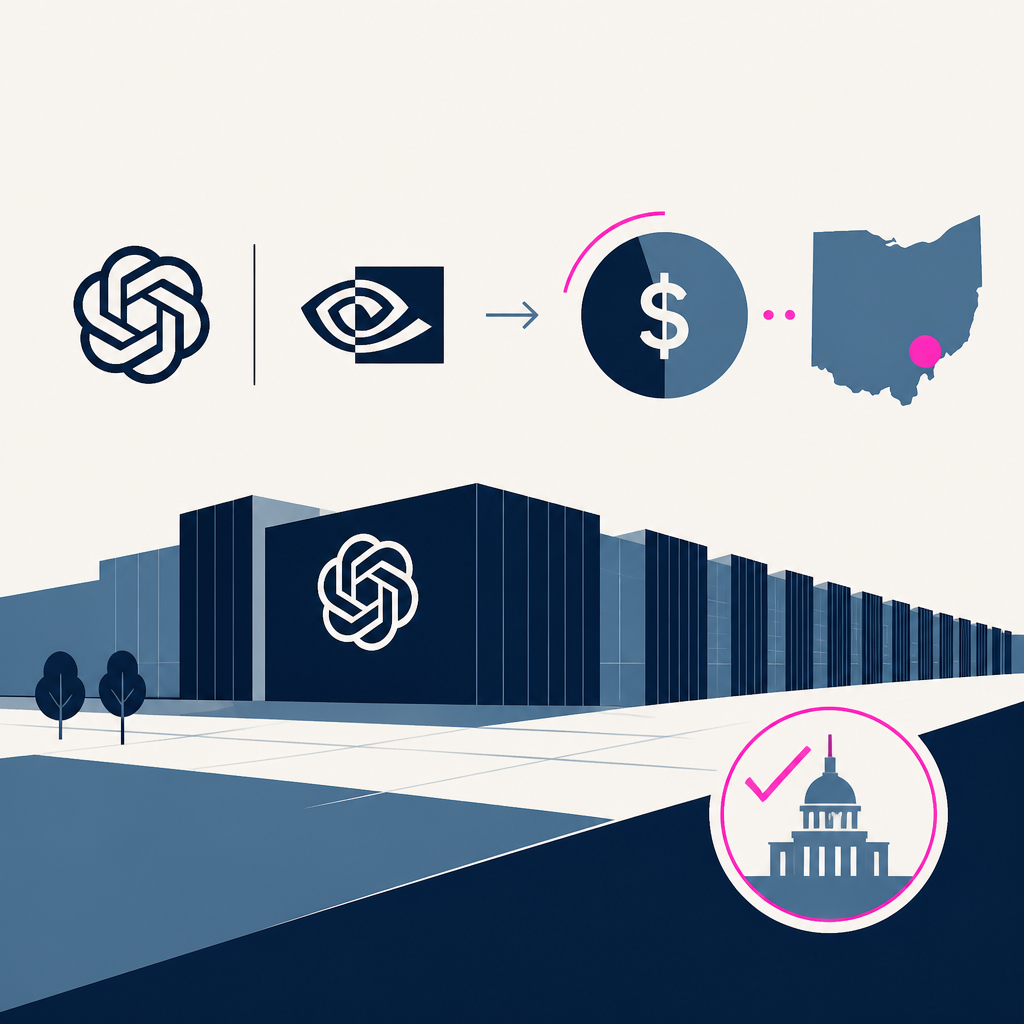
OpenAI is in advanced negotiations to lease a $500 billion data center in southern Ohio, with Nvidia committing $250 billion in financial backing for the project. The facility requires approval from Commerce Secretary Howard Lutnick. If completed, the project would represent a major infrastructure investment supporting OpenAI's large language model development and deployment capabilities.
Asian semiconductor stocks fell sharply on Tuesday, with South Korea's KOSPI down 9% and Japanese chipmakers like SK Hynix and Kioxia losing 13-18%, triggered by concerns over Nvidia's $750 billion in new AI financing commitments and reports of Chinese competition in advanced chip equipment. Major US tech companies including Microsoft, Meta, Apple and Amazon report earnings this week while facing scrutiny over rising capital expenditure, with the five largest hyperscalers set to invest over $690 billion in fiscal 2026, increasingly funded by debt that has risen from 9% to 32% of capex since 2024. The broader question for markets is whether AI infrastructure spending will generate sufficient revenue growth to justify the mounting debt load, with credit conditions showing early signs of tightening.
AMD's Lisa Su announced leadership claims across CPUs, GPUs, and AI infrastructure at the Advancing AI event, positioning the company to compete directly with Nvidia rather than merely serve as a secondary platform. The company is targeting 90% parity with CUDA on vLLM merge-gating tests and achieved an 18-times improvement in Kimi K2.5 interactivity in 30 days through software optimization. AMD's success will depend on building engineering velocity—the ability to continuously improve its entire platform faster than competitors through stable development infrastructure, automated validation, and rapid customer feedback integration.
Every AI story that matters,
in your inbox by 8am.
TLDRocket reads all relevant sources, removes duplicate coverage, and summarises the
day in two minutes. Follow companies and topics for alerts, or get the
briefing in Slack. Free, no spam, unsubscribe anytime.
Reading TLDRocket needs no cookies, and the readership counts we rely on come from
our own cookieless analytics. Google Analytics is the exception: it sets cookies and
reports to Google, so it stays switched off until you allow it. You can change your
mind any time from “Cookie settings” in the footer.
Strictly necessary
Session security and form protection (tldrocket-session,
XSRF-TOKEN, 2 hours). The site cannot work without them,
so they need no consent.
Always on
Google Analytics 4 (_ga,
_ga_<id>, up to 2 years). Measures which
stories and sections readers use. Google acts as a third-party processor and may
store the data outside the EU. No advertising, no profiling, no data sold.