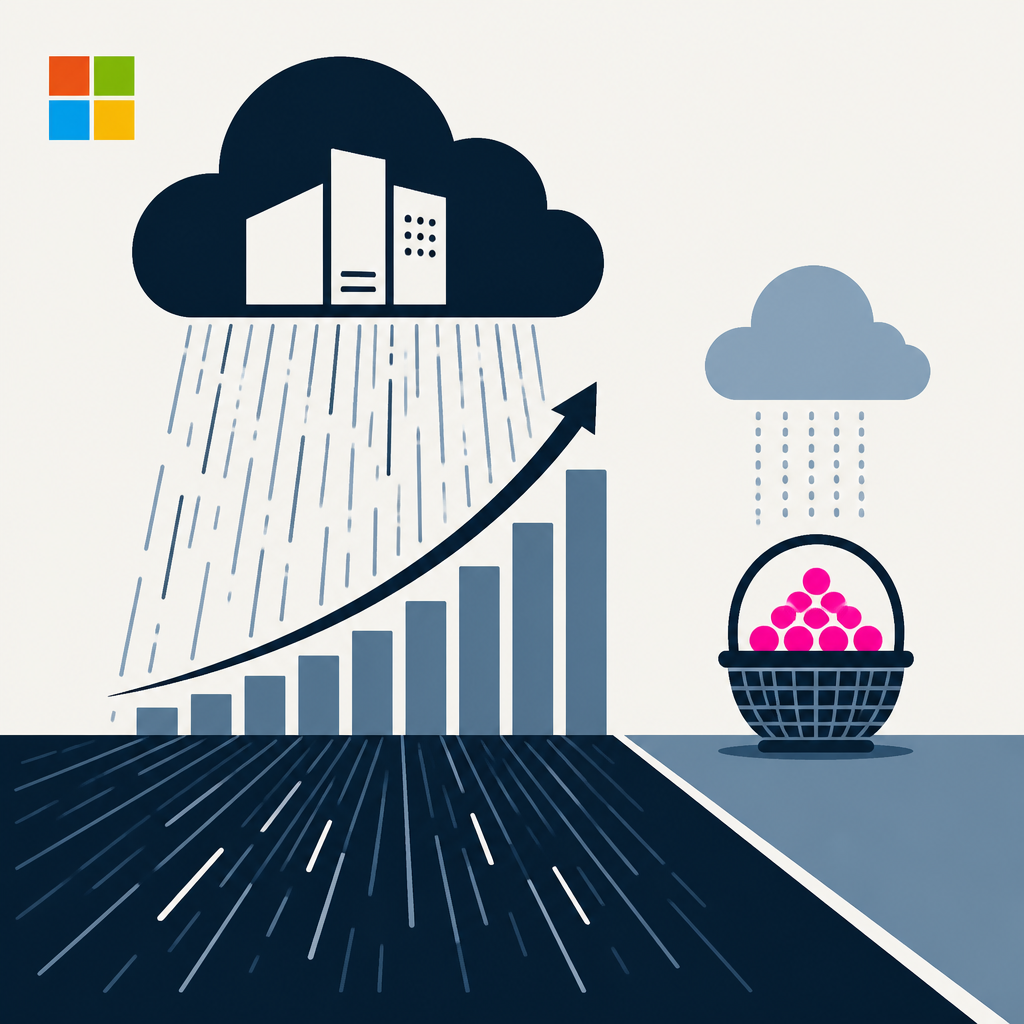
Microsoft reported $90 billion in quarterly revenue with 18 percent growth, driven by cloud services reaching $59.3 billion (up 27 percent) and Azure growing 43 percent. Microsoft 365 Copilot reached 30 million paid seats out of 450 million commercial customers, while capital expenditure climbed to $115.95 billion for the full fiscal year, up 80 percent. The strong results and $678 billion in customer commitments suggest demand for AI infrastructure, though industry concerns persist about whether heavy AI spending will ultimately prove profitable.
Cerebras and AMD announced a partnership to build a disaggregated AI inference system that pairs AMD's Helios architecture for the computationally intensive pre-fill phase with Cerebras' Wafer-Scale Engine for low-latency decode. The combined system delivers 5x higher tokens per second per watt compared to existing solutions, with the Cerebras Wafer-Scale Engine providing 2,000 times more memory bandwidth than Nvidia GPUs. Cerebras will deploy AMD Helios systems in its own data centers by the end of 2026 to serve workloads like agentic coding and real-time voice generation where response speed is critical.
CommonThread AI's CEO argues that graph databases are essential for connecting fragmented enterprise data to unlock business value from AI applications. The company positions graph technologies as a solution to data silos that prevent different business systems from working together effectively. By unifying data relationships through graph databases, enterprises can build larger context windows that enable more adaptive AI-driven decision-making.
Hewlett Packard Enterprise is advancing a self-driving networking strategy that uses AI to automate network operations, reduce complexity, and support AI infrastructure demands. HPE integrates Apstra Data Center Director with its Morpheus platform and Juniper's Mist AIOps to provide automated problem detection and recovery, while also releasing the QFX5250 liquid-cooled switch supporting 1.6 terabits per second. The unified approach aims to shift network operators from reactive firefighting to proactive management and optimize user experience across HPE's compute, storage, and cloud infrastructure.
A power grid incident in the US midwest exposed a fundamental infrastructure crisis: data centers powering the AI boom can be built in under a year, but the power plants and transmission lines needed to operate them take 7-10 years and billions of dollars to construct. Companies are improvising with expensive workarounds like on-site gas turbines and repurposed jet engines, while also raising electricity costs for nearby residents, and some solutions like unregulated natural gas operations are creating significant air quality and environmental violations.
DoorDash, Instacart, and Uber Eats each integrated large language models into their search systems using different architectural approaches: DoorDash uses LLMs mostly offline to enrich and parse queries against an existing knowledge graph, Instacart combines offline RAG caching with real-time fine-tuned models at the query understanding layer, and Uber Eats deployed a two-tower embedding system with fine-tuned Qwen models. DoorDash achieved a 30% lift in carousel trigger rates, Instacart improved query rewrite coverage from 50% to 95% with 6% reduced scroll depth on tail queries, and Uber Eats reduced latency by 34% through ANN parameter tuning plus quantization. Each company's choice depended primarily on existing infrastructure rather than model selection, establishing patterns for how LLMs integrate into production systems across different constraints.
Meta and BlackRock announced a joint venture to build a $14 billion AI data center campus in El Paso, Texas, with BlackRock taking an 80% stake and Meta contributing $2.3 billion in assets. The campus will provide 1 gigawatt of AI-optimized computing capacity and come online in 2028, with Meta as the sole user under a four-year renewable lease. This follows Meta's pattern of selling majority stakes in large data center projects to third-party investors while securing long-term compute access for its AI operations.
Every AI story that matters,
in your inbox by 8am.
TLDRocket reads all relevant sources, removes duplicate coverage, and summarises the
day in two minutes. Follow companies and topics for alerts, or get the
briefing in Slack. Free, no spam, unsubscribe anytime.
Reading TLDRocket needs no cookies, and the readership counts we rely on come from
our own cookieless analytics. Google Analytics is the exception: it sets cookies and
reports to Google, so it stays switched off until you allow it. You can change your
mind any time from “Cookie settings” in the footer.
Strictly necessary
Session security and form protection (tldrocket-session,
XSRF-TOKEN, 2 hours). The site cannot work without them,
so they need no consent.
Always on
Google Analytics 4 (_ga,
_ga_<id>, up to 2 years). Measures which
stories and sections readers use. Google acts as a third-party processor and may
store the data outside the EU. No advertising, no profiling, no data sold.