Ron Johnson, the former Apple retail chief, argues that agentic AI shopping will not replace physical stores for big purchases like laptops. His view is based on his claim that nobody will let an agent buy a $1,000 to $2,000 laptop without customers visiting a website or store. As a result, he expects AI to narrow choices and make shoppers better informed before they go to stores, rather than fully automate checkout.
Kairn launched an iOS AI note-taker that turns meetings or quick thoughts into saved people, tasks, and dated reminders after user edits and approvals.
It’s available via the public TestFlight beta, with the product launching today.
Users can store approved contacts, reminders, and calendar events on their iPhone while keeping human control over the final details.
The Certinia at Dreamforce event argued that AI is reshaping professional services from hourly labor toward fixed-bid and outcome-based delivery. Certinia said it grew from 10 packaged agents and 64 Veda Intelligent Actions to 24 agents and 135 actions, with more than 300 planned by year’s end. The shift moves firms to capture full lifecycle context for agent-driven work where trust and risk acceptance, rather than time spent, determine pricing and delivery.
Alberto published Part 2 of a newsletter compiling 11 charts arguing that the financial/economic side of the AI boom could be a bubble rather than immediate real-world success. Hyperscaler capital expenditures are projected to surpass $1 trillion by 2027. The piece shifts readers to interpret AI performance through economic indicators like cancellations, leverage, and cash flow instead of benchmarks alone.
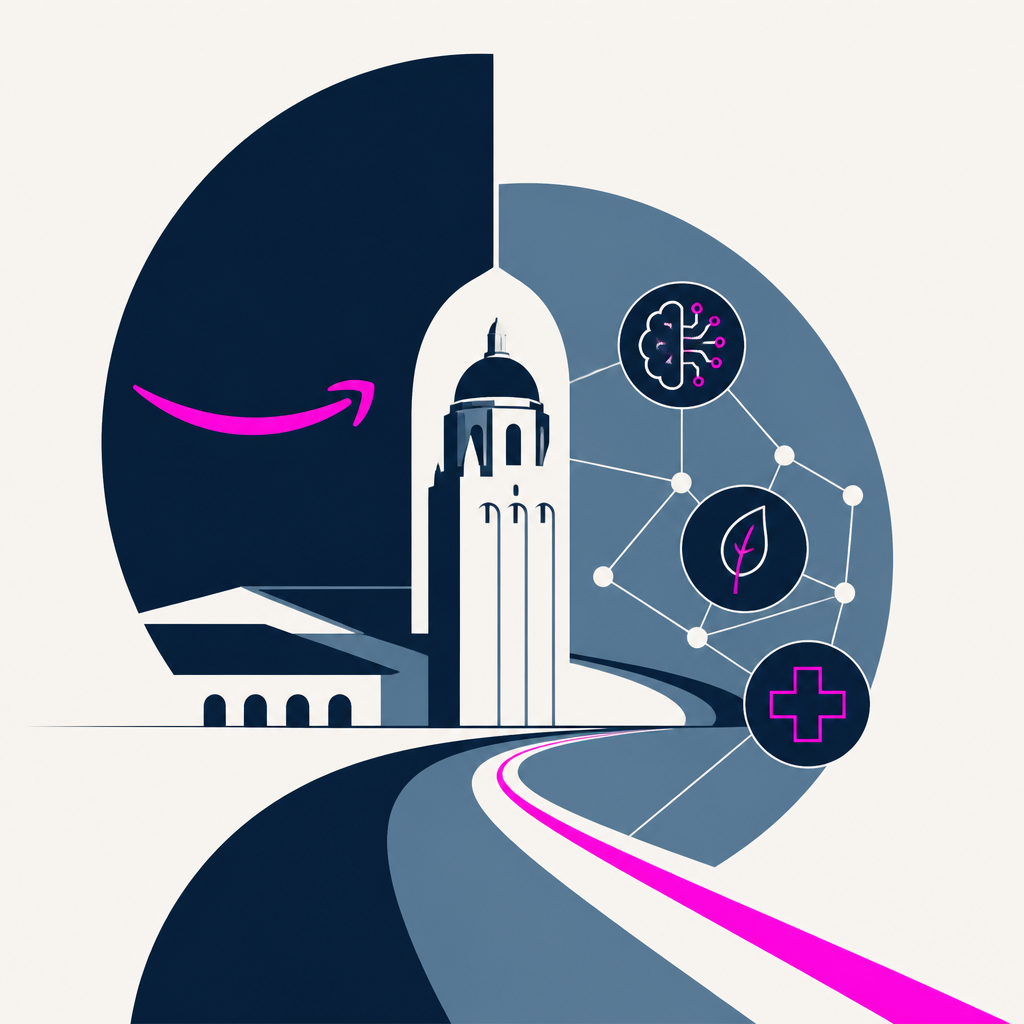
Amazon launched the Stanford and Amazon Research Initiative with Stanford University to advance frontier research in AI, energy, and healthcare. The program formalizes more than 10 teams funding active research and PhD fellowships at Stanford. This expands joint Stanford–Amazon projects, adds new PhD fellowships, and supports symposia and workshops to shorten the path from breakthroughs to real-world solutions.
Fortune’s Archive revisited a 1999 “40 Under 40” story in which Eryn Brown described Silicon Valley “netheads” built by dot-com wealth and expectations tied to money. The update notes that in 2026 there are 10 new billionaires under age 40 on Forbes’ list, with four Anthropic cofounders now able to claim $15.5 billion apiece. The focus shifts from dot-com IPO timing and estate planning to the AI boom’s billionaire-scale outcomes and ongoing pressure to treat personal success as dollar-defined.
Positron, Posit’s data science IDE, was made available to run on Amazon SageMaker AI via SageMaker Studio Spaces using a Positron custom container image. The recorded walkthrough profiled a dataset of 50,000 loans and reported an overall default rate of 2.03%. This lets teams run IDE, R/Python work, and model deployment with governed AWS data access and (optionally) in-account AI assistance from Bedrock without managing separate credentials.
Egypt’s AI ecosystem moved from events and training into production-scale projects, with NVIDIA-led sessions and local startup and enterprise participation at a Grand Egyptian Museum reception. NVIDIA’s Deep Learning Institute learner base in Egypt grew more than tenfold in a single year, and Hassan Allam Data Centers received a June license tied to a $400 million data center investment. Cassava’s expansion and new AI factory plans across Egypt and Africa—plus additional funded infrastructure capacity in the pipeline—are set to make accelerated local compute and model deployment more readily available in-country.
Benchmark will bring all five general partners onto the TechCrunch Disrupt 2026 stage for a session about where the next generation of startups will come from and what founders may be misreading. Benchmark said it raised about $2 billion across a $750 million flagship fund and a $1.25 billion growth fund. The event discussion reframes venture conviction amid fast-moving AI investment, including whether model, infrastructure, data, or distribution is the defensible layer.
Robby Stein, Google Search’s vice president of product, is set to lead a TechCrunch Disrupt 2026 Builders Stage fireside chat on how product decisions shift from early MVPs to products used at massive scale. The event runs October 13–15 in San Francisco. Stein’s session will focus on balancing speed with trust and keeping a reliable experience as products evolve, with TechCrunch also promoting ticket and group-pass discounts.
Walkie launched a tool that converts speech into polished text in any app, creates meeting transcriptions with notes and speaker attribution, and reads content aloud in voice options. It offers playback in 950+ voices and is available for free with fully on-device use when you want. The change is that Mac, Windows, Linux, and iPhone users can now run these speech and voice features starting today.
Companies analyzed S&P 500 earnings-call transcripts to catalog quantified AI claims, focusing on what they show about generative AI’s economic impact.
DeepL CEO Jarek Kutylowski said the company is not aiming to IPO soon, arguing that staying private offers advantages. He pointed to upcoming IPOs of OpenAI and Anthropic as a reason public markets would be difficult for AI firms this year. As a result, DeepL’s leadership is signaling continued stability in its ownership structure rather than pursuing an immediate public listing.
McKinsey argues that CEOs should protect scaling new ventures from core-business governance, teams, and controls as AI makes building and scaling faster. Successful ventures now reach $10 million in revenue within 31 months on average, down from 38 months previously, and break even with 40% less capital. CEOs are advised to choose where the venture sits relative to the core, run a portfolio of multiple bets, fund based on customer/commercial evidence, and prevent premature corporatization so the venture can contribute a larger share of enterprise revenue.
The author describes an iterative process for product building that repeatedly redefines the problem and approach when new information appears, acknowledging they are often wrong during execution. The note says the process is implemented “many tries” for complicated problems. This changes teams’ expectations toward real-time feedback, clearer problem/approach definition, and updating assumptions as new data arrives.
NVIDIA is promoting five clean-energy companies that use NVIDIA AI tooling to speed research, operations, and grid or power system integration. ThinkLabs, which uses NVIDIA CUDA for grid digital twins, reduced interconnection application evaluation time from 30–45 days to two minutes. As a result, utilities and energy operators can iterate faster and deploy solutions sooner, ranging from faster grid interconnections and nuclear operations support to AI-assisted off-grid power and digital twins for advanced reactors and fusion systems.
Apple announced the iPhone Duo at its iPhone hardware event, John Ternus’s first major product launch since taking over as CEO. The event marked Ternus’s debut less than two weeks after he replaced Tim Cook. Mark Gurman says Ternus is pushing a clearer AI point of view while Apple’s near-term AI progress still leans on existing devices, with more AI-native hardware like a smart home hub expected in roughly the next 1.5 years.
Adlyse announced an AI-agent platform that lets paid media teams monitor ads 24/7, run 100+ hypotheses, and execute authorized cross-channel campaign changes. The company said its agents operate for budgets starting around $100,000 per month and can reduce manual work by about 55% to 60% (aiming for around 90% automation). As a result, teams shift from manual campaign management to approving and orchestrating agent-driven workflows, with roles moving toward strategy and “growth architect” systems design.
The European Commission’s AI Office will host the Apply AI Summit in Brussels to focus on moving European organizations from AI experimentation to real-world adoption. The summit is scheduled for 17 November 2026, with about 900 people attending in person and up to 2,500 joining online. It will feature European AI use cases and startup awards and will discuss measures such as €1.3 billion in 2025–2027 funding calls and EU–national strategy alignment to accelerate scaled AI deployment.
Project Ventures, founded by solo GP Shahryar Barati, announced a first close of its maiden fund to back pre-seed and seed startups in AI and deeptech with close ties to Imperial College London. The fund raised £1.2m in its first close. This enables the firm to start investing in early-stage AI and deeptech teams connected to Imperial.
Ursula von der Leyen argued that Europe should focus on moving AI from demonstrations on screens into real-world applications. She pointed to 13% as part of her cited figures on the effort. The emphasis shifts from showcasing AI to deploying it more broadly in practical settings.
Every AI story that matters,
in your inbox by 8am.
TLDRocket reads all relevant sources, removes duplicate coverage, and summarises the
day in two minutes. Follow companies and topics for alerts, or get the
briefing in Slack. Free, no spam, unsubscribe anytime.
Reading TLDRocket needs no cookies, and the readership counts we rely on come from
our own cookieless analytics. Google Analytics is the exception: it sets cookies and
reports to Google, so it stays switched off until you allow it. You can change your
mind any time from “Cookie settings” in the footer.
Strictly necessary
Session security and form protection (tldrocket-session,
XSRF-TOKEN, 2 hours). The site cannot work without them,
so they need no consent.
Always on
Google Analytics 4 (_ga,
_ga_<id>, up to 2 years). Measures which
stories and sections readers use. Google acts as a third-party processor and may
store the data outside the EU. No advertising, no profiling, no data sold.