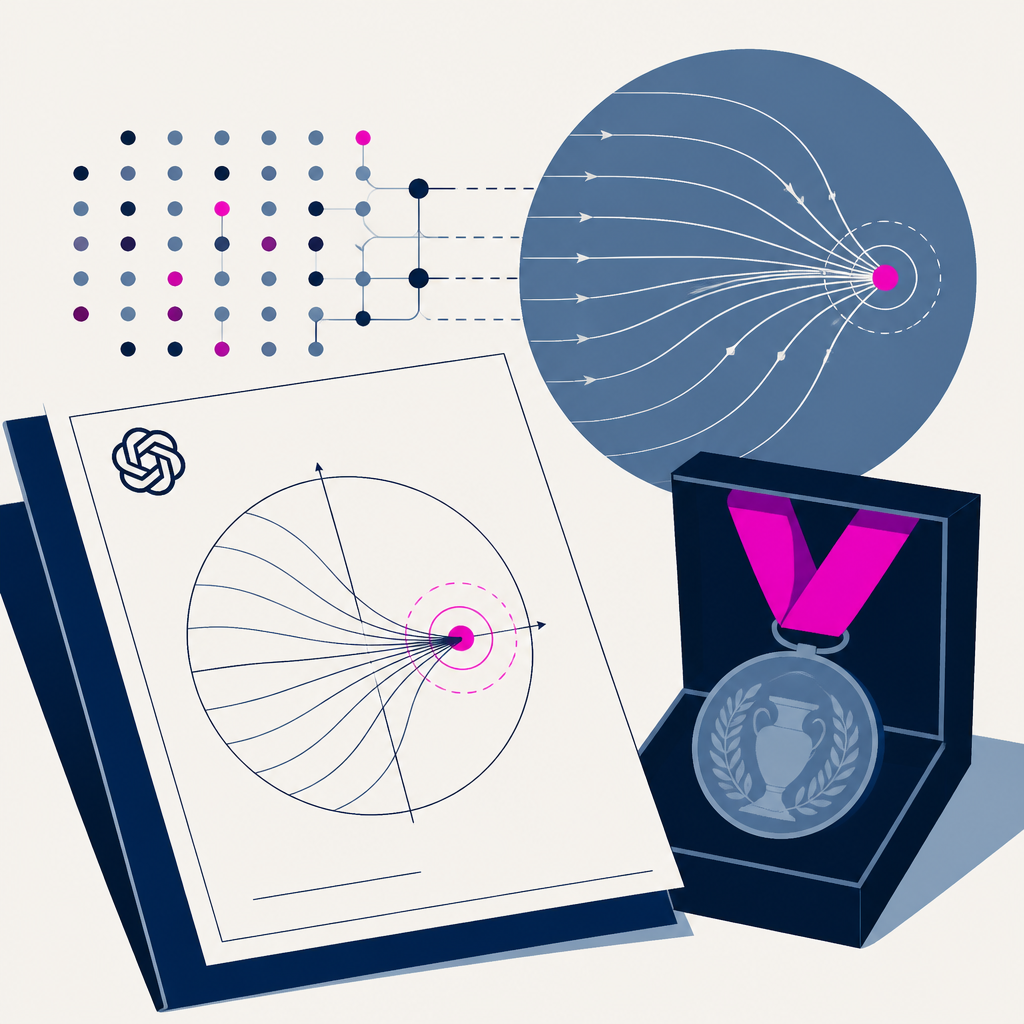
OpenAI’s claim that it cracked a Navier–Stokes “blow up” scenario for one of math’s Millennium Problem candidates—reported as a multi-agent effort using roughly 10,000 sub-agents, about 130B tokens, and “Astra-next” over ~88 hours—dominated the day. The interesting part wasn’t only the scale, but the argument around it: whether large inference-time compute and agentic coordination can produce genuinely usable mathematical insight, and what counts as verification when the public gets a story but not a fully checkable proof.
That uncertainty collided with a broader theme that’s been building behind the curtain: safety warnings and credit. Pieces urging policymakers to take internal “frontier” lab cautions seriously landed alongside disputes about how AI changes attribution, with mathematician Tristan Buckmaster challenging the uniqueness of OpenAI’s approach, and Terence Tao warning that even rumors can “flatten” promising directions by pulling attention and incentives toward whoever can spend the most cycles. If math is supposed to reward clarity, agentic AI adds a new wrinkle: who gets the first clean, reproducible explanation—and how fast everyone else can follow.
Elsewhere, the near-term product world kept moving: OpenAI shipped ChatGPT Images 2.5, promising up to 50% faster generation and sharper multi-step edits, while Meta launched Muse with “secure by design” controls like Secure VM isolation and action monitoring before approvals. Meanwhile, funding kept flowing into applied AI—from CAMAssist automation at CloudNC to churn and churn-cause prediction at Actionable—suggesting that for many teams, certainty isn’t the goal. Adaptation is.