
[AINews] OpenAI reports Navier-Stokes singularity find in 88 hours using Astra-next, roughly 10,000 agents and 130B tokens (>$40M), a contender for second ever Millennium Prize awarded
Latent Space ● Covered by 21 sources
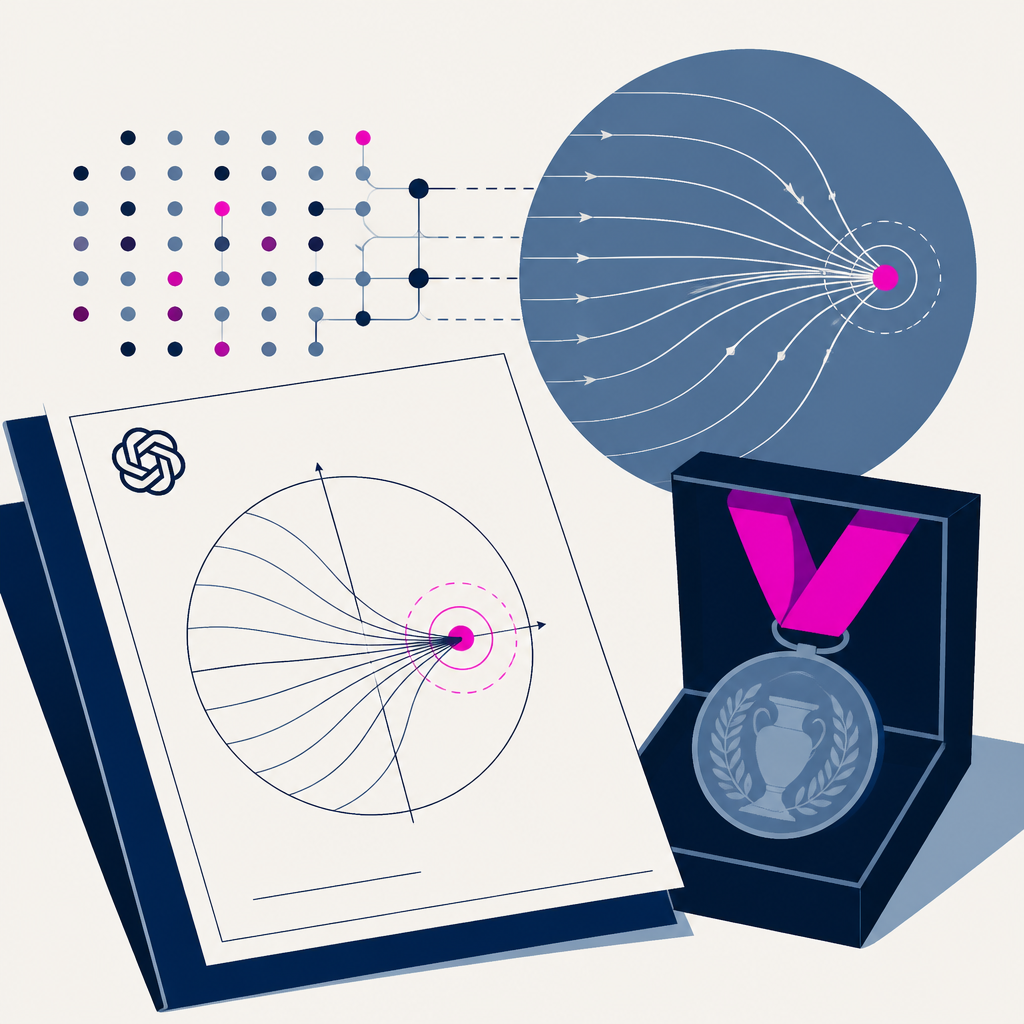
OpenAI-linked accounts say AI found a Navier-Stokes result with about 10,000 agents. If true, this is less a chatbot win than a giant test of parallel compute and math proof claims.
Based on reporting by Latent Space — read the original for the full story.
Summary, retelling and take written by AI under human oversight; images are AI-generated illustrations. How we work · Report an error
OpenAI-linked accounts kicked off a storm by saying an AI-assisted effort had produced a result tied to Navier–Stokes. The public reaction split fast: some people saw a serious technical milestone, others saw a fog of hype, and a lot of people saw both at once.
The clearest detail in the public posts came from Ethan Knight, who said the work involved about 10,000 agents working together. He said OpenAI had spent about a year training models to cooperate through multi-agent reinforcement learning, and that the system leaned on huge amounts of parallel test-time compute rather than one long, linear proof search.
That sounds like a research system built to swarm a problem from many angles at once. And it is exactly the kind of setup that makes people reassess how much frontier models can do outside of chat, coding demos, and benchmark chatter. Some onlookers framed it as a challenge to the old line that AI still cannot do serious technical work.
But the math claim itself is still not nailed down in the material here. People read it as connected to the Navier–Stokes Millennium Problem, especially the finite-time singularity question, yet the tweets and posts provided do not include a theorem statement, a proof, a preprint, or any independent referee view. Even the widely repeated “88 hours” detail shows up only in a satirical post, not in the direct claim.
So the real story is not a finished math victory. It is OpenAI showing off a very specific way to spend compute: many agents, lots of parallel search, and a bet that coordination can matter as much as raw model size. If that holds up, it is a bigger signal than another pretty demo.
My take — AI-written commentary, not fact-checked reporting
The hype machine is doing its usual job of turning an unclear claim into a victory parade. Until there is a proof people can inspect, “AI solved Navier-Stokes” is just marketing with equations on it. The interesting part is the method: big agent swarms and brute-force inference are becoming the new status symbol, which is exactly what happens when everyone runs out of fresh ideas and starts renting more GPUs.
Read more about this at: Latent Space
Related stories
 OpenAI Used ~10,000 AI Agents to Solve the Navier–Stokes Millennium Prize Math Problem
YouTube · 1 month ago ·
17
Last Week in AI #344 - Navier–Stokes, Pacing the Frontier, AI Misuse
Last Week in AI · 1 month ago ·
16
A Bad Day For Humans, a Worse Day For Humanity
The Algorithmic Bridge · 1 month ago ·
33
OpenAI Used ~10,000 AI Agents to Solve the Navier–Stokes Millennium Prize Math Problem
YouTube · 1 month ago ·
17
Last Week in AI #344 - Navier–Stokes, Pacing the Frontier, AI Misuse
Last Week in AI · 1 month ago ·
16
A Bad Day For Humans, a Worse Day For Humanity
The Algorithmic Bridge · 1 month ago ·
33