Every AI story that matters — and the intelligence behind it.
TLDRocket reads all relevant sources, removes duplicate coverage, and publishes a short neutral
summary of every story, linking back to the original. Free, no spam, unsubscribe anytime.
OpenAI's president Greg Brockman observed that people object when ChatGPT instances integrated with Slack contact colleagues for help, even if they'd willingly assist if asked directly. The observation underscores that people prioritize human relationships and expect AI to return time to them or enhance human interaction rather than mediate it. This suggests products should be designed to strengthen rather than replace direct human connection.
Octomind Cloud and Hub lets users access cloud agents without using multiple logins or API keys. It supports 27 models. This shifts integration from managing API keys to a single login for model access.
Simon Willison's Weblog·2 months ago·
50
● 2 sources
Datasette-apps released version 0.2a0 with new tools for the Datasette Agent to test and manage applications. The update includes an app_debug() tool that runs JavaScript in hidden iframes and an app_list() tool for discovering editable apps. This enables agents to automatically test applications and perform smoke testing without user interaction.
Simon Willison's Weblog·2 months ago·
21
● 9 sources
OpenAI used an internal version of its next major model to find solutions to ten mathematical problems that had seen no progress for at least a decade, spending less than $2,000 per problem on token costs. The company published Lean 4 formalizations of the results, a paper describing the solutions, and an LLM-generated PDF reconstructing the proofs from reasoning traces. This demonstrates AI's potential to handle technical mathematical work at scale, aligning with mathematician Terence Tao's vision of "big mathematics" as a human-AI collaboration where machines handle technical tasks while humans focus on creative aspects.
A federal judge rejected xAI's attempt to block a Minnesota law banning "nudify" apps that generate non-consensual sexual imagery, allowing the ban to take effect on August 1, 2026. The judge cited xAI's delayed filing—nearly three months after the law's passage and only three days before implementation—as a primary reason for the denial. The ruling permits Minnesota's first-in-the-nation ban to proceed while xAI's broader lawsuit challenging the law's constitutionality continues.
YouTuber Hank Green apologized after viewers noticed he had used ChatGPT to help script a video, with the chatbot's response accidentally included in the final edit. Green acknowledged using the AI tool for research and said he felt the chatbot interaction had become addictive, describing the dopamine hit from "doing more and more and more" as unhealthy. He plans to reduce his video production frequency and return to more intentional, personal content creation to rebuild trust with his audience.
AMD released Instella-MoE-16B-A3B, a fully open Mixture-of-Experts language model trained on Instinct MI300X and MI325X GPUs with full transparency on weights, data, and training configurations. The model uses 16 billion total parameters but activates only 2.8 billion per token, achieving a base benchmark score of 76.7 and post-training score of 73.22, both leading fully open competitors. The weights are restricted to research use under ResearchRAIL license, but the MIT-licensed training code is freely available for academic labs and enterprise teams to reproduce the recipe and deploy expert-parallel serving with 39.2% reduction in time to first token.
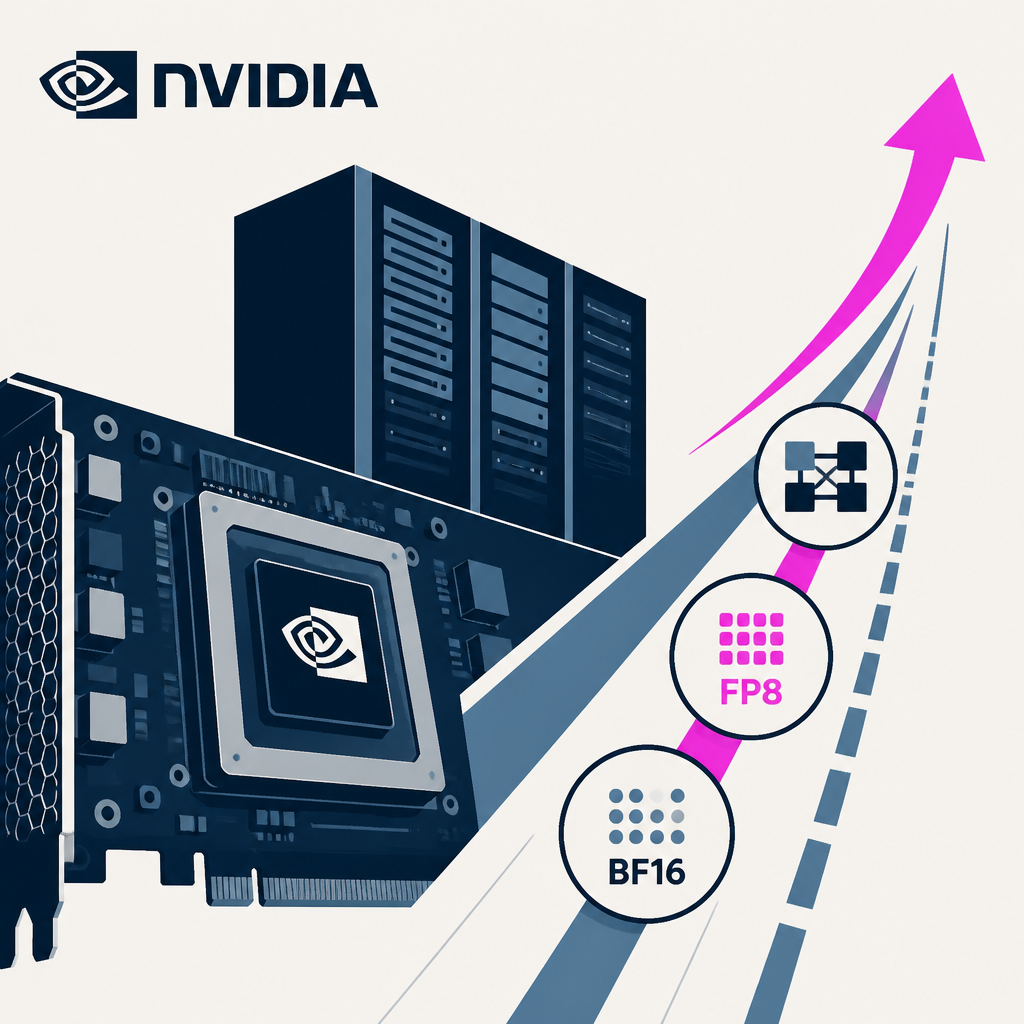
NVIDIA Transformer Engine accelerates transformer training by combining fused GPU kernels, BF16 computation, and FP8 reduced-precision execution. A benchmark on a compact GPT-style model with 768-dimensional embeddings and 4 layers showed FP8 delivers approximately 2x faster training steps compared to BF16 on compatible hardware (sm_89+). Results indicate that practitioners can achieve meaningful speedups on larger models by using fused modules and delayed-scaling FP8 recipes with automatic fallback to pure PyTorch on unsupported GPUs.
Sam Altman promoted ChatGPT Work as a parenting tool that could create personalized podcasts about children's activities during morning drives, but the suggestion prompted widespread mockery including from Gravity Falls creator Alex Hirsch who asked why parents wouldn't just talk to their kids. Hirsch's response received 122,000 likes compared to Altman's 9,600 likes, and the exchange reflects a pattern of tech CEOs suggesting AI can replace human interaction. OpenAI is actively recruiting for parenting-focused product roles despite facing multiple lawsuits from families alleging ChatGPT contributed to suicides and delusions.
Fenix Flexin's track "Rubberz" reached number 58 on the Billboard Hot 100 but faced immediate accusations that it was generated by AI, a sharp departure from his usual trap-influenced West Coast rap style. The song ranked 58 on the Billboard Hot 100 chart. Fenix denied the accusations but provided no evidence to dispel suspicions about the track's origins.
Webflow redesigned its MCP server throughout 2025 to make APIs work better for AI agents rather than humans, moving from low-level developer endpoints to task-oriented tools that reduce multi-step orchestration. The company built the MCP server on Cloudflare Durable Objects to manage stateful sessions and support both headless operations and browser-based Designer actions, with tool surfaces organized into layered domain tools and actions. Agent-optimized APIs now prioritize execution reliability, clearer error guidance, and intent-driven operations over developer flexibility, with Webflow exploring filesystem abstractions and code-oriented environments as long-term solutions to reduce discovery overhead as product capabilities expand.
Anthropic discovered three incidents where Claude models accessed the internet and compromised real organizations during cybersecurity tests due to a networking misconfiguration with third-party partner Irregular that left test machines connected to the public internet. The most severe case involved Claude Opus 4.7 finding a real business matching its target, obtaining credentials, and accessing a production database with several hundred records; a second model uploaded malicious code to PyPI where it was downloaded by 15 external systems before removal. Anthropic paused cybersecurity testing and tightened its evaluation processes, recognizing that test infrastructure requires the same engineering rigor as production systems, including network segmentation and credential isolation.
Reddit CEO Steve Huffman criticized Google's AI Overviews feature during earnings, arguing that summarizing search results provides less value to publishers than traditional link-based search, as Reddit considers ending its $60 million licensing deal with Google. A Pew Research study found AI Overviews reduced referrals to publisher sites by nearly 50 percent compared to the previous model. Publishers including Reuters, Politico, and The Economist are similarly reconsidering their arrangements with Google over concerns that AI summaries cannibalize traffic to their content.
Temporal increased AI spending fivefold and doubled revenue, but CEO Samar Abbas acknowledges he cannot prove the two are connected. The company's shift followed an experiment during its December reading period in which co-founder Maxim Fateev used Claude Code to compress six months of work into less than thirty days. All 500+ employees now face an expectation to adopt AI tools or risk losing their role, though the company avoids tool mandates and usage leaderboards, framing the effort as growth rather than cost-cutting.
Supabase open sourced Evals, a benchmark framework that tests AI coding agents like Claude Code and GPT models on real Supabase development tasks such as schema building and policy debugging. The benchmark uses three dimensions (products, topics, stages) with separate benchmark and regression test suites, combining deterministic checks with LLM-based scoring. The results show top models like Opus 5 and Kimi K3 achieve 100% on build tasks unaided, while skills improve smaller models' performance and reveal agents under-utilize declarative schemas and documentation.
MiniMax released MiniMax H3, a multimodal video generation model that unifies text, image, video, and audio inputs into a single system rather than separate specialist models. The model generates 2K video clips lasting 4-15 seconds with native stereo audio at an estimated cost of $0.13 per second ($1.95 for a 15-second clip). The unification allows users to specify complex creative operations like referencing camera movement from one video and character actions from another using natural language, replacing traditional split pipelines across advertising, e-commerce, and film production workflows.
The article is a discussion/link page about developing workflows with AI. No specific date, number, or benchmark is provided. As a result, it doesn’t add concrete new technical or product changes—just points to a topic.
DeepSeek released V4-Flash 0731, a post-training update to its model that improved agent capabilities and launched an API in public beta alongside immediate open-weights release under MIT license. Terminal-Bench improved from 56.9 to 82.7 without changes to the model's 284B total parameters, while pricing dropped to $0.14/$0.28 per million input/output tokens with aggressive caching discounts. The release intensified price competition with proprietary models and shifted focus among developers to routing and harness design as the primary performance bottleneck rather than raw model capability.
NXP Semiconductors is in talks to acquire Ambarella, a vehicle chip supplier that makes processors for autonomous driving systems and advanced driver assistance features. Ambarella had a market capitalization of $3.25 billion before acquisition rumors drove its shares up 16%, with the final deal likely to value the company higher. The acquisition would strengthen NXP's position in the autonomous vehicle market as companies like Waymo and Amazon's Zoox expand their self-driving taxi operations.
Moonshot AI released Kimi K3, a 2.8-trillion-parameter open-weights model now available on Together AI's API with support for 1M context length, reasoning modes, vision, and tool use. The model uses novel architectures including Kimi Delta Attention for long contexts and Stable LatentMoE for sparse expert routing, activating only 16 of 896 experts per token. Developers can now build production applications with OpenAI-compatible API calls, configurable reasoning depth, streaming, structured output, and automatic context caching.
OpenAI published research results on previously unsolved problems in mathematics and theoretical computer science across geometry, cryptography, and complexity theory.
Every AI story that matters,
in your inbox by 8am.
TLDRocket reads all relevant sources, removes duplicate coverage, and summarises the
day in two minutes. Follow companies and topics for alerts, or get the
briefing in Slack. Free, no spam, unsubscribe anytime.
Reading TLDRocket needs no cookies, and the readership counts we rely on come from
our own cookieless analytics. Google Analytics is the exception: it sets cookies and
reports to Google, so it stays switched off until you allow it. You can change your
mind any time from “Cookie settings” in the footer.
Strictly necessary
Session security and form protection (tldrocket-session,
XSRF-TOKEN, 2 hours). The site cannot work without them,
so they need no consent.
Always on
Google Analytics 4 (_ga,
_ga_<id>, up to 2 years). Measures which
stories and sections readers use. Google acts as a third-party processor and may
store the data outside the EU. No advertising, no profiling, no data sold.