
Accelerating Transformer Training with NVIDIA Transformer Engine, Fused Kernels, BF16, FP8, and GPU Benchmarking
MarkTechPost Sana Hassan
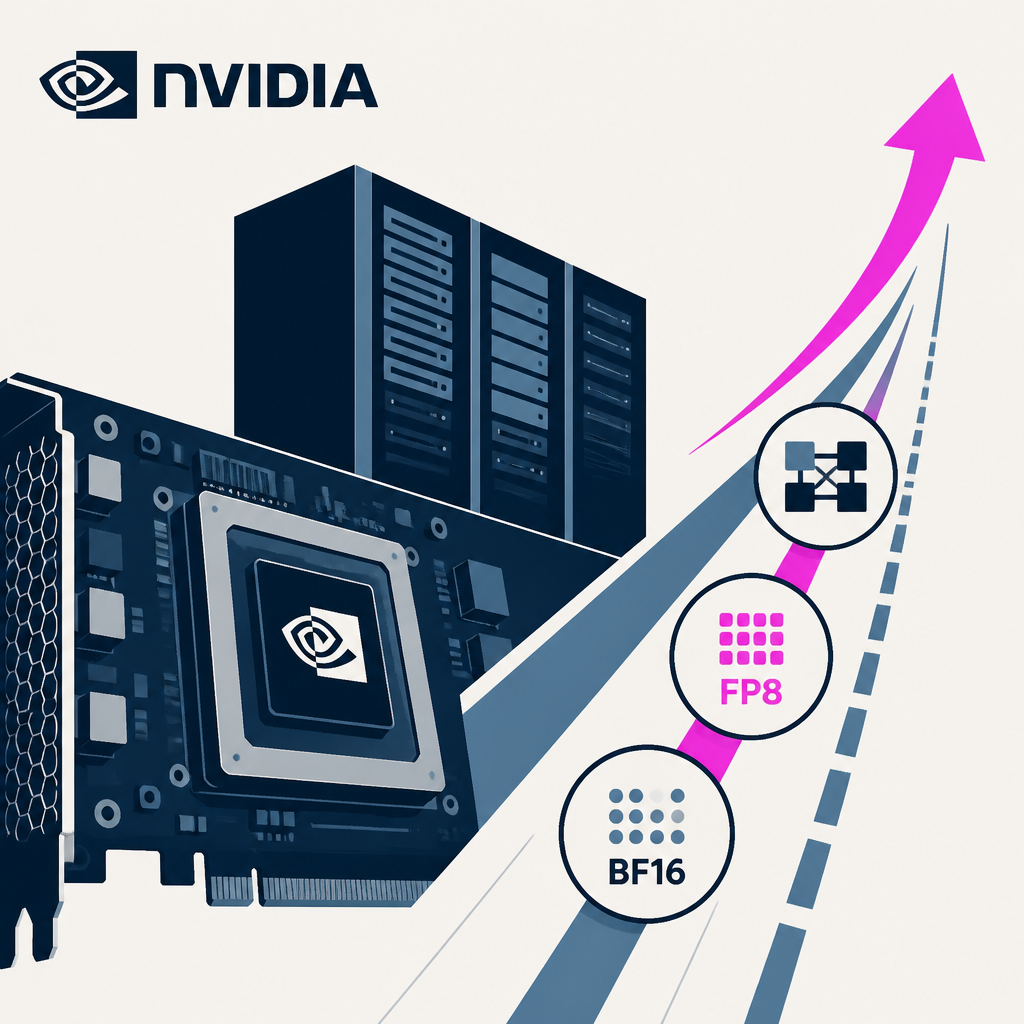
MarkTechPost published a tutorial showing how NVIDIA's Transformer Engine speeds up transformer training with fused kernels and FP8 math. It auto-detects your GPU and falls back gracefully if the hardware can't handle FP8.
Based on reporting by MarkTechPost, Sana Hassan — read the original for the full story.
Summary, retelling and take written by AI under human oversight; images are AI-generated illustrations. How we work · Report an error
There's a specific kind of tutorial that quietly explains more about modern AI infrastructure than any keynote does, and this MarkTechPost walkthrough on NVIDIA's Transformer Engine is one of them. Rather than just claiming FP8 is faster, it builds a small GPT-style causal language model twice — once using fused te.TransformerLayer blocks, once using plain PyTorch attention and MLP layers — and runs both through the same paces so the comparison actually means something.
The first move is defensive, and rightly so. The code checks the GPU's compute capability before doing anything else, because Transformer Engine kernels need Ampere-class hardware or newer, and FP8 tensor cores specifically require compute capability 8.9 or above, meaning cards like L4, H100, Ada, or Blackwell. Older GPUs, a T4 for instance, get bumped down to a pure-PyTorch fallback path automatically. No FP8, no fused kernels, just standard execution. That kind of graceful degradation matters more than people admit when you're writing code that has to run on whatever Colab hands you that day.
Once the hardware is sorted, the tutorial walks through TE's building blocks: te.Linear, te.LayerNorm, te.LayerNormLinear, te.LayerNormMLP, and the full te.TransformerLayer, alongside a delayed-scaling FP8 recipe using the hybrid E4M3/E5M2 format with a 16-step amax history. That recipe isn't decorative — it's the mechanism that keeps FP8 tensors numerically stable during training, tracking scale factors and amax history so precision doesn't quietly collapse mid-run.
The actual training is almost deliberately unglamorous: 60 steps on synthetic sequences built from a fixed phase-and-stride pattern, so the model's job is just to learn a predictable arithmetic rule. The point isn't to train something useful, it's to create a clean testbed for comparing runtime and peak GPU memory across BF16 and FP8 execution, and to sanity-check the result afterward with greedy generation that should reproduce the constant stride the model was trained on.
What stands out is the honesty about scale. The benchmark itself is tiny — one small model, one batch size, thirty benchmarking iterations — and the tutorial explicitly notes that any FP8 speedup will look far more dramatic once you push the model dimensions up, suggesting something like a 2048-wide, 12-layer setup as a next step. It's a reminder that FP8's real payoff shows up at production scale, not in a Colab demo.
My take — AI-written commentary, not fact-checked reporting
Fallback-first design like this deserves more praise than it gets — a workflow that quietly downgrades to BF16 or FP32 on unsupported hardware instead of just crashing is exactly the kind of unglamorous engineering that makes new numerical formats usable outside a handful of flagship GPUs. The bigger tell here is the admission that FP8's advantage barely shows up at toy scale; anyone judging reduced-precision training by a 60-step demo on a mini model is going to draw the wrong conclusion entirely.
Read more about this at: MarkTechPost
Related stories
 Sparser, Faster, Lighter Transformer Language Models
Sakana AI ·
32
Getting Started with Transformers on Habana Gaudi
Hugging Face · 4 years ago ·
42
A Gentle Introduction to 8-bit Matrix Multiplication for transformers at scale using transformers, accelerate and bitsandbytes
Hugging Face · 4 years ago ·
51
Sparser, Faster, Lighter Transformer Language Models
Sakana AI ·
32
Getting Started with Transformers on Habana Gaudi
Hugging Face · 4 years ago ·
42
A Gentle Introduction to 8-bit Matrix Multiplication for transformers at scale using transformers, accelerate and bitsandbytes
Hugging Face · 4 years ago ·
51