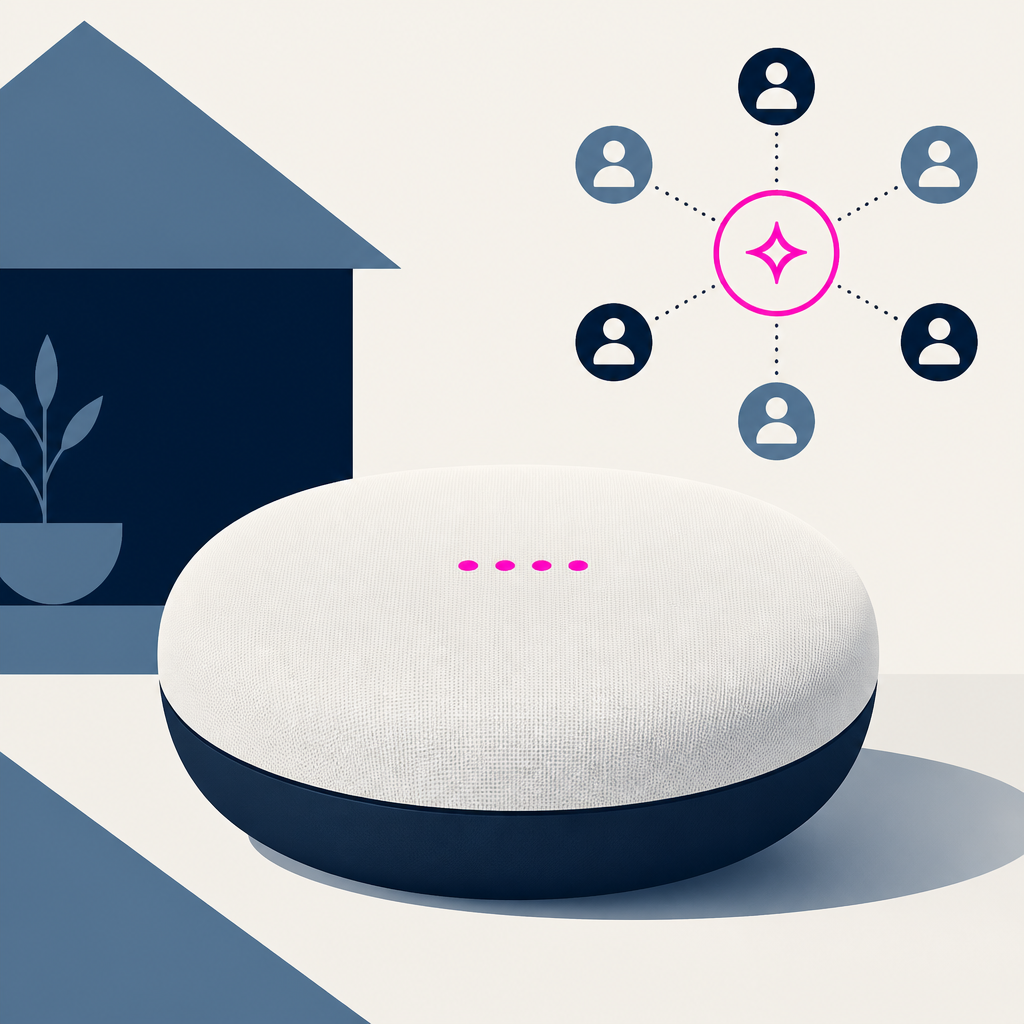
Google expanded its experimental AI agent CC so a household can share one agent with up to six members. Up to six people can share the same CC instance, producing a daily brief, shared calendar and a running task list. The setup now adds member-by-member sharing permissions, a verified CC account identity, and a private/household memory split for what gets stored.
Google says it is enabling teachers to generate custom interactive STEM learning simulations using a generative user interface approach with teacher-set objectives and AI-built scaffolding.
Google announced an experimental CC AI agent for families that customizes actions across multiple household users. CC is designed for up to six users and has its own Google account for shared access controls. This shifts the Daily Brief concept into a shared, permissioned setup that can selectively access shared emails and a designated Google Drive folder.
Emerald AI formed the AI Energy Management Alliance with Google, Nvidia, and Anthropic to use its grid software to expand where data centers can connect. It targets demand response measures that could add 100 gigawatts of additional data center capacity to the grid. The coalition aims to make utilities treat temporary load reductions as part of data center development, reducing reliance on backup generators but not removing the need for new power generation entirely.
Google Research introduced Retrieve-for-Train (R4T) to generate diverse retrieval result sets from one query instead of near-duplicate matches. The R4T diffusion retriever runs in 0.07 seconds at batch size 8, versus about 1.46 seconds for an autoregressive fan-out. R4T first learns retrieval fan-out with offline reinforcement learning and then deploys a 53.9M-parameter diffusion model for a single-pass, faster retrieval fan-out.
Every AI story that matters,
in your inbox by 8am.
TLDRocket reads all relevant sources, removes duplicate coverage, and summarises the
day in two minutes. Follow companies and topics for alerts, or get the
briefing in Slack. Free, no spam, unsubscribe anytime.
Reading TLDRocket needs no cookies, and the readership counts we rely on come from
our own cookieless analytics. Google Analytics is the exception: it sets cookies and
reports to Google, so it stays switched off until you allow it. You can change your
mind any time from “Cookie settings” in the footer.
Strictly necessary
Session security and form protection (tldrocket-session,
XSRF-TOKEN, 2 hours). The site cannot work without them,
so they need no consent.
Always on
Google Analytics 4 (_ga,
_ga_<id>, up to 2 years). Measures which
stories and sections readers use. Google acts as a third-party processor and may
store the data outside the EU. No advertising, no profiling, no data sold.