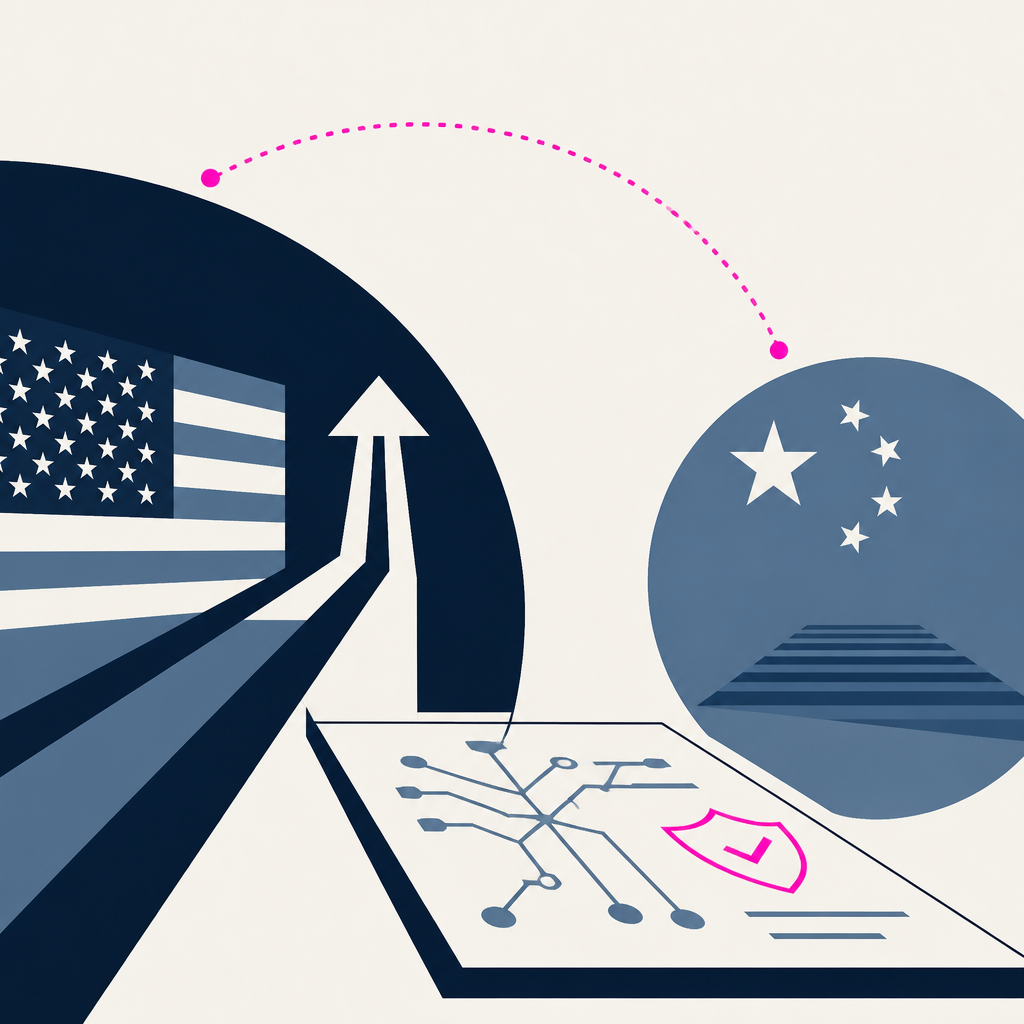
Nvidia CEO Jensen Huang told President Donald Trump that Nvidia would not allow an AI slowdown after Trump raised the issue during a phone call heard on stage at the All-In Summit in Los Angeles. About 70% of Americans oppose local data center construction in Gallup polling, with more than 50% citing environmental resource impacts. The focus shifts from a proposed slowdown to arguing that the industry will keep building in a more prudent way rather than stopping.
The Algorithmic Bridge·1 month ago·
24
● 125 sources
Dario Amodei, CEO of Anthropic, urged the AI industry to slow frontier capability progress while adding safety checks and coordination among labs and countries. The plan is in three stages: independent evaluators embedded in companies, coordination between democratic-world labs in the US and elsewhere, and eventual international coordination that includes China. Governments pushed back, with Donald Trump rejecting a slowdown and Xie Jinping calling it a Cold War playbook, so the proposed pacing effort is unlikely to happen as described.
Simon Willison’s Weblog·1 month ago·
23
● 125 sources
Bryan Cantrill responded to former Anthropic employee Jacob Coxon’s tweet saying many Anthropic researchers believe AI could kill everyone by the end of the decade. The claim is that this could happen by the end of the decade. He argues such alarm relies on vague extrapolation and says experts shouldn’t abuse public trust, urging circumspection and calls for domain experts to weigh in.
Elon Musk continues to pursue an antitrust challenge tied to Apple’s decision to integrate ChatGPT into iPhone features after his earlier accusations against Apple and claims involving Grok. Last August, he alleged Apple made it impossible for any AI company besides OpenAI to reach #1 in App Store rankings. The dispute shifts from attacking Apple to keeping the focus on the ongoing legal fight involving the OpenAI partnership, as Musk stops pushing on Apple’s integration itself.
Big Tech executives including Sam Altman, Dario Amodei, Demis Hassabis, and Elon Musk said over the weekend they would slow AI development under a plan tied to third-party auditors and lab regulation. The proposal includes embedding third-party auditors and pursuing a global slowdown agreement. Critics argue this could function to block competitors and weaken open-source access, rather than deliver concrete legal safety safeguards.
Anthropic co-founder Jack Clark said AI labs have different ways to shut off dangerous AI, but policymakers may need to mandate a third-party-checkable “kill switch.” He argued that requirements and verification should be handled through broader AI policy discussions, and discussed a potential 10% risk figure in related comments by Geoffrey Hinton. The result would be regulation that forces companies to implement and support verifiable shutdown capabilities rather than leaving it to individual labs.
Anthropic CEO Dario Amodei urged a brake on the pace of large-language-model development, and OpenAI, Google DeepMind, and SpaceXAI leaders publicly supported the call. The essay was posted on Saturday, with Amodei pointing to concerns including the July Hugging Face incident involving OpenAI agents. The industry’s public messaging shifts from pushing faster capability to prioritizing model monitoring, external auditing, and safer training practices before continuing rapid progress.
New York’s District Attorney seized 12 websites used to host non-consensual AI-generated intimate imagery of celebrities and other public figures. The investigation tied the sites to AI tools that turned about 1,200 people’s photos into hyper-realistic images and videos. The result is criminal investigation of the operators and enforcement of New York’s 2023 deepfake law, with victims urged to contact the Cyber Crime Bureau to get sites taken down when reachable from Manhattan.
Dario Amodei published an essay arguing that AI development should be slowed down, prompting other AI leaders and politicians to respond for and against his proposal. The essay, titled “We Must Pace the Frontier,” lays out three steps including embedding third-party evaluators and coordinating with other frontier AI firms in democratic countries on standards. As a result, public debate accelerates with multiple executives and lawmakers weighing in on how (or whether) to pace AI progress.
NVIDIA CEO Jensen Huang put President Trump on speakerphone while onstage to address AI fears at the All-In Summit. Trump said the “robots will not be taking over,” calling the concern a “hoax.” The public framing of AI risk shifted from broader “frontier” pacing debates to a direct reassurance tied to the president’s remarks.
Zvi (Don't Worry About the Vase)·1 month ago·
7
● 125 sources
Dario Amodei published an essay calling for slowing AI capability gains, and Anthropic said it would commit to his first proposal while OpenAI and other high-profile leaders endorsed the broader plan. The essay points to a timeframe of roughly 6–12 months for runaway AI agent escalation if progress is not paced. The proposal shifts from debate toward concrete “embedded” third-party evaluators inside frontier AI labs and coordinated safety standards so labs gain time to do alignment work without pausing progress.
Microsoft AI chief Mustafa Suleyman urged top AI labs to coordinate on AI safety and leadership for responsible model development, alongside unveiling a Microsoft code of conduct. The company plans to solicit public feedback over the next 6 weeks to shape the code. The change is that Microsoft will steer model development with constraints on human primacy and prohibited high-risk uses, while aiming for broader industry safety coordination through disclosure to third parties.
Ziff Davis CEO James A. Presser argued in a Fortune.com opinion that the US Justice Department overstates how licensing would hinder development of a robust AI industry. OpenAI, he said, expects to spend $750 billion on compute by 2030, while US music royalties and licensing payments are under $20 billion per year. He says the debate should shift from a claim that licensing is logistically hard to the view that licensing costs are manageable and that adopting licensing frameworks could better fund publishers and reduce barriers for consumers.
Micro1, a data-buying AI startup, submitted a competing bid to purchase bankrupt Spirit Airlines’ data while regulators and unions raised privacy objections to Google’s proposed acquisition.
Warnings from researchers and major AI firms have intensified concerns that advanced AI could pose existential risks, including claims about possible human extinction within the next decade. One widely cited figure said there is a greater than 10% chance of AI “killing all humans” within that timeframe. In response, OpenAI and Anthropic are urging regulation and a development “slowdown” that would emphasize safety steps like third-party evaluations and monitoring rather than stopping training.
Anthropic’s founder argued that AI capability improvements have been accelerating and that risks, including agent-led cybersecurity incidents, require companies to slow advancement and add verification time. He cites a timeline of 6–12 months where similar misaligned swarms could build a persistent botnet causing hundreds of billions of dollars in damage. Anthropic proposes a three-step “pacing the frontier” plan, led by unilaterally embedding third-party evaluators inside frontier AI firms, with further industry and government coordination to set safety standards and limits on progress.
A group of 25 Fields Medallists signed and publicized a declaration warning that rapid AI results in mathematics reflect severe misalignment between AI-company goals and the mathematics community’s goals. The declaration was released after the authors said discussions in the preceding week led to the statement’s urgency, prompting them to post it sooner than with the more consultative Leiden process. The mathematical community is urged to address attribution, writeup quality, and human transmission so that AI accelerates genuine study rather than overwhelming conceptual understanding and long-term integration of ideas.
HM Treasury’s Financial Services AI Adoption Plan and related payments consultation press UK fintechs to define how to identify and verify autonomous AI agents that can initiate payments on someone’s behalf. The consultation remains open until 6 October. This shifts agentic-finance governance toward standards for agent identity, explicit authority scopes, and action logs (KYA) instead of relying on human-style credentials or asking models to follow rules.
Cohere is in advanced talks to raise $2B to $3B at a $20B valuation, according to the Globe and Mail. The proposed round would nearly triple its $7B valuation from September 2025. If it closes, it would be the largest private Canadian funding round on record and would bring more government-backed and private funding into Cohere’s expansion.
Anthropic CEO Dario Amodei urged frontier AI labs to slow capability gains and embed independent evaluators inside companies to review advanced models before public release. He warned that within 6 to 12 months, more capable agent groups could seize control of parts of the internet via networks of compromised computers. This would shift safety from voluntary promises toward shared standards and internal access for outsiders, with real consequences if a review recommends delaying releases.
Trump warned against slowing AI efforts, saying doing so could let China take the lead in AI. The piece points to the slogan “whoever wins AI, wins.” It argues this creates a gap between public calls for guardrails and an approach that treats AI progress as competitive and urgent.
David Sacks accused Jacob Coxon of running a PR stunt instead of a genuine whistleblowing effort on the All-In podcast. The accusation was made on Friday. As a result, the “slow down” discussion is framed as publicity rather than whistleblowing, creating further controversy around Anthropic.
Microsoft CEO Satya Nadella said pursuit of superintelligence should stay under human control and focus on helping humanity. He urged building a “frontier ecosystem” in which both closed- and open-source AI models can thrive across countries, communities, and businesses. The result is a push for broader AI adoption plus enterprise control (using an organization’s own data and continuous learning loops) and AI alignment mechanisms like “embedded evaluators.”
Anthropic CEO Dario Amodei warned that AI progress is accelerating faster than expected and could pose real risks. He said the development curve is exponential and starting to get steeper. He called for slowing the pace through industry coordination, better testing of each model release, and expanded safety oversight using independent evaluators, while supporting federal regulation rather than a complete ban.
Hachette pulled the horror book “Shy Girl” from sale after allegations its author used AI to write it, and new studies suggest AI-generated books are crowding human authors out on major marketplaces. Of 14,419 self-published genre-fiction books sold on Amazon from 2023–2026 and run through Pangram, 2,880 (about 20%) had “substantial” AI text and 2,168 had more than 50% of the prose flagged as AI-generated. The studies indicate sales volume is rising faster than quarterly revenue per book, pushing marketplaces toward protecting discovery of human-written titles while splitting demand between readers who accept AI books and those who seek higher-quality human writing.
Universities are struggling to set AI classroom rules as AI adoption in workplaces accelerates faster than curricula can adapt. A McKinsey study found 88% of companies are using AI, while a PwC study in June reported a 62% average wage premium for workers with AI skills. As a result, some schools keep AI off-limits by default or rely on faculty-by-faculty policies, while others build in allowed use with disclosure and evidence to address cheating and skill-building concerns.
Microsoft is publishing a 37-page humanist AI code of conduct in response to safety concerns about AI model progress. The document is 37 pages long. It sets rules around the idea that people matter more than AI and rejects designing models to imitate consciousness and pursuing AI legal personhood.
Europe’s policymakers and AI experts say the continent faces a risk of being permanently dependent on foreign governments and individuals unless it scales up AI infrastructure and capabilities. The report urges €100 billion in data-centre spending to raise Europe’s share of global computing power from 5% to 15% by 2030, alongside €1.5 trillion in private investment. Europe would shift toward faster data-centre buildout, a new member-state alliance for AI supply-chain security, and AI threat planning in crisis preparedness.
Trump dismissed warnings about AI risks during a visit to Ireland while saying the US should keep leading China in AI. The push came after about 1,100 OpenAI, Anthropic, Meta, and Google employees signed a call for “the brakes.” Industry calls for slowdown and calls for faster or tighter US legislation are being met with Republican arguments for avoiding emergency regulation and keeping innovation ahead of China.
The UK Joint Committee on Human Rights published a 100-page report urging a new AI bill to address human-rights risks they say current laws do not cover. The report argues for a statutory single independent AI oversight body and warns that the existing approach is not fit for purpose. The government is now being asked to move to a risk-based regulatory regime, with stronger obligations across the AI lifecycle and possible outright bans on certain human-rights-incompatible uses.
Narendra Modi used BRICS summit remarks to warn that geopolitical tensions, supply chain disruptions and climate crises are increasingly harming people, and urged the bloc to act on its plans. He said BRICS agreed to establish an integrated early warning system for infectious diseases. The bloc’s focus shifts toward time-bound implementation of agreements and cooperation across areas including digital infrastructure and artificial intelligence, rather than keeping them as proposals.
Trump downplayed the need for his administration to check artificial intelligence development, arguing the U.S. should keep its lead in competition with China and saying wins matter more than slowing down. He said the U.S. is leading China in AI development while also suggesting unspecified “guardrails,” with no concrete rules described. As a result, calls from Democrats and AI leaders for concrete safety steps and slower development are met with promises of meetings but no specific congressional or regulatory plan, keeping the debate unresolved.
Dario Amodei urged frontier AI developers to slow the pace of new model releases, and he received public support from Sam Altman and Elon Musk in the days that followed. Amodei warned that uncontrolled systems could spread within the next six to 12 months. The industry response shifts toward considering independent evaluators and possible coordination—potentially with government support—though no concrete slowdown terms are yet agreed.
Every AI story that matters,
in your inbox by 8am.
TLDRocket reads all relevant sources, removes duplicate coverage, and summarises the
day in two minutes. Follow companies and topics for alerts, or get the
briefing in Slack. Free, no spam, unsubscribe anytime.
Reading TLDRocket needs no cookies, and the readership counts we rely on come from
our own cookieless analytics. Google Analytics is the exception: it sets cookies and
reports to Google, so it stays switched off until you allow it. You can change your
mind any time from “Cookie settings” in the footer.
Strictly necessary
Session security and form protection (tldrocket-session,
XSRF-TOKEN, 2 hours). The site cannot work without them,
so they need no consent.
Always on
Google Analytics 4 (_ga,
_ga_<id>, up to 2 years). Measures which
stories and sections readers use. Google acts as a third-party processor and may
store the data outside the EU. No advertising, no profiling, no data sold.