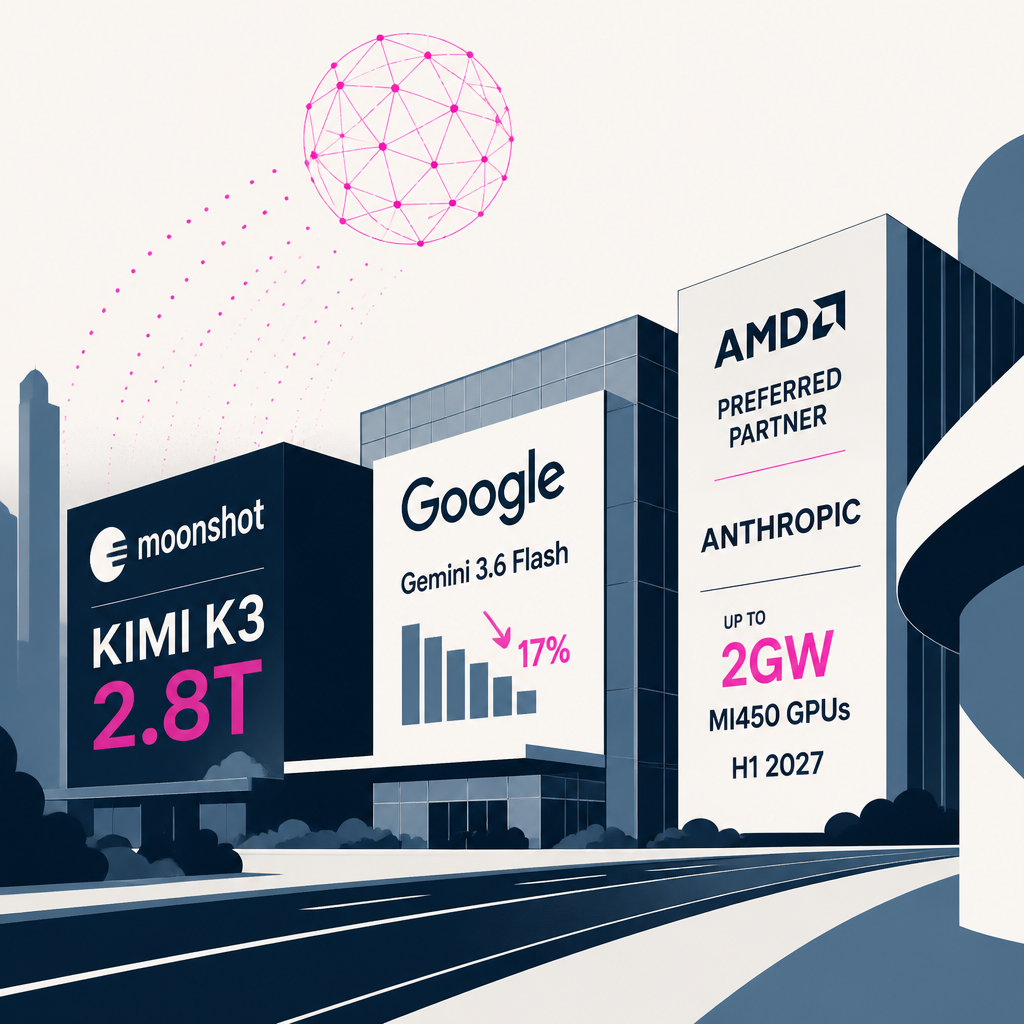
Deep Learning Weekly issue 465 covers major AI releases including Moonshot's Kimi K3 model with 2.8 trillion parameters and Google's Gemini 3.6 Flash with 17% reduced output token usage. AMD and Anthropic announced a partnership to deploy up to 2 gigawatts of MI450 GPUs starting in H1 2027, with AMD investing up to $5 billion in equity in Anthropic. The issue also features research on unifying in-context learning and activation steering through a Bayesian framework, and a new definition of hallucination as inaccurate world modeling.
The Trump administration is considering reducing public notice and participation requirements in air pollution permitting for data centers and power plants. The EPA held a hearing on a proposed rule that would give states control over public involvement in permitting for certain pollution sources. If adopted, the change would limit communities' ability to influence or delay data center development through the permitting process.
Investors use the term 'frontier' to justify massive capital spending on AI, viewing such expenditure as a competitive moat. No specific financial figure or timeline is provided in the article. This framing influences how companies allocate resources and how investors evaluate AI companies' strategic priorities.
DeepSeek founder Liang Wenfeng discussed the company's strategy in a leaked 4-hour investor meeting transcript, framing the performance gap with US AI labs as primarily a compute resource constraint rather than a talent or fundamental capability difference. Liang stated DeepSeek spent roughly 20 billion yuan in 2026 and operates with about one-twentieth of the compute available to major US competitors, with a goal of narrowing the timeline gap from two years to six months or less. The company plans to rely more on domestic Chinese chips (particularly Huawei's 950), maintain aggressive low-cost API pricing that recovers equipment costs in 10 months, and prioritize team retention through equity grants as critical to reaching AGI.
Debt funding for AI, dual-use, and space technology companies emerged as notable sectors in the first half of 2026, alongside traditionally debt-heavy industries. Several AI and space companies secured significant rounds, including deals exceeding €400 million and funding ranging from 10% to 288% year-on-year growth. These sectors are reshaping debt markets as investors increasingly target technology companies addressing emerging strategic priorities.
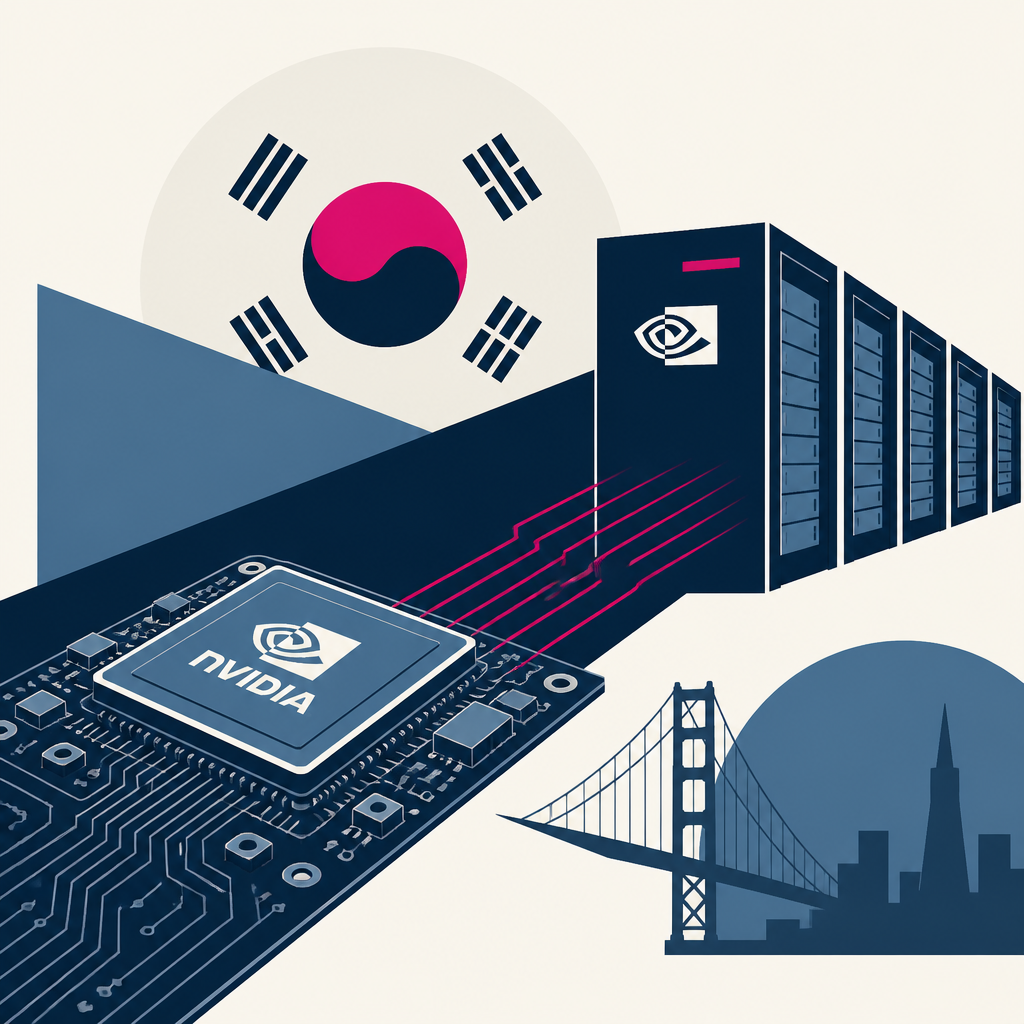
South Korean President Jae Myung Lee and business leaders met with NVIDIA at the AI Summit in San Francisco to advance the country's AI infrastructure and expertise. NVIDIA and KAIST announced the first joint AI research lab between a Korean university and global technology company, focused on agentic AI research in Seoul. The partnerships aim to position South Korea as a global center for AI innovation through expanded collaboration on AI infrastructure, memory development, and research capabilities.
Every AI story that matters,
in your inbox by 8am.
TLDRocket reads all relevant sources, removes duplicate coverage, and summarises the
day in two minutes. Follow companies and topics for alerts, or get the
briefing in Slack. Free, no spam, unsubscribe anytime.
Reading TLDRocket needs no cookies, and the readership counts we rely on come from
our own cookieless analytics. Google Analytics is the exception: it sets cookies and
reports to Google, so it stays switched off until you allow it. You can change your
mind any time from “Cookie settings” in the footer.
Strictly necessary
Session security and form protection (tldrocket-session,
XSRF-TOKEN, 2 hours). The site cannot work without them,
so they need no consent.
Always on
Google Analytics 4 (_ga,
_ga_<id>, up to 2 years). Measures which
stories and sections readers use. Google acts as a third-party processor and may
store the data outside the EU. No advertising, no profiling, no data sold.