Runway launched Media Router, a tool that automatically selects the best generative media model for developers based on priorities like quality, speed, or cost, positioning itself as infrastructure rather than just a model company. The router integrates multiple third-party image, video, and audio models through Runway Dev, Runway's developer platform launched earlier this month. This shift reflects Runway's transition from a consumer AI video tool to a B2B infrastructure layer as generative media models have proliferated and competition intensified.
Google reported $119.8 billion in Q2 2026 revenue but entered negative cash flow for the first time due to massive AI infrastructure spending that exceeded its operating cash flow. The company's capital expenditures on AI have grown so large that despite $39.1 billion in operating cash flow (up 40 percent year-over-year), it now spends more than it generates in cash. This spending surge signals Google's prioritization of AI competitiveness over near-term profitability, forcing the company to fund infrastructure investments through non-operating sources.
xAI's $5 billion GPU cluster (Colossus) serves as collateral for debt financing arranged by Apollo Global Management, but lenders cannot reliably assess its actual value because operational expertise lives with personnel, not in documented systems. GPU failure rates run at 9% annually, and clusters require specialized operations teams to manage failures, silent data corruption, and thermal issues that rarely appear in standard monitoring. The 6-7 percentage point premium charged on GPU-collateralized debt reflects uncertainty that has no equivalent in aircraft, shipping, or real estate financing, where standardized pricing and secondary markets exist after decades of maturation.
Google mirrors NVIDIA's full-stack approach across silicon, interconnects, servers, compilers, frameworks, and cloud operations, making it the closest strategic rival, though not a universal replacement and AWS and AMD also have relevant capabilities. The comparison requires examining the entire industrial system—chip, software, cloud infrastructure, and applications—rather than isolated hardware specifications. Google's position as a potential rival depends on controlling multiple layers simultaneously, something few other companies can replicate.
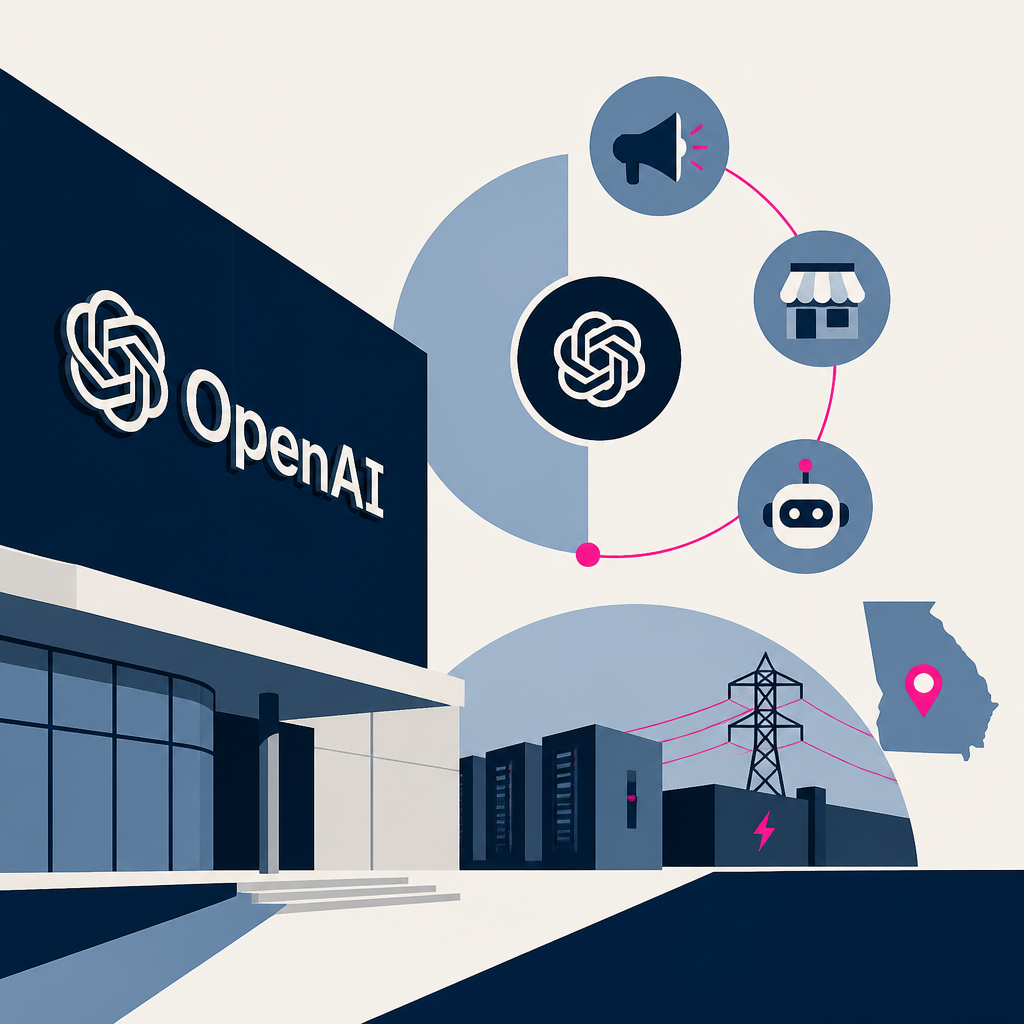
OpenAI added advertising, small-business agents, and announced a 3.2 GW data center in Georgia to transform ChatGPT into a business platform beyond conversational AI. The company is building infrastructure with 3.2 gigawatts of power capacity in Georgia to support expanded services. This positions ChatGPT as an operating system for businesses rather than just a chat interface.
Right-wing and left-wing activist groups in Florida are both protesting the expansion of AI data centers in their communities, despite a county moratorium already in place. Organizers in Hernando County gathered outside a library to oppose hyperscale data center construction and collect signatures for a permanent ban, rather than accepting the one-year pause the commission had approved in June. The convergence of conservative and progressive opposition to data center development reflects shared concerns about local land use and infrastructure impacts, creating an unusual political alliance.
NVIDIA installed a DGX GB300 supercomputer at the Naval Postgraduate School in Monterey, California, to support education and research for 1,500 students and 600 faculty. The system enables large-scale AI model training and inference for applications in weather prediction, cybersecurity, and disaster response. Military officers and researchers now have on-campus access to advanced computing for developing AI tools and digital simulations relevant to operational challenges.
Etched plans to build inference-specific custom silicon and cluster-scale inference systems with production readiness by 2026 through a partnership announcement and investment led by its backers. The deal includes a $300 Million Series C at a $10 Billion pre-money valuation. Early customers gain access to the Gen 1 inference product, and the partnership positions Etched to ship next-generation inference hardware faster.
Every AI story that matters,
in your inbox by 8am.
TLDRocket reads all relevant sources, removes duplicate coverage, and summarises the
day in two minutes. Follow companies and topics for alerts, or get the
briefing in Slack. Free, no spam, unsubscribe anytime.
Reading TLDRocket needs no cookies, and the readership counts we rely on come from
our own cookieless analytics. Google Analytics is the exception: it sets cookies and
reports to Google, so it stays switched off until you allow it. You can change your
mind any time from “Cookie settings” in the footer.
Strictly necessary
Session security and form protection (tldrocket-session,
XSRF-TOKEN, 2 hours). The site cannot work without them,
so they need no consent.
Always on
Google Analytics 4 (_ga,
_ga_<id>, up to 2 years). Measures which
stories and sections readers use. Google acts as a third-party processor and may
store the data outside the EU. No advertising, no profiling, no data sold.