
Deep Learning Weekly: Issue 465
Deep Learning Weekly Miko Planas
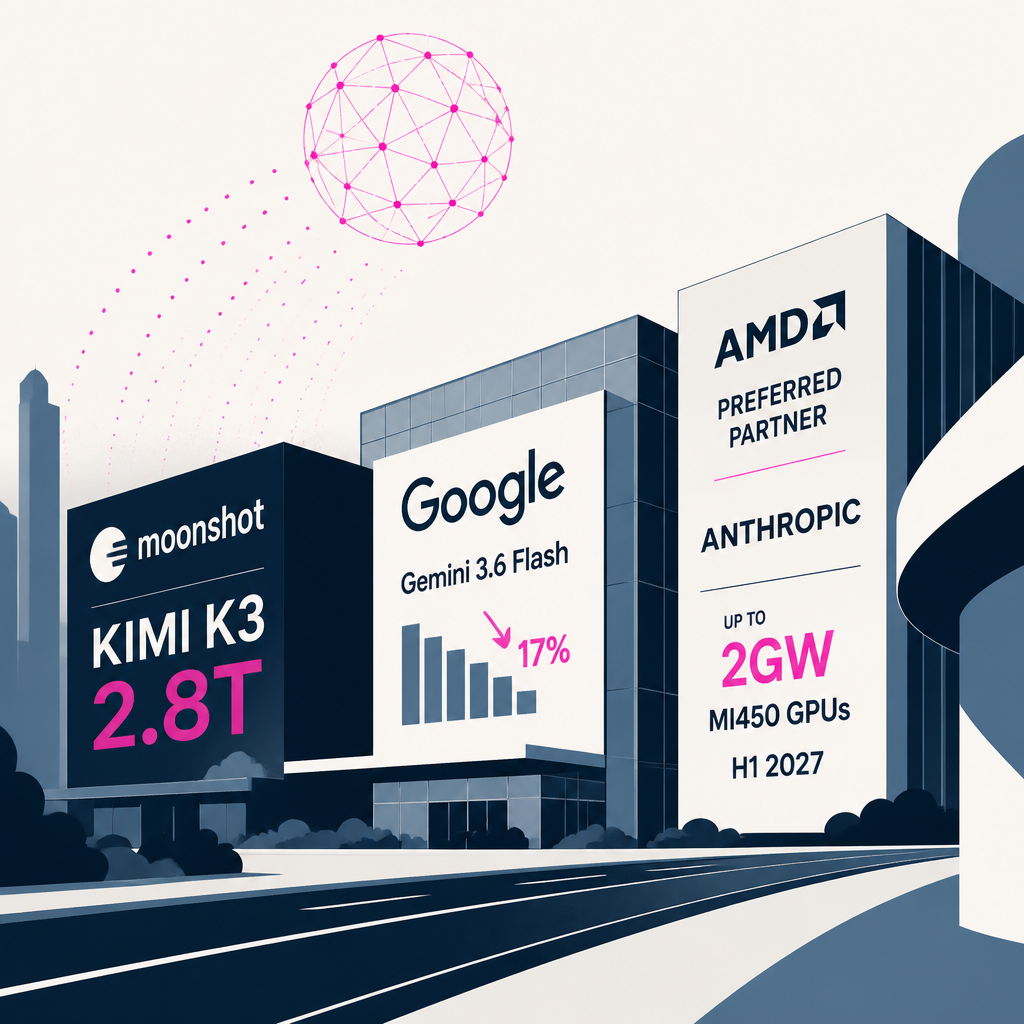
Moonshot AI released Kimi K3, a 2.8-trillion-parameter open model, the same week AMD locked in 2 gigawatts of GPUs for Anthropic through 2027. Meanwhile, quieter work on agent reliability and hallucination definitions might matter more long-term.
Based on reporting by Deep Learning Weekly, Miko Planas — read the original for the full story.
Summary, retelling and take written by AI under human oversight; images are AI-generated illustrations. How we work · Report an error
Two very different stories ran side by side in deep learning this week, and the contrast says a lot about where the industry actually is. On one track, the scale race keeps accelerating: Moonshot AI shipped Kimi K3, described as the first open model in the 3-trillion-parameter class, weighing in at 2.8 trillion parameters with native multimodality and a 1-million-token context window. Google pushed out three new Gemini Flash variants, with 3.6 Flash cutting output token usage by 17% versus 3.5 Flash while getting better at coding tasks. And AMD and Anthropic announced a partnership to deploy up to 2 gigawatts of MI450 GPUs starting in early 2027, wrapped around a $5 billion equity stake AMD is taking in Anthropic itself.
That's a lot of silicon and a lot of parameters. But the more interesting track this week was about whether any of it actually works reliably once it leaves the lab. OpenAI launched Presence, an enterprise product that pairs model reasoning with escalation policies, and reports it's already resolving 75% of inbound issues on OpenAI's own support line without a human touching them. Comet, the company behind the open-source observability tool Opik, published details on a new diagnostics agent that queries trace and span data directly in ClickHouse instead of making engineers scroll through traces one at a time, specifically to catch things like retry loops and agents that over-deliberate themselves into uselessness.
The research side backed this up with something genuinely useful: a paper arguing hallucination has never had a single clean definition, and proposing one — inaccurate internal world modeling that becomes visible to the user, whether that's contradicting a knowledge base or contradicting a source document in a summary. It's a framework, not a fix, but it gives people building evals a shared vocabulary instead of arguing past each other. Speaking of evals, Expedia's chief AI and data officer told VB Transform that evaluation suites have effectively replaced the product requirements document at his company — intent gets encoded into evals before a line of code gets written.
A smaller but telling item: Epoch AI tested three popular AI-text detectors and found they're pretty good at catching plain machine-generated writing, with near-zero false negatives on basic prompts. But once AI text imitates a specific author's style, detection falls apart — scientific writing dressed up this way slipped through undetected roughly 26% of the time. And Google Research's SymptomAI study added another data point to the pile of unsettling healthcare results: in a national-scale trial, their Gemini Flash 2.0-based symptom checker's differential diagnoses were preferred over clinicians' own assessments 53.3% of the time.
None of this cancels out the other. Bigger open models and cheaper Flash variants matter because they set the floor for what smaller teams can build on. But the diagnostics tooling, the hallucination taxonomy, and the evals-as-spec shift are the parts that determine whether any of these agents survive contact with a real support queue or a real patient.
My take — AI-written commentary, not fact-checked reporting
I'll take the open 2.8T model over the AMD-Anthropic equity-swap headline any day — a $5 billion stake dressed up as a GPU deal is just circular financing with extra steps, and calling it a partnership doesn't make it less of a hedge. What actually excites me is the boring stuff: Opik querying spans in bulk instead of trace-by-trace, and a paper finally trying to pin hallucination down to one testable definition. The scale race gets the headlines, but reliability tooling is where the real product gets built, and it's telling that almost nobody outside this newsletter will read about it.
Read more about this at: Deep Learning Weekly