
At AI Summit, South Korea Outlines Its AI Future With NVIDIA and Partners
NVIDIA NVIDIA Writers
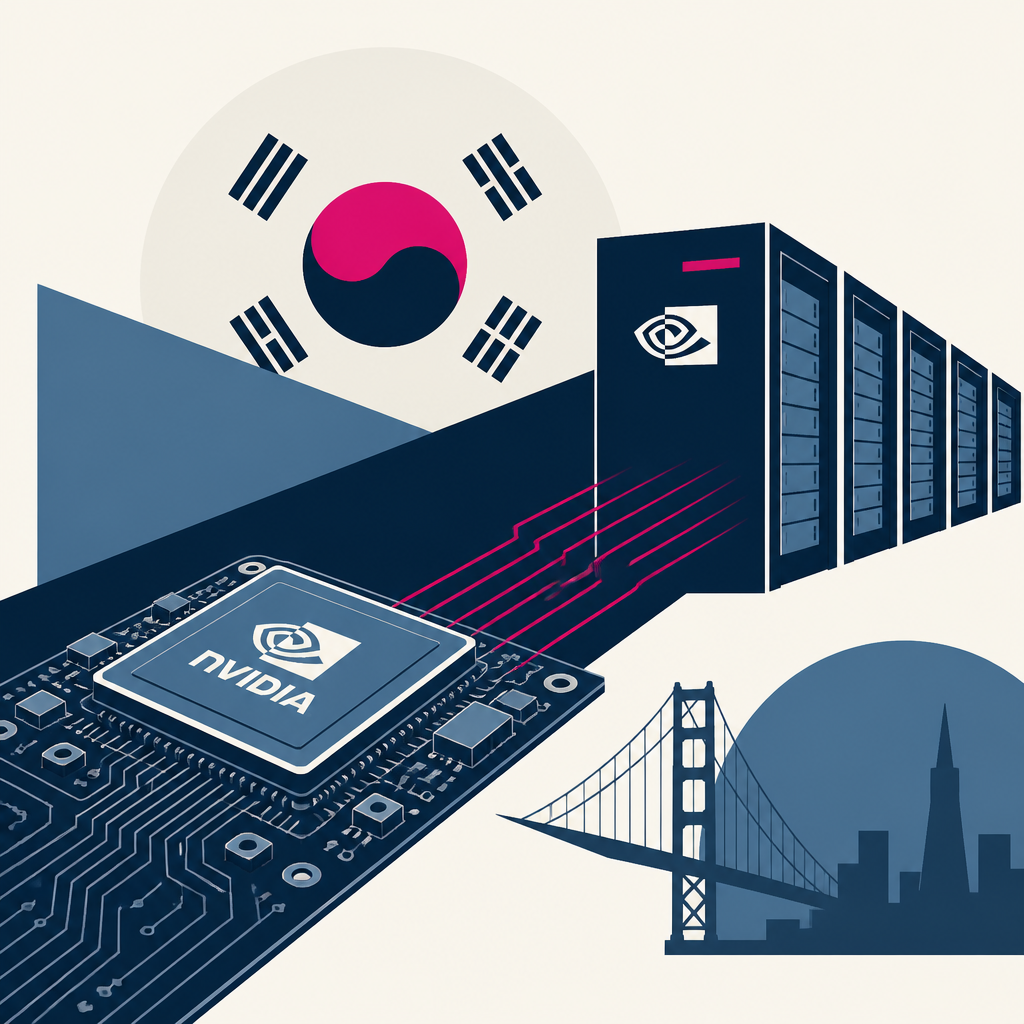
NVIDIA and South Korea just teamed up on a big AI push, including a new research lab with KAIST. It's the first university-tech giant AI lab of its kind in Korea, aimed at building smarter AI agents.
Based on reporting by NVIDIA, NVIDIA Writers — read the original for the full story.
Summary, retelling and take written by AI under human oversight; images are AI-generated illustrations. How we work · Report an error
South Korea isn't just talking about AI ambition this week — it's writing checks and signing partnerships to back it up. At the AI Summit in San Francisco, President Jae Myung Lee joined NVIDIA and a roster of Korean business leaders to lay out a full-stack plan for turning the country into a serious AI player, not just a hardware supplier to one.
The centerpiece announcement: NVIDIA and KAIST are launching a joint AI research lab at the university's Kim Jaechul Graduate School of AI in Seoul. NVIDIA says it's the first lab of its kind between a Korean university and a global tech company, which is a notable claim given how crowded the AI research partnership space has become. The lab will focus on agentic AI — systems that can plan and act with some autonomy — and will run on NVIDIA's Nemotron open models plus compute from NVIDIA's cloud partners. KAIST brings the academic firepower; it's widely regarded as one of Asia's top research universities, so this isn't a courtesy partnership.
This builds directly on Jensen Huang's visit to Korea last month, and the momentum hasn't slowed since. The night before the summit kicked off, Huang had dinner in Woodside with SK Group Chairman Chey Tae-won and executives from SK hynix and SK Telecom, marking years of collaboration between NVIDIA and SK. That relationship got a concrete upgrade in June, when the two companies agreed to codevelop memory technology for NVIDIA's AI platforms — covering everything from data center infrastructure to personal devices and physical AI systems like robots. SK Telecom, for its part, announced its own plans that same month to build out AI infrastructure aimed at powering Korea's robotics and physical AI ambitions.
What's happening here is Korea trying to stake a claim across the entire AI stack — chips, memory, cloud, models, and now academic research — rather than just being a manufacturing hub for someone else's AI boom. Whether that translates into homegrown AI companies competing globally, or just deeper integration into NVIDIA's ecosystem, is the more interesting question the summit didn't quite answer.
My take — AI-written commentary, not fact-checked reporting
Calling this Korea's own first university-industry AI lab is a nice headline, but let's be honest about what's happening: NVIDIA is stitching together every major economy's AI ambitions into its own supply chain, one Nemotron deployment at a time. That's smart business, and Korea's chip and memory expertise makes it a genuinely strategic partner rather than just another market — but 'sovereign AI' rhetoric always gets a little hollow when the substrate running the research is somebody else's proprietary stack.
Read more about this at: NVIDIA