Zed, Anthropic, and OpenRouter updated their agent software harnesses while reporting continued declines in inference cost and persistent gaps in coding-agent performance. Vercel’s AI Gateway reported the average price per token fell 23.2% in August for a third straight month. As cheaper inference spreads, companies are shifting investment toward context handling, routing, verification, and caching so models can be used reliably.
Linkup Research released SPARSEUP, an Apache 2.0 open-source learned sparse embedding model built on a 149M-parameter ModernBERT backbone.
Linkup reports 56.4 average nDCG@10 on BEIR-13.
The release adds a vocabulary-based sparse encoder with deployable weights on Hugging Face and achieves over 97% recall on MS MARCO in about 380 microseconds per query using Seismic search.
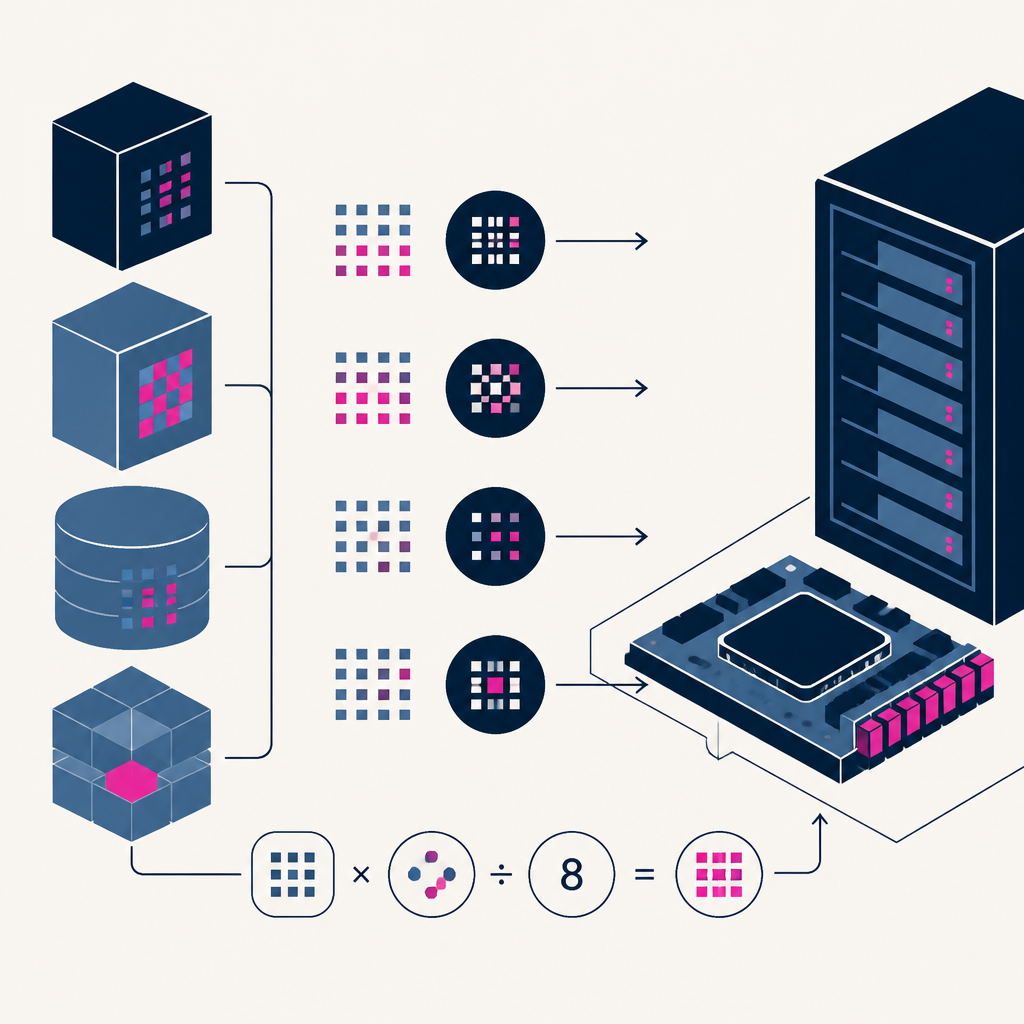
The article explains how GGUF, GPTQ, AWQ, EXL2, and related LLM model formats differ by separating “containers” (how tensors are stored) from quantization methods (how weights are squeezed into fewer bits). It gives a memory rule of thumb for weights: weight memory ≈ parameters × bits-per-weight ÷ 8, noting that 70B at ~4.5 bits per weight is about 39 GB for weights only. It changes readers’ comparisons by making them treat most formats as a pairing of a storage format plus a quantization scheme rather than a single competing format, and it adds security and runtime implications like safetensors being non-executable compared with Python pickle.
Every AI story that matters,
in your inbox by 8am.
TLDRocket reads all relevant sources, removes duplicate coverage, and summarises the
day in two minutes. Follow companies and topics for alerts, or get the
briefing in Slack. Free, no spam, unsubscribe anytime.
Reading TLDRocket needs no cookies, and the readership counts we rely on come from
our own cookieless analytics. Google Analytics is the exception: it sets cookies and
reports to Google, so it stays switched off until you allow it. You can change your
mind any time from “Cookie settings” in the footer.
Strictly necessary
Session security and form protection (tldrocket-session,
XSRF-TOKEN, 2 hours). The site cannot work without them,
so they need no consent.
Always on
Google Analytics 4 (_ga,
_ga_<id>, up to 2 years). Measures which
stories and sections readers use. Google acts as a third-party processor and may
store the data outside the EU. No advertising, no profiling, no data sold.